The ‘Fire Amoeba’ That Still Divides at 63°C: How One Eukaryotic Cell Redrew the Known Thermal Limit of Complex Life
Original Chinese title: 63°C 還能分裂的「火焰阿米巴」:一個真核細胞如何改寫複雜生命的耐熱上限?
Incendiamoeba cascadensis divided at 63°C, remained motile at 64°C, and formed dormant cysts at higher temperature in culture. The record applies to a particular unicellular eukaryote; it does not prove equivalent tolerance in multicellular life or life beyond Earth.
山海資料庫;共同作者:王振庭|原傳媒AI 科技與社會觀察作者|關注自然科學教育、科技公共性、氣候調適與地方公共服務
Co-authors: ["王振庭, 科技公共性, 氣候調適與地方公共服務"]
山海資料庫 focuses on landscapes, spatial data, natural observation, and public governance. Co-author 王振庭 writes on science education, public-interest technology, climate adaptation, and local public services for Yuan Media AI.
# The ‘Fire Amoeba’ That Still Divides at 63°C: How One Eukaryotic Cell Redrew the Known Thermal Limit of Complex Life
Author: 山海資料庫
This feature separates source-supported findings, editorial interpretation, and possible local implications. Its evidence boundary is explicit: Division at 63°C and motility at 64°C were observed in a particular unicellular eukaryote; they do not establish the same tolerance in multicellular life and are not evidence of extraterrestrial life.
Three temperatures make three different biological statements
Incendiamoeba cascadensis is an amoeba isolated and cultured from a geothermal environment in the western United States. Heating experiments showed cell division at 63°C, a new known record for eukaryotic proliferation; movement remained observable at 64°C; and at 70°C the cells formed cysts, dormant structures capable of reactivation after conditions improve. Division, motility, and encystment are not interchangeable. Division completes a reproductive cycle, motility shows that some cellular functions remain active, and a cyst indicates endurance rather than active growth.
A headline saying that the organism “lives normally at 70°C” would merge distinct evidence. The strongest reported boundaries are division at 63°C and motility at 64°C. The duration and conditions under which cysts remain recoverable depend on experimental design. The record applies to a particular unicellular eukaryote. It does not show that animals, plants, or humans tolerate the same temperature, and it does not make all amoebae equally thermotolerant.
Why 63°C matters for a eukaryotic cell
Eukaryotic cells contain nuclei, membrane-bound organelles, cytoskeletons, and elaborate protein systems. Heat changes membrane fluidity, disrupts protein folding, damages nucleic-acid stability, and interferes with division machinery. Around 60°C had therefore been treated as an important boundary for eukaryotic growth. The new culture and imaging evidence shows that at least one eukaryotic lineage can extend active proliferation beyond it. This expands the observed range; it does not repeal thermodynamic constraints.
The repository abstract reports growth experiments, visualisation of mitosis using expansion microscopy, and high-temperature live-cell imaging of movement. Comparative genomics found enrichment in genes associated with proteostasis, genome stability, and environmental sensing. Enrichment is a mechanistic clue, not proof that one gene acts as a heat-tolerance switch. Functional experiments, membrane and protein measurements, and time-resolved comparisons across temperatures are needed to move from association to mechanism.
A culture record and a geothermal habitat are not the same temperature table
A laboratory controls medium, food, pH, heating rate, and exposure. A geothermal stream contains gradients, daily variation, flow, chemistry, symbiosis, and competition. Water temperature at a sampling point may not equal the microenvironment actually occupied by a cell, and differences can occur across millimetres. Connecting field and culture evidence requires sampling coordinates and time, instrument calibration, continuous temperature and chemistry records, and replicate isolates.
Finding active cells only in cooler field patches would not automatically invalidate division at 63°C in culture; food, oxygen, current, or competition may constrain distribution. Conversely, short-term division in culture does not establish long-term population growth in the hottest field zone. In-situ imaging, environmental DNA, single-cell sequencing, stable-isotope work, or labelling can cross-check observations, with contamination and temperature-drift controls. Different methods answer different levels of the question.
Geothermal sampling is simultaneously conservation, safety, and scientific quality
Geothermal sites often lie on protected public land, where thin crust, boiling water, steam, and toxic gases endanger field teams. Permits, minimal disturbance, approved access routes, protective equipment, and a buddy system are basic requirements. Sterilised tools and limits on sample volume reduce cross-pool contamination and habitat damage. Sensitive location data may need controlled precision; reproducibility does not require publishing coordinates that invite unmanaged access.
Conservation managers and researchers should agree on sample number, frequency, season, storage, data return, and disposal of remaining material. If work could lead to commercial enzymes or biomaterials, benefit, patent, and access terms belong before collection. Public-land science is not free extraction. Sampling authority carries duties to minimise disturbance, report findings, support long-term monitoring, and explain uncertainty to the public.
Astrobiology gains a search boundary, not a photograph of alien life
The National Park Service describes geothermal environments as useful analogues for extreme-environment and astrobiology research. Extremophiles help scientists understand how temperature, pH, pressure, and chemical energy constrain life and inform instruments, sampling, and planetary-protection practice. Incendiamoeba extends the observed high-temperature range for active eukaryotic proliferation and warns mission designers not to treat an old biological record as an absolute wall in nature.
An analogue is not evidence of life elsewhere. Liquid water, energy, elements, and long-term habitat stability on Mars or icy moons require their own observations, and a terrestrial organism does not prove independent origins beyond Earth. The study can revise assumptions about which conditions deserve investigation and how biosignatures might persist. It cannot establish an extraterrestrial eukaryote or translate amoeba heat tolerance into human habitability.
Generated media can easily turn a scientific record into a monster
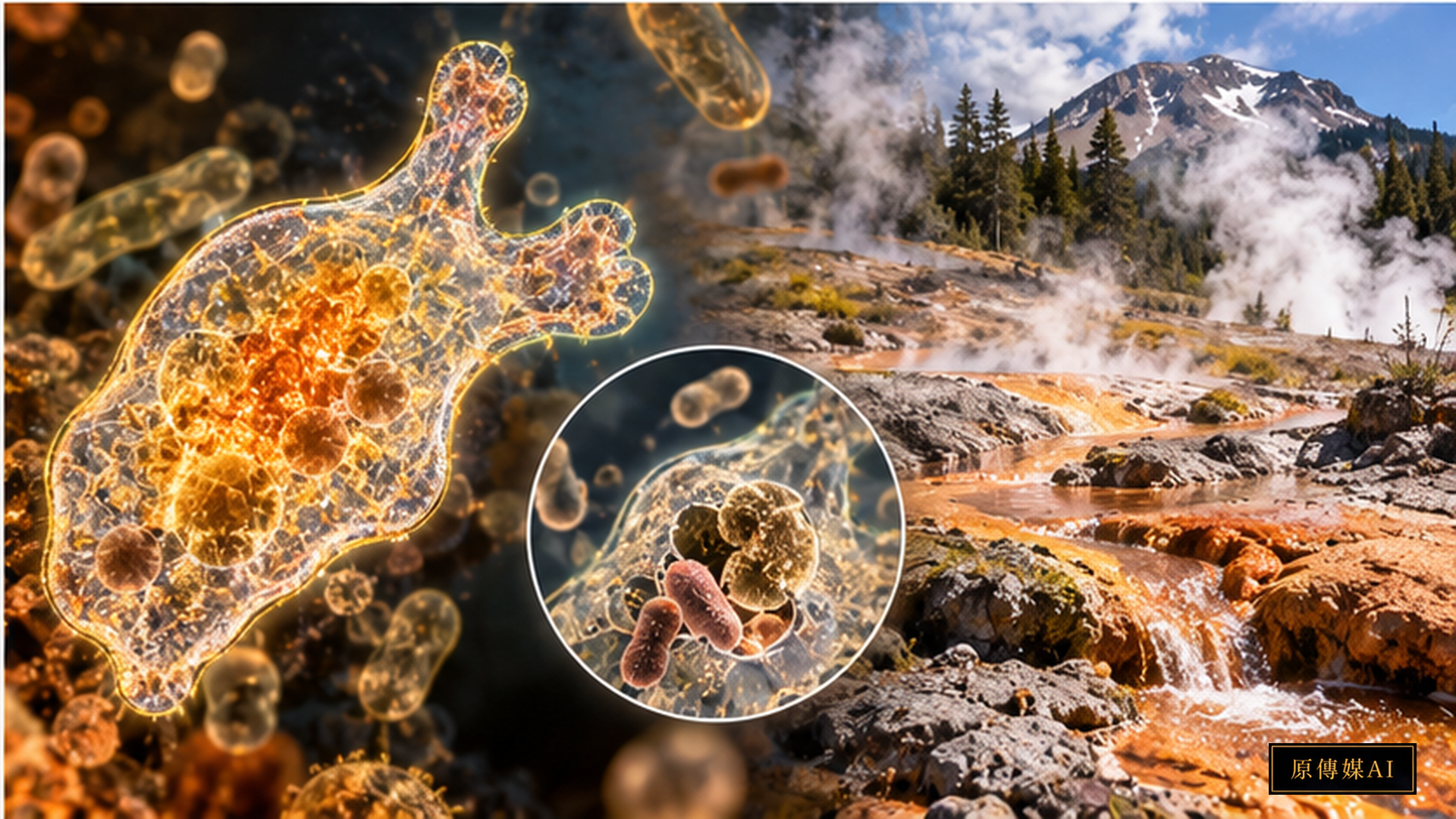
“Fire amoeba” is a narrative translation of a name and a heat-tolerance trait. It does not mean that the cell burns, glows, carries a fiery shell, or lives in lava. Generative image systems may invent an orange giant with eyes and teeth or combine microscopy and a volcano as if they were one photograph. Scientific communication should label concept art, avoid fictitious scale, colour, and organelles, and state the imaging method and scale when a micrograph is used.
Text models may convert movement at 64°C into reproduction at 64°C, encystment at 70°C into normal growth, or gene enrichment into a proven thermal switch. A practical safeguard is a claim table pairing every temperature with observation type, condition, and source, with inference separated from result. Where versions differ, the repository record should be identified as an author version or preprint and checked against the later definitive publication.
Taiwan's geothermal education can begin with different meanings at the same temperature
Taiwan has volcanic and hot-spring landscapes alongside geothermal development, conservation, tourism, and local life. This study can teach the distinction among survival, motility, proliferation, and dormancy and support close reading of graphs, methods, and limitations. It should not encourage untrained collection in hazardous hydrothermal sites. Classroom work can use public data to design gradients and controls and discuss sensor error, representativeness, permits, and environmental-DNA interpretation.
Thermotolerant microbes may inspire enzymes and materials, but policy needs rules for biological resources, environmental impact, conflict disclosure, and public benefit. The value of a record-breaking organism is not another development slogan. It shows how the limits of life are revised through reproducible evidence, with organism, method, and uncertainty carried forward each time.
A new record must travel with version history and reproducibility
The Portland State University repository identifies an author version and preprint information and notes that peer review and publication may introduce changes. Anyone citing temperatures, methods, or genomic results should check the version used. Databases and teaching material should retain DOI, date, revision, and correction rather than copying only a striking number. Independent replication with calibrated instruments, replicate isolates, and the same criterion for division would strengthen the record.
Reproducibility does not require every detail to remain identical. Differences in medium, prey organisms, or heating profile can reveal the range of conditions supporting tolerance and should be treated as mechanistic data. Open raw images, temperature logs, analysis code, and sampling conditions would help later teams distinguish physiology from measurement and prevent generative systems from combining an early version and a definitive result into a claim that no source made.
Sources and further reading
Role-Driven Inquiry
Yuan Media AI | Guided Questions by Role
Select a role first, then review the complete questions from that perspective; clicking a question will display Yuan Media AI’s response in real time.
Select a role
Protist or cell-biology researcher
Examine the article's evidence, governance boundaries, data rights, and actionable steps from the perspective of a Protist or cell-biology researcher.
Choose a question
AI use and content-safety disclosure
AI assisted source organisation, formatting, translation, and role-based questions. Source-supported findings, interpretation, and local implications are separated.