Adding Iron to the Ocean Is Not a Carbon-Removal Switch: Why a New International Research Coalition First Barred Itself from Selling Credits
Original Chinese title: 往海裡加鐵,不是按下吸碳開關:新的國際研究聯盟為何先禁止自己賣碳權?
Adding trace iron to iron-limited waters may stimulate phytoplankton, but a bloom is not proof of durable atmospheric carbon removal. A new ExOIS coalition bars itself from selling credits to separate research from commercial incentives and governance claims.
Lawrence Lee|英國里茲大學學者
University of Leeds scholar, technology journalist, science-fiction critic, and space-science educator focused on energy, materials, civilisational infrastructure, and technology narratives.
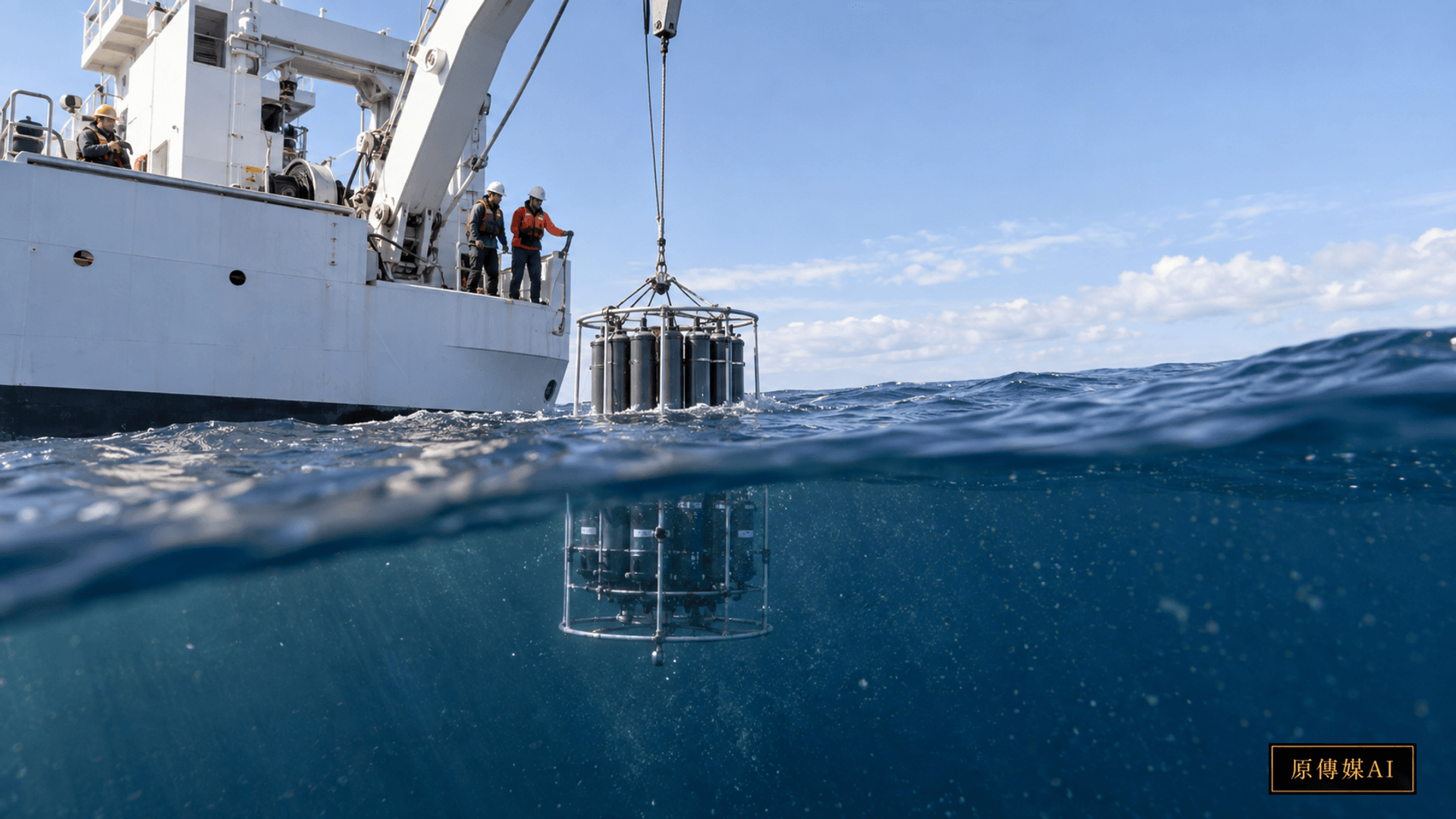
# Adding Iron to the Ocean Is Not a Carbon-Removal Switch: Why a New International Research Coalition First Barred Itself from Selling Credits
Author: Lawrence Lee
This feature separates source-supported findings, editorial interpretation, and possible local implications. Its evidence boundary is explicit: The coalition's formation does not establish that iron fertilisation is safe or effective, and phytoplankton growth cannot be converted directly into an equal amount of permanently removed atmospheric carbon. The article therefore treats a research coalition, a field experiment, carbon-removal certification, and large-scale deployment as separate stages, each requiring distinct evidence, permission, participation, and stopping conditions; success cannot be promised in advance. Failed and null results still matter.
Iron can trigger a bloom; it cannot sign a permanence contract for carbon
In some high-nutrient, low-chlorophyll waters, iron is the micronutrient limiting phytoplankton growth. Adding a small quantity can stimulate a bloom that draws dissolved inorganic carbon into photosynthesis. That mechanism explains why ocean iron fertilisation is discussed as a form of marine carbon dioxide removal. Yet a bloom is only the first step into a surface food web. Carbon may rapidly return through respiration, be consumed by grazers, or decompose in the upper ocean. Only a fraction that sinks deeply enough and remains isolated long enough could count toward durable removal.
Chlorophyll, ocean colour, or short-term air-sea carbon flux therefore cannot be converted directly into an equal quantity of permanent credits. The evidence chain must establish additionality, export depth, residence time, lateral transport, nutrient redistribution, and downstream ecological effects against a credible counterfactual. Moving water makes treatment boundaries unstable, and observations lasting weeks cannot alone answer questions about decades or centuries. Models extend scales, but their parameters still require field evidence and uncertainty.
The coalition begins with a commercial firewall
The ExOIS Field Research Coalition announced by Woods Hole Oceanographic Institution brings researchers and institutions together around principles for responsible field research. The announcement states explicitly that the coalition is not an endorsement of large-scale deployment or commercialisation and that ExOIS does not sell carbon credits or offsets. That separation matters because anticipated credit revenue could influence experimental design, metric selection, the publication of negative findings, and the way uncertainty is communicated.
A ban on selling credits is a beginning, not a complete guarantee. Funding, advisory roles, intellectual property, data embargoes, method selection, and publication can still create conflicts. Credible safeguards include disclosure of finance and governance, preregistered hypotheses and stopping rules, independent statistical and ecological review, publication of positive and negative results, and accessible underlying data. If companies later cite coalition research, their carbon accounting claims must remain visibly separate from what the study itself established.
Ecological consequences cannot be collapsed into one carbon number
Iron fertilisation may alter phytoplankton communities, food webs, and nutrient ratios. Some taxa may benefit while others are displaced; decomposition of sinking material consumes oxygen and may affect gases such as nitrous oxide or methane. Outcomes also depend on season, light, silicate, nitrogen and phosphorus, mixed-layer depth, and grazing. Carbon export observed in one experiment cannot be assigned the same efficiency in another region or scaled by several orders of magnitude without new evidence.
The National Academies research strategy treats nutrient fertilisation as a research pathway, not a deployment-ready standard. Experiments need simultaneous carbon, ecosystem, and non-carbon greenhouse-gas measurement, observation beyond the treatment patch, and stopping thresholds for outcomes such as deoxygenation or biodiversity harm. “Effective” cannot mean only that some carbon uptake occurred; ecological cost, measurability, reversibility, and alternatives matter.
The high seas are not an empty governance space
The Sabin Center assessment explains that ocean iron fertilisation research engages the London Convention and London Protocol and the assessment framework developed under them. Even beyond national jurisdiction, flag states, ports, research institutions, funders, and international rules can form a chain of responsibility. Researchers cannot treat the high seas as permission-free or assume that a scientific purpose removes the need to assess environmental risk, alternatives, monitoring, and the character of material introduced.
Scale, purpose, and design affect whether an activity qualifies as legitimate scientific research. Governance concern increases where an experiment also validates credits, expands rapidly, or lacks independent peer review. Transparency should cover material, quantity, coordinates, timing, models, monitoring, data release, and incident response. Because water masses and ecological effects cross borders, potentially affected states and communities require early notice.
Coastal and Indigenous rights cannot appear only after the ship sails
Ocean research often schedules participation after a plan has already been written, but iron fertilisation may affect fisheries, migratory species, cultural relationships, and marine governance. Coastal communities and Indigenous rights holders should participate in problem definition, site selection, baselines, risk scenarios, data governance, and stopping rules—not merely receive notice of an approved cruise. Participation also concerns who can contribute knowledge, who receives resources, who may refuse, and how effects across jurisdictions are handled.
Local observations can contribute seasonality, species behaviour, fishing-ground change, and historical baselines, but they must not be extracted as free data. Agreements should address authority over knowledge, confidentiality of sensitive places, joint interpretation, attribution, feedback, and resources for long-term monitoring. If findings later underpin policy or commercial claims, affected communities should help define which uncertainties remain unacceptable. Social licence is a relationship that can be revisited as evidence changes.
Taiwan should ask about observation and rights before asking how many tonnes can be sold
Waters around Taiwan are shaped by monsoons, the Kuroshio, shelves, and coastal upwelling; iron limitation cannot be imported as an assumption from another ocean. Any participation in this research should begin with long-term baselines for carbon flux, nutrients, plankton, oxygen, and fisheries, open models, and shared observation capacity. Fishers, coastal settlements, and Indigenous marine relationships belong in governance. Without baselines, intervention effects cannot be separated from natural variability; without rights procedures, scientific feasibility is not public legitimacy.
Media and policy should avoid the switch-like phrase “add iron, absorb carbon.” A more accurate account is that iron may alter primary production under particular iron-limited conditions, while net removal, durability, ecosystem externalities, and governance remain deeply uncertain. The coalition's separation from credit sales is a conflict-of-interest safeguard, not proof of safety or effectiveness. Responsible research has to permit the conclusion that benefits are too small, risks too high, or monitoring too costly for climate policy.
Measurement, reporting, and verification must permit an unattractive answer
For carbon-removal research to inform public decisions, measurement, reporting, and verification boundaries must be defined in advance. Before a cruise, researchers should disclose primary endpoints, controls, sampling depths and times, model versions, data-exclusion rules, and uncertainty propagation. Calibration, missing observations, and protocol deviations also belong in the record. An external reviewer should be able to recalculate the carbon budget and see whether natural variability could produce a similar signal. Selecting only the strongest bloom period or treating a model centre estimate as measurement will bias the result upward.
The crucial institutional capacity is to accept that there may be no verifiable net removal, that effect may be smaller than monitoring cost, or that ecological risk is unacceptable. Funding and careers should not reward only positive effects, and repositories should include failed, null, and stopped cruises. Any later crediting methodology requires a separate process for conservative discounting, long-term liability, reversal, and independent regulation. Shared research principles cannot substitute for commercial validation.
Sources and further reading
Role-Driven Inquiry
Yuan Media AI | Guided Questions by Role
Select a role first, then review the complete questions from that perspective; clicking a question will display Yuan Media AI’s response in real time.
Select a role
Marine biogeochemistry researcher
Examine the article's evidence, governance boundaries, data rights, and actionable steps from the perspective of a Marine biogeochemistry researcher.
Choose a question
AI use and content-safety disclosure
AI assisted source organisation, formatting, translation, and role-based questions. Source-supported findings, interpretation, and local implications are separated.