After 1,228 Drone Flights, Who Decides What It Should Carry? How Stellat’en First Nation Turned Medical Logistics into Co-Governance
Original Chinese title: 無人機飛完 1,228 趟之後,誰決定它該送什麼?Stellat’en First Nation 如何把醫療物流變成共同治理?
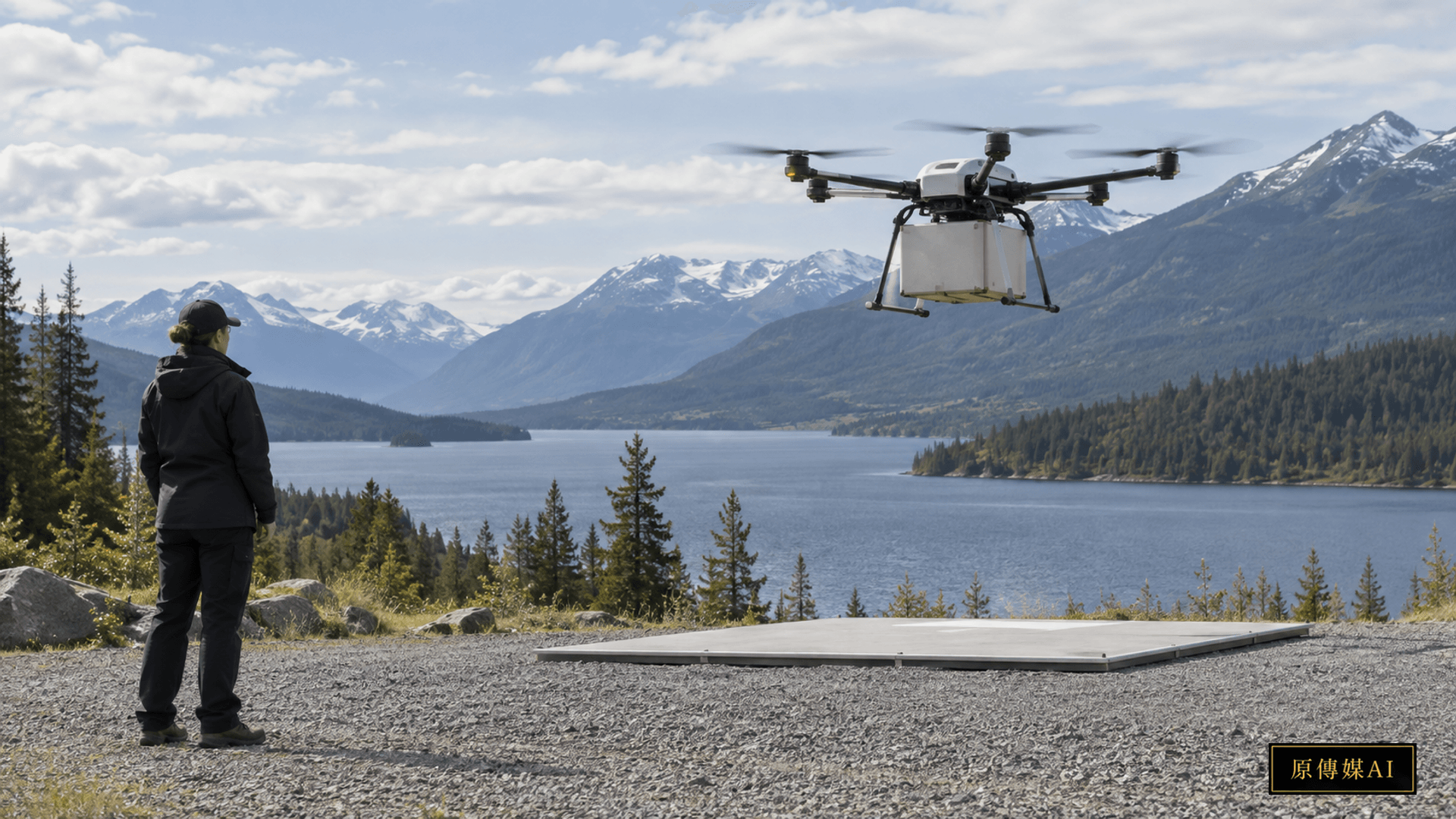
A co-designed route involving Stellat’en First Nation, Fraser Lake, and UBC completed 1,228 flights. The number demonstrates operation on a defined route; public value depends on how communities govern needs, authority, backup systems, and continuity.
鄭淑禎|實踐大學專任助理教授、關注產業轉型、農業價值鏈、地方經濟與科技應用的專題作者
Assistant professor at Shih Chien University and feature writer focused on industrial transition, agricultural value chains, local economies, public-service design, and frontline technology use.
# After 1,228 Drone Flights, Who Decides What It Should Carry? How Stellat’en First Nation Turned Medical Logistics into Co-Governance
Author: 鄭淑禎
This feature separates source-supported findings, editorial interpretation, and possible local implications. Its evidence boundary is explicit: The 1,228 successful flights demonstrate feasibility on a defined demonstration route; they do not resolve every weather, terrain, cold-chain, emergency-response, or beyond-visual-line-of-sight question. Evaluation must also remain open to correction by residents.
1,228 flights are an operating record, not a universal clearance
The Drone Transport Initiative was co-created by Stellat’en First Nation, the Village of Fraser Lake, and the University of British Columbia's Faculty of Medicine in response to medical supply-chain disruption during the pandemic. Phase I established a defined demonstration route and completed 1,228 successful flights, first carrying surrogate medical supplies and later, after relevant approvals, some real medications. The total documents repeated operation under a particular combination of staff, aircraft, route, and regulation. It does not establish that every coastal route, mountain valley, winter wind field, payload, cold chain, or emergency mission is safe and effective.
“Successful” must also be disaggregated. Safe take-off, planned arrival, intact cargo, uninterrupted communications, acceptable weather, and receipt by the intended patient are different outcomes. A single total can make a proof of concept look like a mature public service. Useful reporting includes cancellations and delays, visibility and wind thresholds, equipment faults, human intervention, package temperature, backup-transport time, cost per operation, and whether patients avoided unnecessary travel.
Co-design is an allocation of decision-making authority
The community's official account describes the initiative as co-created. The interview study involved people from steering and operational roles and identified themes of trust, mutual benefit, meaningful community engagement, and future possibility. A drone project should therefore not be completed and then presented to a community for acceptance. Community authorities need a role in defining the problem, choosing cargo, locating launch and landing areas, identifying places that should not be overflown, governing data, and deciding when operations pause.
Co-governance must accommodate disagreement. Some people may prioritise timely medications or specimens; others may be concerned about noise, wildlife, privacy, and land use. Employment and youth training can be valuable, while the economics of a short road-connected route may still be questioned. Those differences are public choices, not communication defects. A credible structure records the scope of consent, dissenting views, review dates, and withdrawal conditions, and does not confine community representatives to ceremonial launches or promotional material.
From a surrogate package to real medication lies a chain of responsibility
Medical logistics is not accomplished merely by making an aircraft fly. Identity, product quality, time, and custody must remain intact. Prescription verification, authorised packing, temperature and vibration monitoring, response to anomalies, receipt, and failed delivery all require auditable procedures. Blood, specimens, vaccines, controlled drugs, and routine supplies have different risk profiles. A route that carried a surrogate package cannot therefore be assumed ready for every clinical product.
The patient side is not just a last mile. Virtual consultation, pharmacy validation, informed consent, delivery privacy, retrieval of incorrect medication, and adverse-event reporting determine whether a service works. If a drone arrives while the patient lacks connectivity, safe storage, or a way to reach the landing site, transport efficiency has not automatically produced health equity. Evaluation has to follow the end-to-end pathway and count the people who remain unserved.
Weather, beyond-visual-line-of-sight operation, and emergency care require different evidence
Experience on a fixed demonstration route can inform later risk assessment, but every new route needs its own terrain, wind, communications, population exposure, and forced-landing analysis. Beyond-visual-line-of-sight operation involves surveillance, lost-link procedures, coordination with other aircraft, and regulatory approval. Icing, mountain turbulence, smoke, and heavy snow can change payload and battery performance. Operating limits should be explicit, and the person with authority to stop a flight when forecasts and local observation diverge must be known.
Emergency response must not be collapsed into routine resupply. One hour has different consequences for a routine prescription and for blood or emergency equipment, but urgency cannot erase safety thresholds. Each service needs road, boat, crewed aviation, or local-stock backup and drills for return-to-home, forced landing, damaged cargo, cold-chain breach, and failed handover. Only a comparison of whole systems can show whether a drone adds resilience or creates a new single point of failure.
AI may schedule; it cannot replace clinical and community decisions
AI could combine weather, energy, routes, inventory, and appointments to suggest a dispatch order. Yet training data may favour places with more flights, reliable connectivity, or easily measured demand. A cost-minimising objective could once again delay a small, remote community. Community authorities and public-health services should jointly set equity constraints, disclose principal rules and exceptions, and preserve manual dispatch, clinical priority, and emergency-stop powers.
Permissions must also be separated. A flight contractor does not need a patient's diagnosis; flight tracks should not become a secondary system for observing households; and data about lands or sensitive places should not become public because navigation is easier. Access, model versions, overrides, and anomalous decisions need audit records, together with incident notification, deletion, contract termination, and vendor-transition plans. Co-governance extends through the data life cycle.
The transferable lesson for rural Taiwan is the order of governance
Taiwan's islands, mountains, and Indigenous communities have distinct logistics, so a five-kilometre Canadian demonstration cannot supply a local benefit calculation. The useful first step is for local health services, community organisations, pharmacists, patients, aviation personnel, and emergency agencies to identify actual delayed items and existing backups before deciding whether a drone fits. Landing sites, noise, wildlife, traditional territories, privacy, and liability belong before procurement, not in an explanation added after equipment is purchased.
A pilot should measure safety, cancellation, end-to-end time, product quality, patient access, community satisfaction, labour and training, cost, emissions, and backup performance. Local young people and workers should have paid pathways into operations, and communities should share ownership of evaluation data and public narratives. Technology then becomes a public tool that local people can accept, modify, or stop—not a gift flying in from elsewhere.
Before a pilot becomes a service, answer who maintains, pays, and can leave
Short demonstrations often depend on one-off grants, special permissions, and a few project champions. A continuing service requires stable budgets, parts, qualified staff, insurance, cybersecurity, airspace coordination, and multiyear procurement. If research ends with an aircraft but no local maintenance capacity, the community inherits interruption risk. Expansion should disclose total cost of ownership, separating research, infrastructure, operations, and paid training, and compare drones with roads, local stock, mobile clinics, or other transport.
Exit is part of governance. Contracts should specify ownership of equipment and data, transition if a vendor closes or raises prices, suspension and return-to-service criteria after an incident, and whether a community can refuse expansion without losing an existing service. Continuation requires joint review by community, clinical, logistics, and regulatory authorities; a flight count is not automatic renewal. A change in noise, overflight area, route, or cargo class is a material change requiring renewed community decision and professional approval.
Sources and further reading
Role-Driven Inquiry
Yuan Media AI | Guided Questions by Role
Select a role first, then review the complete questions from that perspective; clicking a question will display Yuan Media AI’s response in real time.
Select a role
Stellat’en community member or Elder
Examine the article's evidence, governance boundaries, data rights, and actionable steps from the perspective of a Stellat’en community member or Elder.
Choose a question
AI use and content-safety disclosure
AI assisted source organisation, formatting, translation, and role-based questions. Source-supported findings, interpretation, and local implications are separated.