A metre underground is no sleeping carbon vault: deep microbes reveal different strategies under whole-soil warming
Original Chinese title: 地表下一公尺不是沉睡碳庫:七年全土層加熱看見深層微生物的另一套生存策略
A seven-and-a-half-year whole-soil warming study reveals depth-specific microbial strategies. Genes, proteins and earlier carbon-stock measurements require distinct interpretations and cautious geographical extrapolation.
雙向知識實驗室
Integrates life science, microbiology and technology research across disciplines, focusing on how experimental evidence becomes understandable, verifiable public knowledge.
Soil depth is more than background information
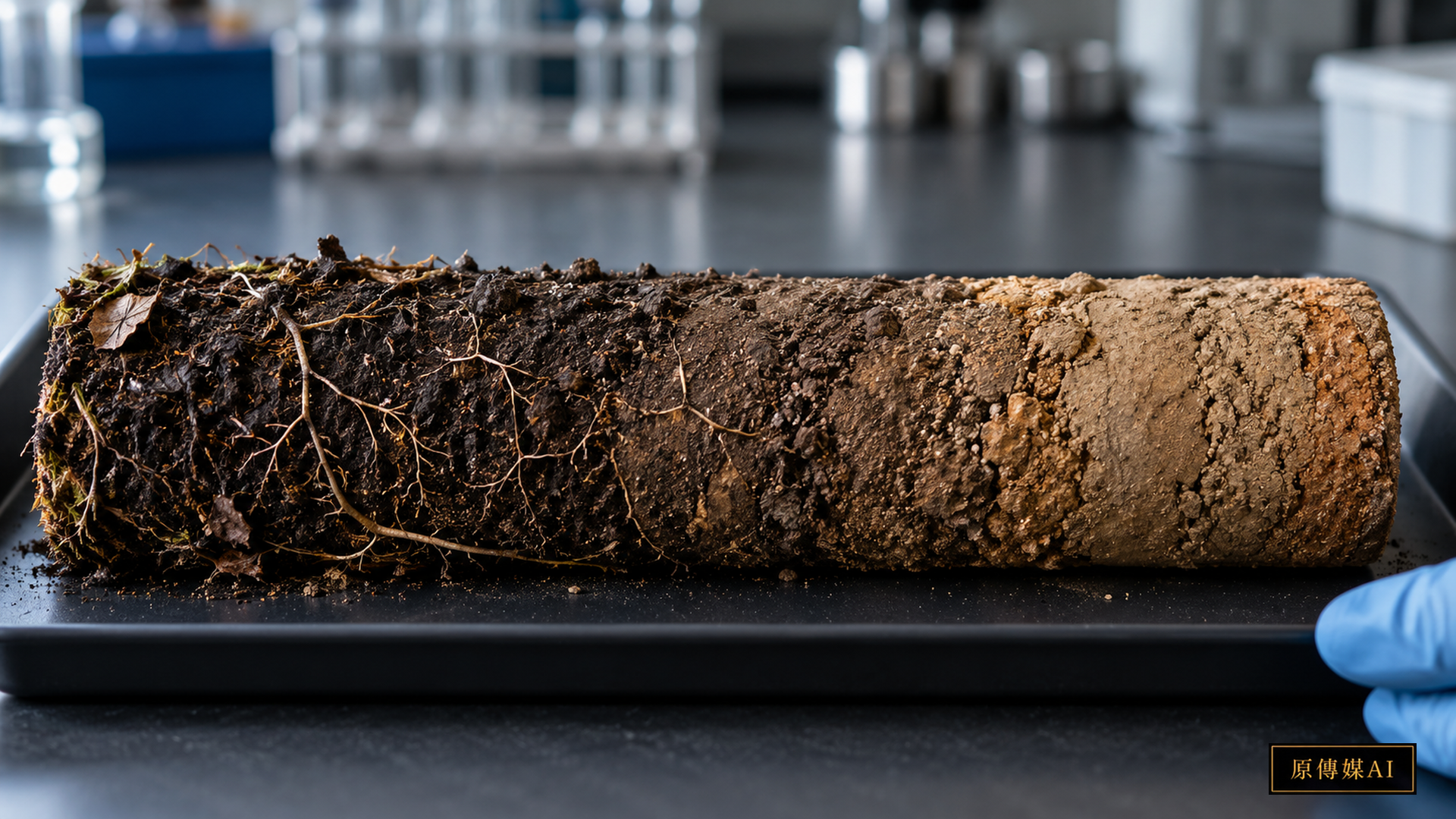
A forest’s carbon story is written not only in trunks and litter but also in deep soil. Subsoil is often imagined as a quiet, stable store, yet limited nutrients and different water and oxygen conditions can support distinct microbial strategies. A Nature Communications paper published on 13 October 2026 combines genomic and protein evidence within a long-term whole-soil warming experiment. The question moves from how many microbes are present to what capacities they carry and which functions leave detectable protein signals. That distinction matters for models of carbon storage and decomposition, without implying that this study has calculated the future of the global carbon reservoir.
What the seven-and-a-half-year experiment observed
At Blodgett Forest in the Sierra Nevada foothills of California, three pairs of control and warmed plots support a treatment of approximately four degrees Celsius above controls from the surface to one metre. Sampling covered zero to ninety centimetres over seven and a half years, yielding 115 soil samples; 95 produced high-quality metagenomic datasets. Those are sample and sequencing counts, not 95 microbial species or independent experiments. Paired plots allow treatment comparisons but still represent one forest. Repeated observations across times and depths do not become an equivalent number of independent forests.
Genes indicate capacity; proteins add functional evidence
Metagenomics reconstructs genetic information from mixed organisms and identifies possible metabolic pathways. Metaproteomics searches for expressed proteins, bringing interpretation closer to activity in the field. Neither directly films a microbe consuming carbon, and a gene’s presence is not a measurement of current flux. Protein analyses in this paper concern samples after four and a half years of warming, rather than every time point across seven and a half years. Relic DNA, extraction efficiency and database coverage also affect detection. Potential capacity, detectable associated proteins and measured carbon loss therefore need separate descriptions.
A strong depth effect does not mean warming has no effect
Depth was the main axis of community and functional stratification, with smaller warming responses that varied by depth and time. This does not mean warming is unimportant: a modest compositional shift may still affect carbon use, nitrogen cycling or stress tolerance. Nor does every change show successful adaptation. Survival, decomposition and resource acquisition describe different processes. Comparing sources of variation answers a question within particular data and models, rather than ranking global climate risks. The methodological lesson is that ignoring depth can merge different underground environments into a misleading average.
Deep soil is not a diluted version of topsoil
Functional clues in deep communities include carbon-monoxide oxidation, fermentation, nitrogen fixation and use of complex sugar-containing material. Microbes may obtain energy and elements from diverse resources. Proteins associated with glycan processing raise questions but do not establish the origin and decomposition rate of every glycoprotein. Carbon-monoxide oxidation is not evidence that the forest offsets human emissions, and nitrogen-fixation capacity is not a ready-to-use fertilizer. The observations suggest experiments on substrate origins, rate limitations and resource exchanges between organisms. They expand the pathways models may need to consider without replacing flux measurements or causal tests.
Earlier carbon-stock results need their own timescale
Official Department of Energy and Berkeley Lab reports describe earlier carbon-stock work in the same experimental system. After four and a half years, subsoil carbon declined by about 33 percent with an uncertainty of plus or minus 11 percentage points, while soil carbon-dioxide efflux rose by approximately 30 percent, plus or minus four percentage points. These are specific earlier comparisons, not global percentages newly measured by the 2026 proteogenomics analysis. Stock loss alongside gas efflux offers stronger evidence of vulnerability than increased respiration alone, but the site, depth and treatment limits remain. Results from different studies should not be assembled into an unmeasured continuous decline curve.
Respiration, soil stocks and net forest balance are not interchangeable
Soil respiration measures carbon dioxide from different sources; stocks describe stored carbon over time. The net forest balance also involves photosynthesis, plant growth, litter inputs and other exchanges. One number cannot represent all of them. Calling a forest a net carbon source solely because soil efflux increased skips other necessary measurements. Faster tree growth likewise does not establish an increase in deep-soil carbon. Policy needs accounting boundaries, observation periods, gaps and distinct carbon pools, not the most striking percentage. This distinction helps microbial research inform models without being mistaken for a completed carbon-credit calculation.
Models need depth and an account of what remains unknown
A model that treats all microbial activity as responses to one carbon substrate may miss deep-soil resource differences. The paper can help propose depth-specific functions and candidate parameters, which still require independent tests. Greater complexity is not itself better performance. Researchers should examine prediction at sites and years excluded from calibration and the adequacy of uncertainty intervals. Gene and protein signals can constrain hypotheses but cannot directly be read as annual carbon release per square metre. Separating assumptions, observations and predictions helps managers and policy reviewers assess what a finer model actually improves.
Taiwanese forests need their own depth baseline
Taiwanese forests differ in rainfall, temperature, parent material, species and management history. A carbon-loss percentage from one Californian forest cannot be copied directly. A local assessment could first document soil thickness, bulk density, stones, moisture, root distribution and disturbance before choosing depths and seasons. This is a research-planning proposal, not a claim that Taiwan has already reproduced the experiment. On Indigenous or community land, access, sample removal and publication also need appropriate participation and consent. Long-term work depends on stable field records, responsibility and continuing communication as well as sequencing equipment.
Managers can ask about costs beyond sampling
Deep-soil work involves disturbance, equipment maintenance, seasonal safety and stable funding. Managers can ask which operations are reversible, where coring is unsuitable and how repeated sampling avoids introducing new biases. If moisture changes as well, its relationship to temperature needs recording instead of attributing every difference to warming. Useful success measures can include reusable data, answers to field questions and sustained collaboration as well as publications. These management proposals are not institutional effects measured by the paper. They are conditions to discuss when translating long-term experiments into public-land research.
Carbon policy should not replace unknowns with product guarantees
A policy reviewer should identify whether a claim concerns molecular capacity, community change, depth-specific stocks or the whole forest balance. A product promising permanent storage needs evidence on that product, application and durability. This paper does not validate a commercial inoculant or certify a land project. Public assessment can request a baseline, controls, monitoring period, failure conditions and repeat-measurement methods, including management costs. Evidence of possible subsoil vulnerability supports careful measurement and improved modeling. It cannot justify removing uncertainty from a commercial guarantee.
Turn original data into repeatable questions
Access to sequences, protein data and code helps other teams inspect classification, processing and statistical choices. Running code again is not repeating the forest experiment, and downloadable data do not validate every extrapolation. A student or team can reproduce a narrow question, such as whether depth grouping changes an interpretation, and document data and limitations. Disagreement calls for checking identifiers, versions and parameters rather than immediately alleging misconduct. Repeatable analysis lets molecular evidence and field observation question each other, reducing reliance on headlines alone.
Understanding quiet subsoil requires longer observation
Underground change is difficult to capture in a striking photograph, making long records particularly valuable. Short-term sampling can identify pathways; sustained monitoring can examine persistence, seasonality and changes in both stocks and gas exchange. A declining compositional warming effect is not automatically disappearing risk, because functions, substrates and stocks may respond on different timescales. New sites, years and independent measurements should test model predictions. Clear unknowns give forest and climate policy a better guide to further evidence than a premature global conclusion.
Two-way knowledge between laboratories and forests
Moving from laboratory to forest, the study warns that topsoil averages cannot represent deep microbial life. Moving back, roots, moisture, structure, management history and local observations should shape research questions. Scientists need not promise an immediate climate solution, and managers need not treat a new technology as the sole answer. Shared records of conditions and changes, including what was not measured, allow knowledge to accumulate. Deep soil is neither simply dormant storage nor inevitably a collapsing time bomb. It is an ecological process requiring careful measurement. Public decisions need checkable data, explicit boundaries and continuing improvement.
Sources and further reading
Role-Driven Inquiry
Yuan Media AI | Guided Questions by Role
Select a role first, then review the complete questions from that perspective; clicking a question will display Yuan Media AI’s response in real time.
Select a role
Soil microbiologist
Examine the article's evidence, governance boundaries, data rights, and actionable steps from the perspective of a Soil microbiologist.
Choose a question
AI use and content-safety disclosure
AI assisted in organizing public research and institutional information for this article and its guided questions. Findings, limitations and practical proposals are distinguished. The cover is an AI-generated concept image.