Can the two-to-six-week forecast gap be bridged? How AI learned to correct legacy model biases
Original Chinese title: 兩到六週的「預報缺口」能補起來嗎?AI這次先學會校正模型的老錯誤
Between two-week weather forecasts and seasonal climate outlooks lies a critical predictability gap. AI resolves this by learning systematic biases in dynamical models to improve S2S forecasts.
雙向知識實驗室
Interdisciplinary lab bridging life sciences, microbiology, and technology research, focusing on translating experimental evidence into accessible, verifiable public knowledge.
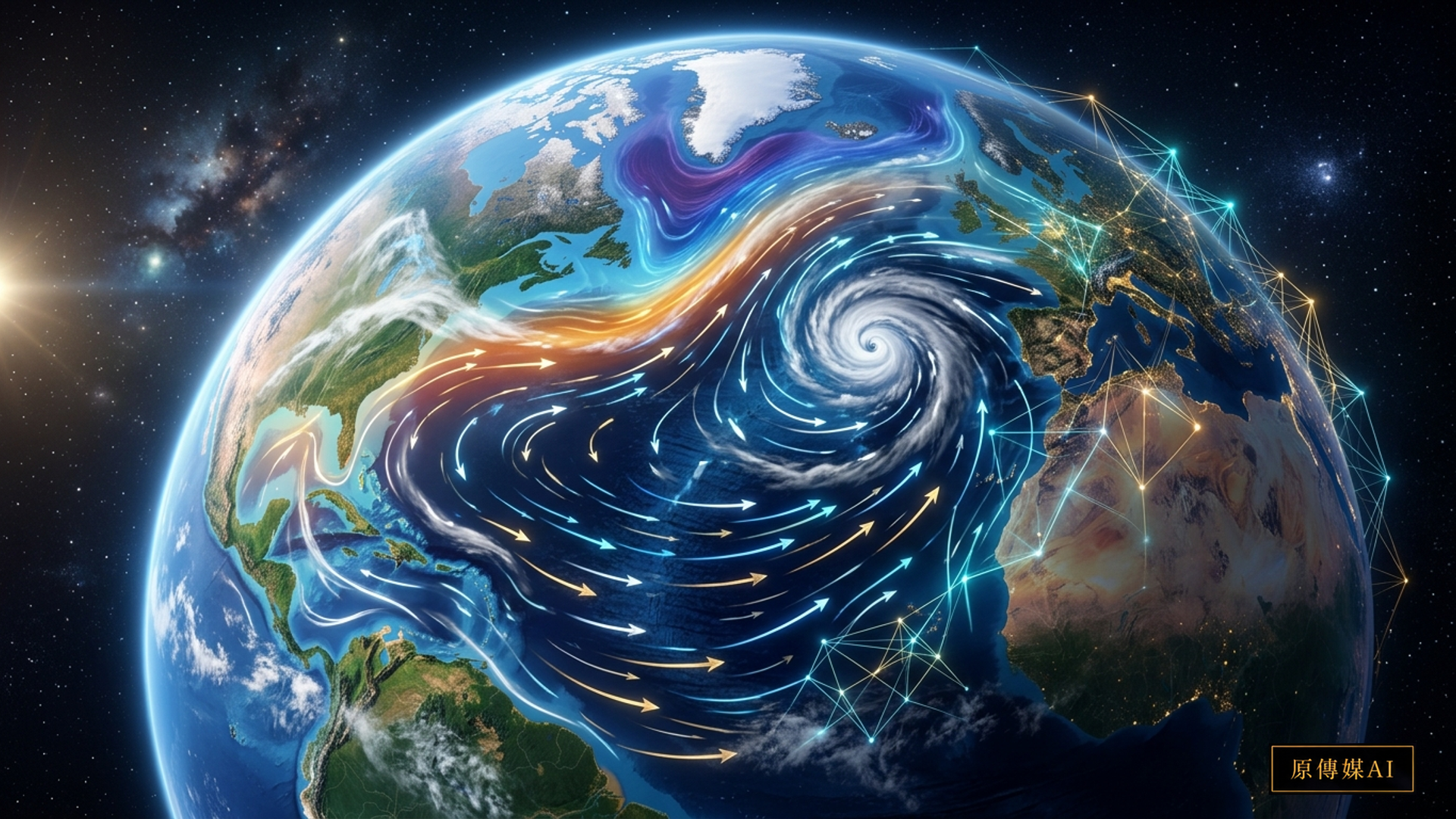
1. The two-to-six-week prediction desert: atmospheric science neglected forecast gap
Checking mobile weather applications has become second nature in modern society. Whether tracking afternoon convective storms, frontal passages, or typhoon paths, current numerical weather prediction (NWP) models deliver unprecedented skill across day-one to day-fourteen horizons. At the opposite end of the temporal spectrum, seasonal climate outlooks spanning three to six months leverage slowly evolving boundary conditions—such as El Niño–Southern Oscillation sea surface temperatures—to project macro-scale probabilistic climate tendencies. Yet between these horizons lies a formidable predictability chasm spanning weeks two through six (days 15 to 42): the subseasonal-to-seasonal (S2S) forecast gap.
This temporal window occupies a challenging dynamical transition zone. Within fourteen days, atmospheric evolution is dictated primarily by initial conditions; supercomputers integrate Navier-Stokes fluid dynamics equations, yielding accurate forecasts provided initial observational states are sufficiently constrained. Beyond two weeks, however, atmospheric non-linear chaos—the butterfly effect—amplifies minute observational errors exponentially, extinguishing deterministic predictability. Concurrently, the two-to-six-week window is too brief for the atmosphere to respond fully to slowly evolving oceanic and land-surface boundary forcings. Unable to rely solely on atmospheric memory or oceanic momentum, subseasonal forecasting represents one of the steepest challenges in modern meteorology.
In societal practice, however, this two-to-six-week prediction desert represents the most strategically valuable decision-making window. Will a persistent heat dome collapse power grids? Will pre-monsoon agricultural districts experience prolonged drought necessitating water rationing? Will emerging rice seedlings suffer severe late-season cold damage? Short-range weather forecasts cannot provide four-week lead times, while seasonal outlooks remain too diffuse. Bridging this subseasonal forecasting desert promises an operational revolution in disaster preparedness, reservoir management, and global food security.
2. The computational bottleneck: why doubling processing power fails to resolve chaos
To resolve this longstanding challenge, the World Meteorological Organization (WMO)—via the World Weather Research Programme (WWRP) and World Climate Research Programme (WCRP)—launched the international S2S Prediction Project over a decade ago. Leading operational forecasting centers, including the European Centre for Medium-Range Weather Forecasts (ECMWF), the US National Centers for Environmental Prediction (NCEP), and the Japan Meteorological Agency (JMA), dedicated massive supercomputing clusters to develop fully coupled atmosphere-ocean-ice-land dynamical ensemble systems. Yet even as grid resolutions narrowed from dozens of kilometers to single digits, dynamical models encountered persistent performance bottlenecks beyond day fourteen.
The primary obstacle resides in systematic climate drift and teleconnection errors. As ensemble models integrate physical equations forward in time, empirical parameterization schemes—governing cumulus convection, cloud microphysics, and radiative transfer—accumulate subtle systematic biases. Over multi-week integrations, model circulation drifts toward distorted synthetic equilibria: blocking highs are systematically underrepresented, Madden-Julian Oscillation (MJO) eastward propagation is artificially retarded, and subtropical jet streams exhibit persistent latitudinal displacement.
These systematic errors represent structural model biases rather than random noise. Traditional post-processing relied on subtracting static historical climatology, yet linear corrections fail amidst dynamic weather regimes. When extreme events develop, model bias is highly state-dependent, fluctuating with prevailing large-scale planetary wave patterns. When physical dynamical equations remain constrained by internal systematic biases, scaling supercomputing power tenfold cannot disperse the chaos obscuring the subseasonal desert.
3. A hybrid dynamical-AI breakthrough: learning to correct legacy model errors
In recent years, deep learning and data-driven artificial intelligence have demonstrated remarkable speed in short-range forecasting. However, when purely statistical neural networks are tasked with multi-week integrations, they rapidly suffer from atmospheric blurring, averaging out critical meteorological features due to the absence of explicit physical conservation laws. Confronting this limitation, atmospheric scientists pioneered a transformative hybrid paradigm: rather than replacing dynamical models, AI is trained as a specialized diagnostic specialist that identifies and corrects the systematic errors of dynamical models.
Interdisciplinary research published in American Meteorological Society journals and research repositories illustrates the extraordinary efficacy of this hybrid dynamical-AI architecture. Leveraging decades of ECMWF reanalysis data (ERA5) alongside extensive historical re-forecast (hindcast) archives, researchers trained deep convolutional neural networks equipped with spatial attention mechanisms. The model's objective is not predicting surface temperatures directly; instead, it analyzes how dynamical ensembles systematically distort specific variables between days 15 and 42 given prevailing large-scale teleconnections like the North Atlantic Oscillation.
By digesting historical error archives, deep learning models internalize state-dependent non-linear bias structures. When fresh ensemble forecasts are generated, the AI system executes real-time dynamic probabilistic bias correction. It calibrates mean temperature anomalies while refining ensemble spread, restoring sharp, reliable probabilistic distributions. Experimental benchmarks demonstrate that this hybrid framework boosts Brier Skill Scores by over twenty percent for three-to-four-week extreme heatwaves and blocking cold-air outbreaks, successfully traversing the subseasonal predictability desert.
4. Elevating early warning frontiers: capturing heat domes, cold snaps, and atmospheric rivers
Advancing subseasonal forecasting precision fundamentally transforms human defenses against extreme meteorological events. In conventional disaster management, emergency responders and utility grid operators receive definitive alerts only three to five days prior to an event, leaving dangerously constrained response windows. Under AI-augmented subseasonal architectures, decision-makers detect anomalous atmospheric reorganizations three to four weeks in advance, transforming reactive emergency management into proactive strategic preparedness.
Consider persistent heat domes and atmospheric rivers that generate regional flooding and thermal stress. These extreme phenomena are modulated by large-scale Rossby wave trains excited by tropical convective pulses like the MJO. Traditional dynamical models frequently dissipate wave energy prematurely, failing to anticipate downstream impacts. However, when AI calibrates tropical-extratropical teleconnections and jet-stream waveguides, systems reliably predict whether coastal regions will be trapped under persistent ridging three weeks later, issuing timely heat and drought advisories.
Parallel breakthroughs apply to sudden stratospheric warming (SSW) events and resulting mid-latitude cold air outbreaks. Propagating stratospheric anomalies downward into tropospheric circulation requires two to four weeks, a vertical coupling process dynamical models often delay or miscalculate. AI trained on decades of polar vortex breakdowns filters false alarms with high fidelity, tracking cold-air outbreak trajectories accurately. This multi-week buffer enables civil defense authorities to secure heating energy stockpiles, reconfigure power grid loads, and implement agricultural crop protection, minimizing socioeconomic disruption.
5. Transformative socio-economic value: water resources, agriculture, and grid resilience
Transitioning from research code to socio-economic infrastructure, subseasonal forecast advancements are redefining risk management across critical industrial sectors. Water resource management benefits profoundly. Facing fluctuating drought and flood risks, reservoir operators face acute dilemmas: discharging storage prematurely risks water shortages, while holding capacity risks catastrophic dam overtopping during sudden cloudbursts. Reliable two-to-six-week probabilistic forecasts provide dynamic reservoir dispatch rule curves, allowing hydraulic engineers to optimize hydroelectric generation and irrigation while securing flood retention margins.
In agriculture, subseasonal forecasting serves as the technological foundation for parametric agricultural insurance and smart agronomic scheduling. Farmers traditionally relied on historical intuition when selecting planting windows, fertilizer schedules, and pest mitigation. Accessing probabilistic soil moisture and temperature distributions four weeks prior to planting allows agricultural producers to adjust sowing schedules or deploy drought-resilient cultivars. Concurrently, agricultural finance institutions utilize subseasonal indices to structure automated indemnity payouts when precipitation falls below critical thresholds, providing financial safety nets for vulnerable rural communities.
Furthermore, subseasonal forecasting plays an indispensable role in energy transition and renewable grid stability. Modern electrical grids increasingly depend on intermittent solar and wind generation; during multi-week calm, cloudy conditions (dunkelflaute) or protracted heatwaves, grids face simultaneous drops in generation and surges in cooling demand. AI-calibrated subseasonal wind and solar forecasts enable transmission operators to schedule thermal generator maintenance a month in advance, adjusting inter-regional power transfers to avert rolling blackouts and fortify national energy security.
6. Beyond uncertainty: reframing human climate adaptation with wisdom and humility
Humanity's drive to predict the future has always intertwined fear of the unknown with the desire to master nature. From ancient astronomical augurs to modern supercomputing centers deploying millions of algorithmic lines, science has sought to quantify atmospheric chaos. Yet the demanding journey toward subseasonal predictability delivers a profound philosophical lesson: nature's non-linear chaos cannot be extinguished through brute computational force. Authentic scientific progress begins by acknowledging model boundaries and learning humbly from past systematic errors.
AI-augmented subseasonal error correction establishes an enlightened scientific paradigm: it rejects claims that machine learning replaces centuries of atmospheric fluid mechanics, while avoiding uncritical reliance on pure black-box computation. Instead, it brokers a reconciliation between physical laws and data science. Dynamical equations supply immutable causal architecture and conservation laws, while neural networks calibrate the subtle discrepancies between mathematical theory and turbulent reality. This hybrid intelligence represents the essential cognitive toolkit required to navigate the climate crisis.
Illuminating the two-to-six-week forecast gap does not grant omniscient dominion over atmospheric forces; rather, it provides precious time to reflect, prepare, and adapt wisely alongside a dynamic Earth. In an era of accelerating climate disruption, every additional day of early warning defends human lives and community infrastructure. Embracing deep synergy between physics and artificial intelligence empowers humanity to cultivate enduring resilience beneath turbulent skies, finding sustainable balance with the living planet.
Sources and Further Reading
Role-Driven Inquiry
Yuan Media AI | Guided Questions by Role
Select a role first, then review the complete questions from that perspective; clicking a question will display Yuan Media AI’s response in real time.
Select a role
Numerical Weather Prediction and Climate Dynamics Researcher
Examine the article's evidence, governance boundaries, data rights, and actionable steps from the perspective of a Numerical Weather Prediction and Climate Dynamics Researcher.
Choose a question
AI use and content-safety disclosure
AI assisted in organizing public research and institutional information for this article and its guided questions. Findings, limitations and practical proposals are distinguished. The cover is an AI-generated concept image.