Can spreading crushed basalt on farmland lock away carbon? How rhizosphere microbes decide the real ledger of enhanced rock weathering
Original Chinese title: 把玄武岩粉撒進農田就能固碳嗎?根圈微生物如何決定增強岩石風化的真實帳本
Spreading crushed silicate basalt across croplands to accelerate carbon mineralization is hailed as a scalable negative-emissions technology. Yet multi-year field trials reveal that root exudates, mycorrhizal fungi, and soil microbes control the true weathering rate and trace-metal safety margins.
雙向知識實驗室
Interdisciplinary lab bridging life sciences, microbiology, and technology research, focusing on translating experimental evidence into accessible, verifiable public knowledge.
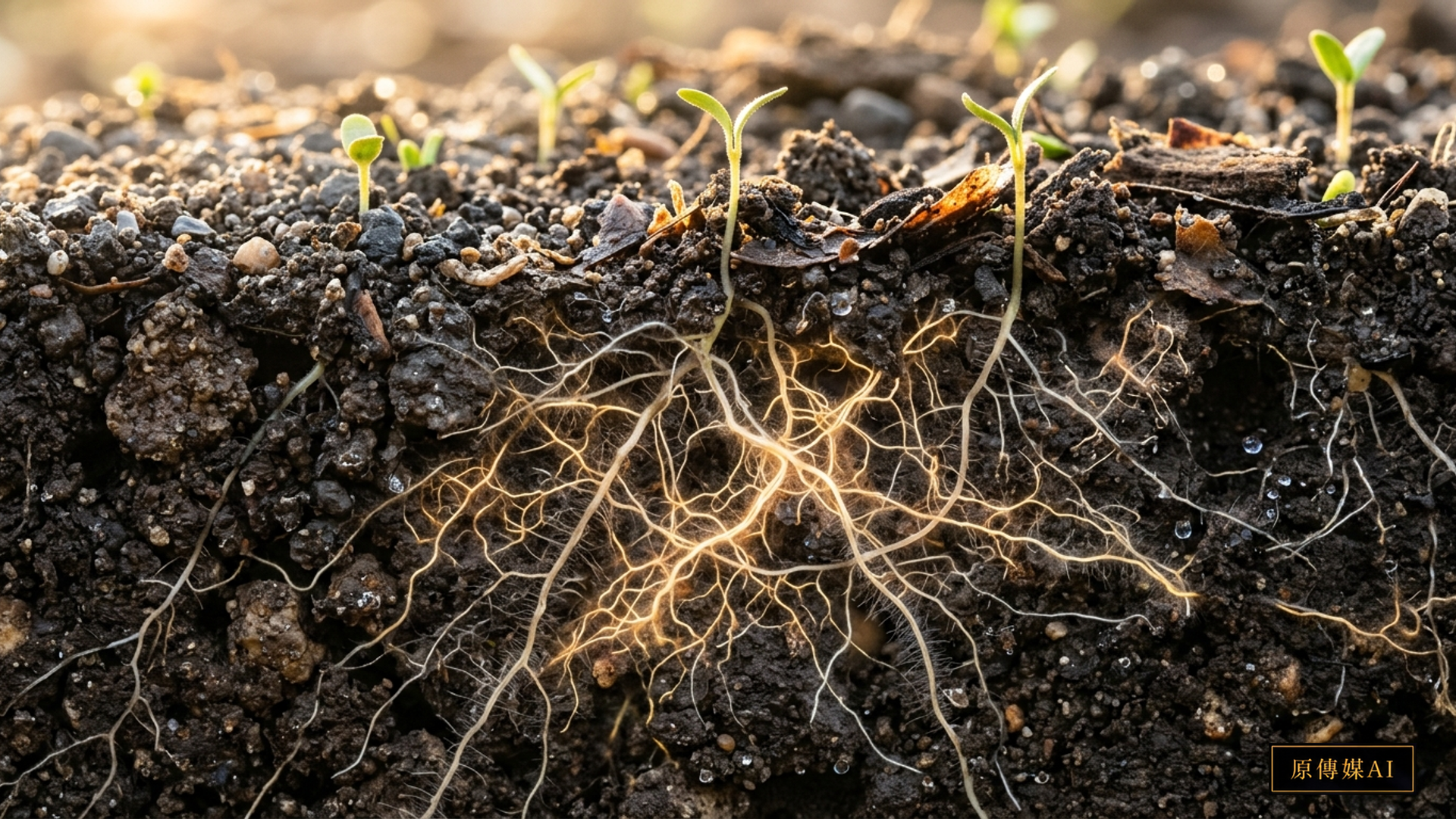
1. Fast-forwarding the million-year geological clock: the vision of enhanced rock weathering on farmland
Across billions of years of Earth's climatic evolution, the ultimate planetary thermostat stabilizing atmospheric carbon dioxide over geological timescales has been neither forests nor surface oceans, but the slow, relentless process of silicate rock weathering. When atmospheric carbon dioxide dissolves in rainwater to form weak carbonic acid and percolates through volcanic basalt or silicate rock formations rich in calcium and magnesium, chemical dissolution converts gaseous carbon into dissolved bicarbonate ions and carbonate minerals. Washed down rivers into the global ocean, this carbon is locked away on the seafloor for hundreds of thousands to millions of years. Yet nature's geological weathering clock ticks far too slowly to counteract the anthropogenic climate crisis driven by trillions of tons of greenhouse gases emitted over just two centuries.
To compress this million-year geological cycle into a matter of years or decades, biogeochemists and climate scientists proposed an ambitious negative-emissions technology known as Enhanced Rock Weathering (ERW). By taking abundant silicate rock byproducts from mining and construction quarries—most notably calcium- and magnesium-rich basalt—and grinding them into micrometer-scale rock dust, farmers can apply these minerals directly onto existing croplands using standard agricultural lime spreaders. Crushing massive rock formations into fine powder multiplies their reactive specific surface area by thousands of times, theoretically accelerating chemical weathering reactions from millennia down to single-digit years.
Enhanced rock weathering has attracted surging scientific and commercial investment within the carbon dioxide removal (CDR) sector because it requires neither the energy-intensive industrial fans of Direct Air Capture (DAC) nor land-use competition against food production. On the contrary, as basalt dust dissolves in agricultural topsoil, it captures carbon while simultaneously releasing essential plant nutrients—calcium, magnesium, silicon, and potassium—reversing soil acidification caused by decades of synthetic nitrogen fertilizer application and boosting crop yields. Yet as this elegant inorganic equation moved from laboratory beakers into living agricultural fields, multi-year trials revealed a pivotal truth: the true gatekeeper deciding how much carbon crushed basalt actually locks away is not abiotic chemistry alone, but the invisible rhizosphere microbiome.
2. The blind spot of abiotic kinetic models: why laboratory beakers miscalculate field weathering rates
In early theoretical assessments and global carbon-removal projections for enhanced rock weathering, modelers relied heavily on classical abiotic kinetic equations borrowed from aqueous geochemistry. These models assume that once basalt powder enters the soil, its dissolution rate is governed primarily by four physical and chemical variables: mineral particle size distribution and specific surface area, soil pore-water pH, ambient temperature, and hydrological percolation rates. Inside sterile, well-flushed laboratory reactor columns supplied with constant moisture and carbon dioxide partial pressures, silicate mineral dissolution follows predictable mathematical trajectories.
However, when interdisciplinary research consortia conducted multi-year field trials across North American corn belts, European rotational croplands, and tropical agroecosystems, empirical carbon ledgers frequently diverged sharply from abiotic predictions. In degraded, compacted soils depleted of organic matter or suppressed by heavy fungicide use, even massive applications of ultrafine basalt dust rapidly stalled as mineral grains became coated in passivating layers of amorphous silica and secondary clays. Conversely, in biologically vibrant plots cultivated with deep-rooted crops and thriving mycorrhizal networks, calcium and magnesium weathering fluxes exceeded abiotic aqueous predictions severalfold.
This dramatic field variability exposed the fundamental blind spot of classical geochemical models: agricultural soil is not a sterile beaker filled with quartz sand and distilled water, but a living biogeochemical reactor containing billions of bacteria, archaea, and kilometers of fungal hyphae in every gram of earth. Within the rhizosphere—the narrow, millimeter-wide zone immediately surrounding living plant roots—roots and microbes engage in intense metabolic exchange and chemical engineering. Ignoring the catalytic and regulatory power of this rhizosphere engine turns desk-based enhanced rock weathering carbon projections into deeply flawed accounting.
3. Rhizosphere microbes and mycorrhizal fungi: the biological mining crew on mineral surfaces
When a micrometer-sized basalt grain settles into the rhizosphere, soil microbes and plant roots immediately treat it as a vital nutrient vault. Plants allocate between ten and thirty percent of their photosynthetically fixed carbon belowground, actively secreting a complex cocktail of root exudates—including low-molecular-weight organic acids such as citric, oxalic, and malic acids, alongside phenolic compounds, amino acids, and mucilage—directly into the soil matrix. These organic acids generate localized micro-zones of intense proton acidity on basalt grain surfaces, launching direct acid-hydrolysis attacks on pyroxene, plagioclase, and olivine crystal lattices while acting as powerful organic chelators that pluck iron, aluminum, calcium, and magnesium ions out of mineral structures.
At the forefront of this biological mining operation are arbuscular mycorrhizal fungi (AMF) and ectomycorrhizal fungi living in symbiotic partnership with plant roots. With hyphal diameters measuring just two to ten micrometers—over ten times thinner than the finest plant root hairs—fungal hyphae penetrate microscopic mineral fissures and crystal boundaries inaccessible to roots. Field micro-spectroscopy demonstrates that fungal tips exert mechanical trenching forces while enveloping basalt grains in extracellular polymeric substance (EPS) biofilms saturated with oxalate and iron-scavenging siderophores, creating sealed, hyper-acidic micro-reaction chambers that aggressively dissolve silicate lattices.
Simultaneously, phosphate-solubilizing and mineral-weathering bacteria—such as Pseudomonas, Bacillus, and Burkholderia species—colonize the fungal hyphosphere to form synergistic metabolic consortia. While fungal hyphae etch basalt surfaces to extract phosphorus, potassium, and trace micronutrients for their host plants, bacterial biofilms consume dissolved weathering byproducts, preventing local ion supersaturation that would otherwise precipitate passivating mineral coatings. Furthermore, intense root and microbial respiration elevates soil pore-space carbon dioxide partial pressures to ten to fifty times atmospheric levels; coupled with microbial secretion of the enzyme carbonic anhydrase, which accelerates the hydration of carbon dioxide into bicarbonate by orders of magnitude, the rhizosphere microbiome functions as the indispensable biological turbocharger of enhanced rock weathering.
4. The tug-of-war over the real carbon ledger: alkalinity leaching, soil organic carbon, and greenhouse gas co-benefits
Does rapid microbial dissolution of basalt automatically guarantee permanent atmospheric carbon removal? Constructing an honest carbon ledger for enhanced rock weathering requires tracking both Soil Inorganic Carbon (SIC) and Soil Organic Carbon (SOC) pathways alongside their downstream losses. Along the inorganic pathway, calcium and magnesium cations released from weathered basalt neutralize soil acidity and trap root-zone carbon dioxide as dissolved bicarbonate ions ($HCO_3^-$). Yet as this bicarbonate percolates through deeper soil horizons or drains into agricultural watersheds, encountering strong non-carbonic acids—most notably nitric acid generated when nitrifying microbes oxidize synthetic ammonium fertilizers—can protonate bicarbonate back into gaseous carbon dioxide, erasing a substantial fraction of the initial carbon capture.
Along the organic pathway, basalt weathering triggers a complex tug-of-war within the soil carbon pool. On the positive side, microbial etching of basalt generates reactive secondary iron and aluminum oxides alongside fresh clay surfaces; these minerals bind tightly with microbial necromass and root exudates to form Mineral-Associated Organic Matter (MAOM), locking organic carbon into physically protected aggregates that persist for decades. On the cautionary side, raising soil pH and alleviating micronutrient limitations can transiently stimulate heterotrophic microbial respiration—a phenomenon known as the positive priming effect—accelerating the decomposition of pre-existing labile soil organic matter. Whether a field experiences net organic carbon accrual or transient loss depends critically on local carbon-to-nitrogen stoichiometries and microbiome community composition.
Beyond carbon dioxide itself, a pivotal bright spot in the enhanced rock weathering ledger lies in its potent suppression of agricultural nitrous oxide ($N_2O$), a greenhouse gas with nearly 273 times the warming potential of carbon dioxide over a century. Multi-year field trials and isotopic tracing confirm that when crushed basalt buffers acidic rhizosphere pH and supplies bioavailable molybdenum (Mo), copper (Cu), and iron cofactors, it strongly upregulates the microbial gene nosZ, which encodes nitrous oxide reductase in denitrifying bacteria. Equipped with functional reductase enzymes, soil microbes complete the denitrification cascade, converting greenhouse $N_2O$ gas into harmless dinitrogen ($N_2$) and slashing cropland $N_2O$ emissions by twenty to fifty percent.
5. Trace metal boundaries and soil ecological safety: microbial regulation of nickel and chromium release
Despite the compelling agronomic and climatic promise of enhanced rock weathering, environmental toxicologists and agricultural regulators scrutinize a critical safety boundary: the release of trace heavy metals naturally embedded within igneous silicate rocks. Depending on their geological magma source, basalts and ultramafic rocks (such as dunite, peridotite, and serpentinite) contain varying lattice concentrations of nickel (Ni), chromium (Cr), vanadium (V), and cobalt (Co). If carbon-removal projects indiscriminately apply olivine-rich ultramafic rock dust year after year to maximize dissolution speed, could weathering release bioavailable heavy metals that accumulate in food crops or poison earthworms and beneficial soil microfauna?
To evaluate this food-safety threshold, multi-institutional consortia—including the Leverhulme Centre for Climate Change Mitigation (LC3M)—have conducted rigorous multi-year trace-metal monitoring across temperate and tropical trial sites. Empirical findings demonstrate that when projects strictly select mafic basalts with low baseline heavy-metal concentrations rather than ultramafic olivine rocks, and apply them within standard agronomic rates (ten to forty metric tons per hectare annually), the vast majority of released nickel and chromium is rapidly immobilized by newly formed secondary iron-manganese oxides, aluminosilicate clays, and humic complexes, showing no hazardous bioaccumulation in corn, soybean, or wheat grains.
Nevertheless, the rhizosphere microbiome acts as both a protective buffer and a dynamic mobilizer along this toxicological boundary. When roots and microbes secrete citric acid, oxalic acid, and siderophores to chelate iron and magnesium, these organic ligands can also form soluble organometallic complexes with nickel and chromium ions, altering their mobility in soil pore water. Furthermore, fluctuations in soil redox potential and the activity of manganese-oxidizing bacteria govern whether relatively immobile trivalent chromium (Cr(III)) is oxidized into toxic, mobile hexavalent chromium (Cr(VI)). Consequently, safe deployment of enhanced rock weathering cannot rely solely on bulk chemical assays at the quarry gate; it requires continuous monitoring of soil cation-exchange capacity, redox dynamics, and rhizosphere bioavailability.
6. From subtropical hillside orchards to global carbon markets: the future of MRV and agronomic integration
As enhanced rock weathering transitions from academic field plots into commercial carbon-credit markets, the sector confronts formidable Measurement, Reporting, and Verification (MRV) challenges. Unlike point-source industrial carbon capture where gas flowmeters measure exact tonnage inside a pipe, open agricultural landscapes exhibit immense spatial and temporal heterogeneity in rainfall infiltration, root density, and microbial activity. To prevent over-crediting, scientists are pioneering multi-tiered MRV protocols that pair solid-phase geochemical mass balance—tracking the depletion of mobile calcium and magnesium relative to immobile tracer elements like titanium and zirconium—with pore-water ion-exchange resin capsules, automated watershed alkalinity sensors, and next-generation reactive transport models that explicitly incorporate microbial kinetics.
Viewed through the lens of Taiwan and subtropical monsoon agroecosystems, enhanced rock weathering presents both exceptional natural advantages and acute local constraints. Taiwan's warm temperatures and abundant seasonal rainfall act as a powerful natural thermodynamic accelerator for silicate dissolution. Moreover, intensive tea plantations, fruit orchards, and croplands across Taiwan's western plains and foothills suffer from severe soil acidification (often pH 4.0 to 5.0), forcing farmers to apply agricultural lime whose calcination emits substantial carbon dioxide. Replacing conventional lime with rigorously screened, low-metal basalt or andesite quarry byproducts could theoretically deliver a quadruple dividend: neutralizing acid soils, curbing nitrous oxide emissions, replenishing silicon and magnesium nutrients, and locking away atmospheric carbon.
At the same time, Taiwan's steep topography and torrential typhoon downpours pose a serious erosion hazard: if rock dust is spread onto bare hillside soils without conservation coverage, heavy surface runoff will wash unweathered mineral grains straight into rivers and reservoirs before rhizosphere microbes can catalyze carbon mineralization. Ultimately, the science of enhanced rock weathering teaches us a humbling ecological lesson: no climate technology functions as a mechanical silver bullet divorced from living ecosystems. Only by partnering with the unseen microbial artisans of the rhizosphere—integrating crushed silicate minerals with regenerative practices like cover cropping, reduced tillage, and mycorrhizal conservation—can humanity heal degraded farmlands while writing a verifiable, enduring carbon ledger.
Sources and Further Reading
Role-Driven Inquiry
Yuan Media AI | Guided Questions by Role
Select a role first, then review the complete questions from that perspective; clicking a question will display Yuan Media AI’s response in real time.
Select a role
Soil Microbiologist and Rhizosphere Biogeochemist
Examine the article's evidence, governance boundaries, data rights, and actionable steps from the perspective of a Soil Microbiologist and Rhizosphere Biogeochemist.
Choose a question
AI use and content-safety disclosure
AI assisted in organizing public research and institutional information for this article and its guided questions. Findings, limitations and practical proposals are distinguished. The cover is an AI-generated concept image.