Modeling Particle Collisions into a Foundation AI: Will CERN's Flare Be a Scientific Breakthrough or the Next Black Box?
Original Chinese title: 把粒子碰撞做成「物理基礎模型」:CERN 的 Flare 會是科學工具,還是下一座黑箱?
In mid-October 2026, CERN and Mistral AI announced a strategic initiative to train Flare, an unprecedented AI foundation model for fundamental physics utilizing petabytes of Large Hadron Collider (LHC) collision events. This analysis evaluates the mathematical necessity of enforcing exact conservation laws and Lorentz symmetries within neural architectures, investigates the risks of statistical hallucinations in rare-signal searches, and addresses crucial open-science governance dilemmas arising from public-private partnerships in Big Science.
Lawrence Lee
Scholar at the University of Leeds and science and technology policy observer.
# Modeling Particle Collisions into a Foundation AI: Will CERN's Flare Be a Scientific Breakthrough or the Next Black Box?
In mid-October 2026, the European Organization for Nuclear Research (CERN) in Geneva and European open-source artificial intelligence pioneer Mistral AI announced a strategic initiative that sent shockwaves across the global scientific community. The two institutions unveiled an unprecedented partnership to harness petabytes of high-energy proton-proton collision records collected over decades at the Large Hadron Collider (LHC) to co-develop the world's first foundational physics AI model—codenamed "Flare."
This ambitious endeavor immediately ignited intense debate among scientific circles and technology policymakers. Enthusiasts enthusiastically heralded the initiative as the end of computationally agonizing Monte Carlo detector simulations, projecting that generative AI will dramatically compress research timelines and catalyze a transformative era of AI for Science. Conversely, theoretical physicists and philosophers of science voiced profound skepticism: when the quantum field theories governing fundamental natural forces are entrusted to deep neural networks spanning hundreds of billions of parameters, will Flare serve as a revolutionary scientific instrument illuminating cosmic mysteries, or will it construct an opaque, uninterpretable black box fraught with statistical hallucinations?
Partnership Announcement vs. Scientific Validation: Delineating Roadmap from Reality
In scrutinizing this scientific milestone, analysts and researchers must first establish a rigorous factual boundary: the announced collaboration constitutes an exploratory research initiative, not an established, peer-reviewed physics simulation engine ready to replace verified computational workflows.
According to the official framework detailed in the CERN Official Press Release on Mistral AI Partnership, the project currently focuses on foundational data engineering, standardizing graph representations of collision events, and assessing the mathematical viability of embedding hyperbolic symmetries into Transformer architectures. As objectively reported by the CERN openlab Scientific Computing Framework, raw sensor readouts from LHC collision events produce terabytes of telemetry per second. Even after hardware-level filtering by ultra-fast Level-1 and High-Level Triggers, the retained datasets of collision jets, primary vertex tracks, and calorimeter energy depositions remain exceptionally complex.
Translating these non-Euclidean geometric structures into generalized tensor representations suitable for deep neural networks represents a mathematical challenge orders of magnitude beyond tokenized natural language processing. Any preliminary models demonstrated today represent early proof-of-concept curve fittings within constrained decay channels; marketing narratives proclaiming that AI has mastered quantum physics fundamentally misrepresent the arduous realities of empirical science.
The Inviolable Laws of Physics: Conservation Laws, Lorentz Symmetry, and Hallucination Defenses
Particle physics occupies a preeminent status among the natural sciences due to its uncompromising mathematical rigor. Under the relativistic framework of quantum electrodynamics and the Standard Model, all physical interactions must strictly conserve energy, momentum, electric charge, and baryon and lepton numbers, while exhibiting invariant symmetry under the Poincaré group and Lorentz transformations.
This requirement exposes the core vulnerability of generative machine learning architectures. Conventional deep learning operates as a probabilistic pattern recognition and conditional density sampling system. Without structural mathematical constraints, neural networks possess no internal understanding of objective physical laws. Applying unconstrained generative adversarial networks (GANs) or diffusion models directly to particle generation inevitably produces physical absurdities, such as non-conserved four-momentum or spurious asymmetries under spatial rotations.
As emphasized in the Mistral AI Announcement on Physics AI and Flare, Flare cannot rely on black-box heuristics; it must transition fundamentally to geometric deep learning and physics-informed neural networks (PINN). Research teams must hard-code continuous Lie group symmetries and four-momentum conservation tensors directly into the model's loss formulations and attention mechanisms. This guarantees that generated synthetic collision events reside strictly on valid physical manifolds. Without these inviolable geometric guardrails, foundation models merely generate elaborate pseudo-scientific artifacts.
The Five-Sigma Standard vs. Ghost Resonances: Statistical Perils in the Extreme Long Tail
The validation threshold in high-energy physics is the most stringent in empirical science. To claim a genuine discovery—such as the 2012 observation of the Higgs boson—a signal must achieve a statistical significance of five standard deviations (5-sigma), corresponding to a probability of less than one in three million that the observation arose from random background fluctuations.
This relentless search for ultra-rare phenomena exposes generative foundation models to acute systemic vulnerabilities. Within billions of LHC collision events, the overwhelming majority represent well-understood Standard Model quantum chromodynamic (QCD) background processes. In contrast, hypothetical Beyond the Standard Model (BSM) phenomena—such as dark matter candidates, supersymmetric partners, or micro-black holes—reside within the extreme long-tail distribution of one in tens of billions.
When experimental physicists deploy foundation models to generate synthetic datasets for rare-event searches, acute statistical risks emerge: could the model's generative priors or latent-space irregularities fabricate an artificial five-sigma peak—a phantom "ghost resonance" born purely of algorithmic artifacts? In a multibillion-dollar discipline, an unverified anomaly could misdirect global research teams for years. Consequently, algorithmic explainability and rigorous residual uncertainty quantification are not optional luxuries; they are indispensable prerequisites for scientific legitimacy.
Public Scientific Commons vs. Commercial AI: The Governance Divide
Beyond technical considerations, the CERN-Mistral partnership sparks profound dilemmas in international scientific data governance. CERN operates as a treaty-governed international research organization sustained by public taxpayer funding, dedicated to open science for the collective benefit of humanity. Conversely, Mistral AI is a venture-backed commercial enterprise beholden to private investors and commercial revenue targets.
This public-private nexus prompts urgent ownership questions: who owns the model weights, hyperparameter checkpoints, and derivative algorithmic insights trained on decades of publicly funded particle collision data? Will these assets remain universally accessible public goods, or will access be gatekept behind proprietary commercial APIs?
Furthermore, should the global high-energy physics community become dependent upon closed foundation models rather than transparent open-source toolkits like Geant4 and Pythia, the foundational peer-review mechanism of science would face severe erosion. If independent research teams cannot inspect training weights, loss formulations, and filtering pipelines, independent reproducibility—the bedrock of empirical science—becomes compromised. Open science principles must never be sacrificed for computational shortcuts.
Strategic Perspectives for Taiwan's High-Energy Physics and Advanced Computing
Amidst this profound paradigm shift in fundamental science, Taiwan must actively position itself at the frontier. Taiwanese institutions possess extensive expertise in international high-energy physics collaborations: researchers from Academia Sinica, National Taiwan University, and National Central University have contributed for decades to CERN's Compact Muon Solenoid (CMS) and Alpha Magnetic Spectrometer (AMS) experiments, earning global distinction in silicon microstrip detector fabrication, Grid Computing, and data analytics.
To navigate the emergence of physics foundation models, Taiwan's scientific agencies should pursue three strategic initiatives:
First, participate proactively in establishing international open-science benchmark protocols. Taiwanese physics teams should leverage decades of collision data analysis to help define global verification standards for scientific AI, ensuring that foundation model weights remain accessible to academic researchers worldwide.
Second, harness Taiwan's semiconductor manufacturing leadership to build dedicated AI-for-Science computing architectures. Combining Taiwan's advanced semiconductor ecosystem with expanding high-performance computing at the National Center for High-performance Computing (NCHC), research agencies should foster interdisciplinary consortia to engineer specialized accelerators optimized for geometric deep learning and tensor conservation equations.
Third, cultivate interdisciplinary talent bridging fundamental physics and neural computation. Future investigators must be bilingual in quantum field theory and deep learning architectures, capable of identifying subtle generative artifacts and defending the epistemological integrity of empirical science.
The ultimate objective of particle physics is discovering the fundamental truths of our universe, not fitting plausible statistical approximations. In wielding artificial intelligence, humanity must maintain reverence for physical laws, fidelity to empirical evidence, and commitment to open inquiry, ensuring that Flare illuminates the frontiers of knowledge rather than leading science into an opaque algorithmic labyrinth.
資料來源與延伸閱讀
Role-Driven Inquiry
Yuan Media AI | Guided Questions by Role
Select a role first, then review the complete questions from that perspective; clicking a question will display Yuan Media AI’s response in real time.
Select a role
Particle Physicist
Examine the article's evidence, governance boundaries, data rights, and actionable steps from the perspective of a Particle Physicist.
Choose a question
AI use and content-safety disclosure
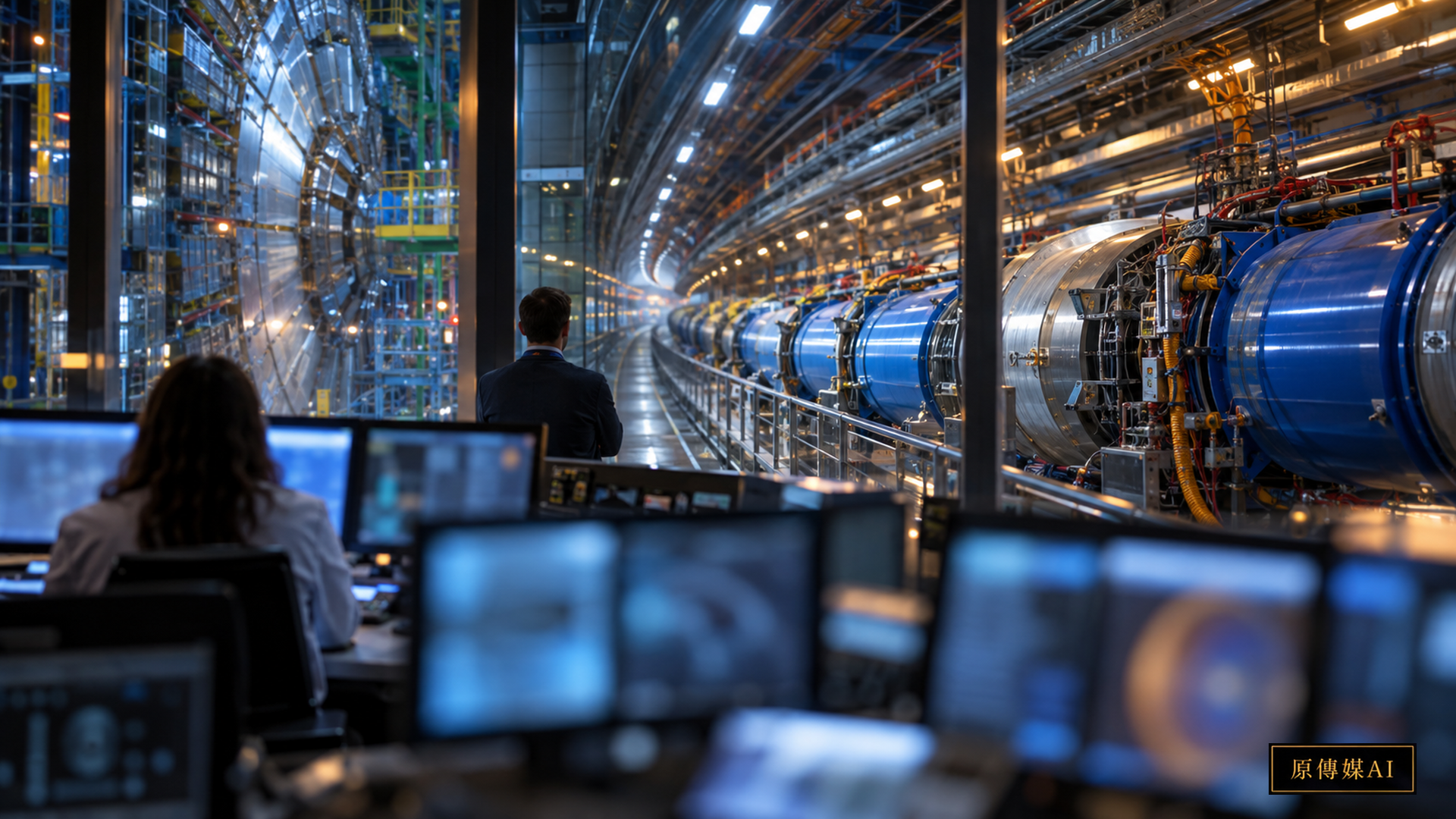
AI assisted in organizing public research and institutional information for this article and its guided questions. Findings, limitations and practical proposals are distinguished. The cover is an AI-generated concept image.