Viruses Have No Blueprints, So How Do Capsids Self-Assemble? Single-Molecule Tracking Reveals 'Trial-and-Lock'
Original Chinese title: 病毒沒有施工藍圖,外殼怎麼自己蓋起來?單分子量測看見「試錯—鎖定」
A research team from the Department of Chemistry at the University of Oxford has captured the self-assembly of engineered virus-like particles (VLPs) molecule-by-molecule for the first time using mass photometry and single-molecule interferometric optical scattering. Overturning textbook assumptions of a deterministic, rigid structural blueprint, the study reveals that capsid protein monomers undergo millions of transient, reversible millisecond contacts. Through dynamic 'trial-error-and-lock' thermodynamic pathways, subunits progressively settle into stable pentamers and intermediates before spontaneously converging into a closed icosahedral shell. Approaching this breakthrough from science education and biophysics, this feature demystifies thermodynamic entropy and molecular symmetry, rigorously distinguishes empty synthetic shells from living viral pathogens, and illuminates how advanced measurement transforms targeted nanocarrier design.
王振庭
Natural science education teacher, helping readers understand experimental design, measurement methodologies, and research limitations through science education.
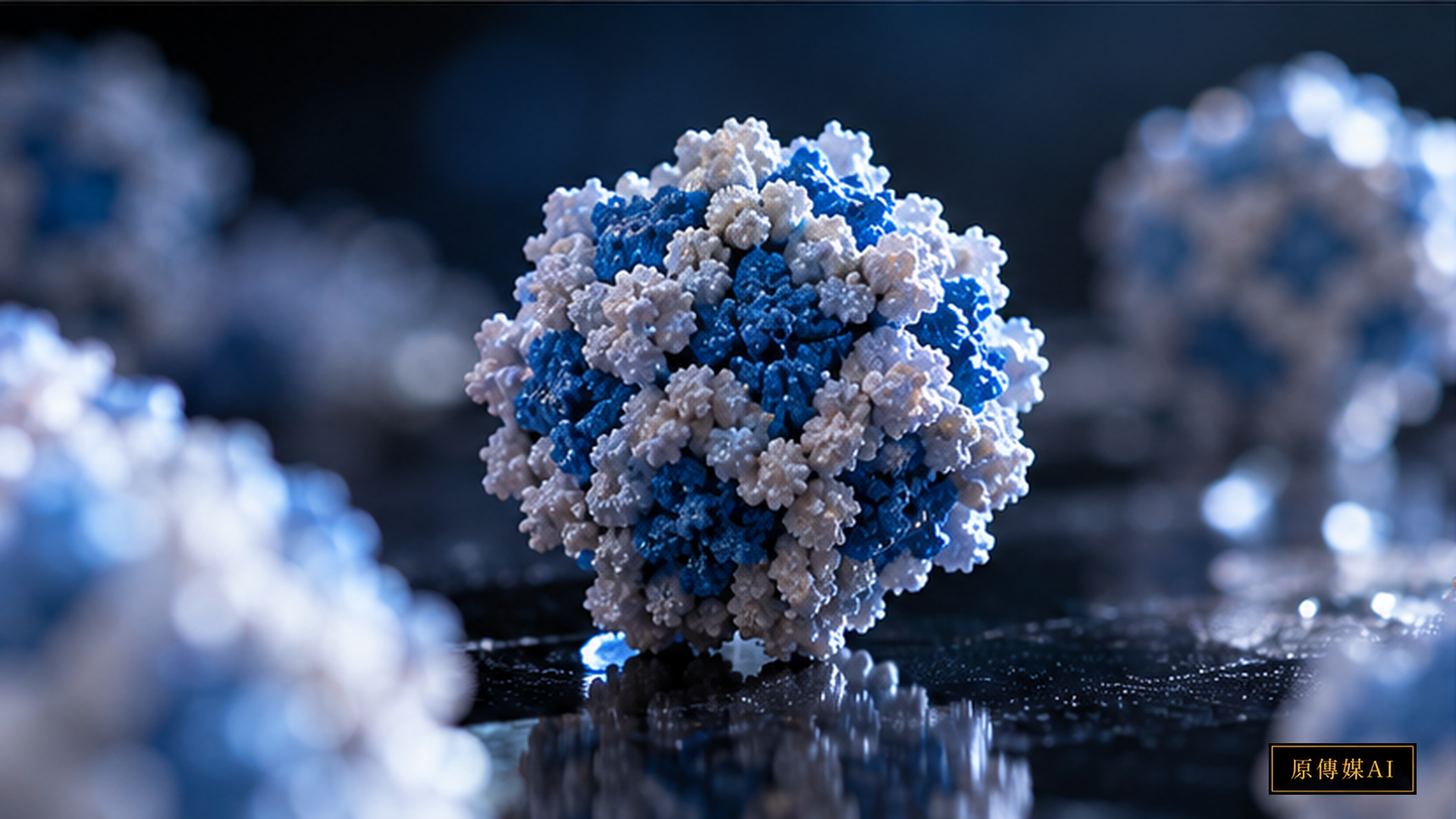
In secondary and undergraduate physics and biochemistry classrooms, when educators present the breathtaking geometric symmetry of viral capsids—intricate icosahedrons meticulously assembled from dozens or hundreds of identical protein subunits—students frequently voice an intuitive question: 'Viruses possess no brains, measurement rulers, architectural blueprints, or cellular assembly machines; how do individual protein subunits drifting in turbulent aqueous solutions know where to slot in to build such flawless structures?' For decades, structural biology textbooks, constrained by static cryogenic imaging techniques, could only depict dispersed monomers alongside fully completed capsids, oversimplifying self-assembly into a deterministic 'lock-and-key' or pre-programmed assembly line. However, a pioneering biophysical study from the Department of Chemistry at the University of Oxford, published in Nature Nanotechnology, has deployed mass photometry to capture the real-time self-assembly of engineered virus-like particles (VLPs) molecule-by-molecule with millisecond resolution. Their discoveries overturn rigid structural dogmas, revealing that viral capsid emergence is an exhilarating thermodynamic odyssey governed by 'trial-error-release-and-lock' kinetics.
Core Facts and Experimental Architecture: Breakthrough Single-Molecule Optical Tracking
Deciphering how millions of nanoscale protein monomers self-assemble into uniform macromolecular shells within seconds has historically run up against fundamental instrumentation limits. Classical cryo-electron microscopy (Cryo-EM) and X-ray crystallography furnish atomic-resolution spatial coordinates but require freezing specimens to cryogenic temperatures or packing them into rigid lattices, entirely erasing dynamic kinetic intermediate states. Conversely, traditional ensemble dynamic light scattering averages over billions of particles simultaneously, completely obscuring fleeting transient intermediates.
According to the 牛津大學新聞公報 and the 牛津大學化學系成果專頁, the Oxford research team deployed proprietary mass photometry paired with high-sensitivity interferometric scattering microscopy (iSCAT). This revolutionary optical principle measures the minute interference contrast between light scattered by a single protein molecule landing on a glass coverslip and reference background reflection, converting optical contrast directly into absolute molecular mass with kilodalton precision at sampling frequencies of hundreds of frames per second. As detailed in the experimental procedures within the PubMed 奈米科技文獻, investigators selected a genetically engineered icosahedral virus-like particle model. Initiating self-assembly in physiological saline buffers without perturbing fluorescent tags or fixatives, they tracked the step-by-step oligomerization of capsid proteins in their native aqueous state.
Key Data and Empirical Mechanisms: Thermodynamic Energy Landscapes and Trial-and-Lock
Single-molecule kinetic measurements unveiled a mesmerizing nanoscopic reality. In the initial nucleation phase, freely diffusing protein monomers do not dock into stereospecific positions in a single deterministic step. Instead, driven by relentless Brownian thermal motion, monomers undergo tens of thousands of random collisions per second. Remarkably, over ninety percent of these initial contacts represent misaligned, unproductive collisions. Because the Gibbs free energy of misaligned interfaces is insufficiently negative, the weak intermolecular bonds break within milliseconds under thermal solvent collisions, returning monomers to the free pool—this constitutes the indispensable 'trial and release' mechanism.
As demonstrated by the kinetic trajectories reported in the PubMed 奈米科技文獻 and elaborated on the 牛津大學化學系成果專頁, only when subunits collide in the exact stereospecific orientation required to form pentameric or dimeric interfaces does the complex sink into a localized thermodynamic energy well, extending interface lifespans to hundreds of milliseconds. The measurements conclusively identified previously hypothesized but unobserved metastable intermediates: curved, bowl-shaped partial capsids composed of oligomerized pentamers. Once nucleation crosses a critical cluster threshold, subsequent monomer recruitment transitions into positive cooperativity, accelerating assembly rates until the structure spontaneously converges and closes into a completed icosahedral shell. This empirical evidence dismantles the macroscopic intuition that complex precision architectures require rigid blueprints, demonstrating that natural self-assembly is a thermodynamic error-correcting machine powered by thermal fluctuations and free energy minimization.
Limitations, Nuances, and Empirical Boundaries: Demarcating Biophysics from Clinical Panaceas
As a natural science educator, I emphasize that while celebrating this monumental biophysical measurement milestone, society must rigorously demarcate fundamental physical measurement from immediate clinical applications.
According to statements in the 牛津大學新聞公報, the experimental model studied consists of engineered virus-like particles (VLPs). These are hollow recombinant protein shells devoid of viral genetic genomes (DNA or RNA), rendering them non-infectious, non-pathogenic, and incapable of independent biological replication. Media reports framing this study as 'capturing live killer viruses assembling' confuse synthetic biophysics with pathogenic infection. Furthermore, a clean, dilute, in vitro buffer solution diverges dramatically from the crowded intracellular cytoplasm of a living host cell, which teems with molecular crowding agents, chaperone proteins, and proteases. The principal contribution of this study resides in establishing measurement methodology and fundamental assembly biophysics; translating these kinetic insights into clinical therapeutics—such as small molecules that disrupt natural viral assembly or stable nanocarriers for targeted drug delivery—requires extensive pharmacological refinement, toxicology profiling, and human clinical trials. It cannot be overstated as an instantaneous cure for viral diseases.
Insights for Science Education: Fostering Scientific Methodology and Critical Inquiry
This Oxford breakthrough provides an exemplary real-world case study for secondary and university science education. In traditional pedagogy, students often compartmentalize thermodynamic laws in physics, chemical bond energies in chemistry, and protein folding in biology into isolated silos, struggling to perceive their underlying continuity.
Introducing the self-assembly of viral capsids into classrooms enables students to observe firsthand how advanced physical instrumentation (optical interferometry and mass photometry) serves as the indispensable investigative lens for chemical biology. More profoundly, it demystifies teleological assumptions that nature requires an intentional conscious designer, illustrating how random thermal agitation, non-covalent intermolecular forces (hydrophobic interactions, hydrogen bonding, electrostatic attraction), and the Second Law of Thermodynamics spontaneously yield breathtaking geometric order. Guiding learners to examine experimental controls, understand how researchers extract kinetic rate constants from stochastic single-molecule noise, and maintain healthy skepticism toward sensationalized science news represents the core objective of modern scientific literacy.
Conclusion and Future Trajectory: From Molecular Self-Assembly to Targeted Nanomedicine
The Oxford University team's single-molecule mass photometry tracking of virus-like particle assembly opens an inspiring new chapter in our comprehension of how order spontaneously emerges from molecular chaos. With engineered VLPs already forming the technological foundation of human papillomavirus (HPV) vaccines, hepatitis B vaccines, and next-generation delivery vehicles for mRNA therapeutics, elucidating the precise kinetics of assembly and disassembly provides an essential physical compass for designing artificial nanocarriers. The beauty of fundamental science lies in the realization that when we observe the dance of individual molecules with consummate precision, we not only uncover the physical mechanics of macromolecular architecture, but also appreciate the profound self-ordering majesty of the universe under thermodynamic law.
資料來源與延伸閱讀
Role-Driven Inquiry
Yuan Media AI | Guided Questions by Role
Select a role first, then review the complete questions from that perspective; clicking a question will display Yuan Media AI’s response in real time.
Select a role
Molecular Biologists
Examine the article's evidence, governance boundaries, data rights, and actionable steps from the perspective of a Molecular Biologists.
Choose a question
AI use and content-safety disclosure
AI assisted in organizing public research and institutional information for this article and its guided questions. Findings, limitations and practical proposals are distinguished. The cover is an AI-generated concept image.