Why School Phone Bans Don't Automatically Improve Mental Health: Iceland's 23,938 Youth Observations and Policy Boundaries
Original Chinese title: 校園禁手機為何沒有自動改善心理健康?冰島 23,938 筆青少年觀察的政策邊界
Centered on Iceland's school phone ban research, distinguishing observational findings from causal inference, and discussing policy implementation and student well-being.
王莉如
Counseling psychologist supervisor, long focused on trauma recovery, couple and family relationships, helping-profession ethics, and social-emotional support.
# Why School Phone Bans Don't Automatically Improve Mental Health: Iceland's 23,938 Youth Observations and Policy Boundaries
Does Putting Away Phones Improve Mental Health?
School phone bans are often given great expectations: students will be less distracted, peer relationships will improve, bullying will decrease, anxiety will drop, and even grades will rise. These goals have public value, but each requires different evidence. On October 27, 2026, *JAMA Network Open* published a study focused on Icelandic adolescents, reminding education administrators that a management measure cannot be treated as a panacea for mental health. The study compared multiple survey years and school policy changes, and found no meaningful overall association between phone bans and adolescent mental health or related social behavior indicators.
The study does not answer whether phones are good or bad, but rather whether, under these schools, at these time points, and with these implementation conditions, the ban is accompanied by measurable outcome changes. This distinction is important. Social discourse often extends a study's average result into an evaluation of all students, forgetting that student age, purpose of use, family relationships, school support, and policy implementation style may all differ.
The Meaning and Limitations of 23,938 Observations
This study used repeated cross-sectional surveys across multiple Icelandic schools, involving 70 schools and approximately 23,938 youth observations, comparing 22 schools that later implemented bans with others. Repeated cross-sectional design is not continuous tracking of the same students' life histories, but obtaining comparable group samples at different time points. Researchers can estimate group trends before and after policy implementation, but must still handle school differences, concurrent events, questionnaire measurement, and implementation intensity.
According to the JAMA Network Open original study, the study found no meaningful overall change in mental health and related social, behavioral outcomes associated with the ban. This does not prove that every student felt nothing, nor that every phone management scheme is ineffective. In policy research, "no significant improvement" may reflect small effects, insufficient intervention, observation period too short, or positive and negative effects canceling each other; it cannot be rewritten as "phone bans are definitely ineffective."
Restricting Use and Improving Life Are Different Things
Phones may distract attention, but adolescent mental health is also affected by sleep, academic pressure, family finances, peer conflict, social media interaction, help-seeking resources, and school culture. Even if phones are placed in storage bags, students may still face exclusion, anxiety, or loneliness. If policy only addresses devices without simultaneously improving rest time, social spaces, teacher-student communication, and psychological support, mental health indicators may not change. This is not defending phones, but reminding that management tools and health promotion mechanisms differ.
Conversely, one should not deny other possible values of restricting phones in classroom order, attention, and safety management because the study did not observe mental health improvements. If schools position the ban as classroom management, they should use corresponding classroom indicators for evaluation; if they claim to improve depression or anxiety, they should have mental health measurements and supporting services. The more policy goals, the more evidence is needed item by item, and one cannot replace all results with a single phrase like "everyone feels quieter."
U.S. Research Shows Effects May Change Over Time
The University of Michigan Youth Policy Lab compiled U.S. research on lockable-pouch phone policies, combining surveys, location signals, academic grades, and administrative records, finding that lockable-pouch policies did reduce in-school phone use; however, in the early implementation phase, some disciplinary events increased and subjective well-being declined, with later changes. Overall test score effects were near zero, and high school and middle school may show different directions. This does not necessarily contradict the Icelandic study, because policy type, observation period, age composition, and outcome indicators differ.
Putting the two studies together, the most valuable insight is not selecting one as a political slogan, but seeing that "reducing use" does not immediately equal "improving mental health." Short-term adaptation costs may also exist. For educators, what is truly needed is to incorporate the policy implementation process into observation: do students have alternative activities? Do teachers receive assistance? Are exceptions provided for disabilities and medical needs? Do parents and students know emergency contact methods?
How Icelandic Local Government Designed Exceptions and Tracking
The Reykjavik City Government announced a primary phone-free school policy in 2026, proposing in-school storage, rule explanation, and exception arrangements, and planning cooperation with universities to track learning outcomes, student well-being, and teacher work environment. Officials specifically mentioned reasonable exceptions for health, disabilities, and learning needs, and reminded schools to provide game, outdoor, and social spaces. These supports do not guarantee policy success, but they show that local governance can treat bans as public interventions requiring evaluation, not as one-and-done announcements.
For Taiwanese schools, the most worth borrowing may not be whether to adopt the same ban, but how to publicly state policy purposes and evaluation methods. If the goal is improved attention, look at classroom participation, assignments, and learning conditions; if the goal is reduced conflict, look at bullying reports, student subjective safety, and counseling records; if the goal is health, look at sleep, anxiety, depression, and accessible support services. Each indicator must respect privacy; student psychological records cannot be treated as freely publishable rankings.
Mental Health Professionals' Views on Help-Seeking and Safety
Some students use phones in school to contact family; for certain mental health conditions, phones or assistive technology may also be part of safety and accessibility. Rules should avoid treating all usage contexts as violations. Counseling psychologists can help identify in campus discussions: which problems are caused by device use, which are existing stresses expressed through phones, and which students need individual support. Mental health is not a single number; students' autonomy, sense of belonging, and trust relationships are equally important.
When research reports show limited average effects, schools can adopt a pragmatic response: maintain reasonable order management while expanding class activities, rest, and counseling resources, and regularly collect anonymous student feedback. This approach does not demonize phones nor ignore problems from overuse, but brings discussion back to testable, adjustable educational policy.
Policy Should Be a Correctable Experiment
Mature school policies are not announced once and never changed; they first define purposes, establish baselines, record implementation, evaluate differences, and then revise based on evidence. Administrators should include students, parents, teachers, counseling staff, and special education professionals in discussions, publicly stating which outcomes truly improved, which did not, and which need more time. If different age groups or different needs show opposite results, one should avoid reporting only overall averages that mask disadvantaged situations.
The most robust conclusion from the Icelandic study is that school phone bans alone are insufficient to guarantee adolescent mental health improvements at the group level. Educators should place restriction measures within a broader support network and evaluate with corresponding indicators, not let a single regulation bear all expectations. When we truly care about students, the endpoint of policy discussion should not be "were phones taken away," but "do children have greater capacity to learn, make friends, seek help, and live peacefully."
Digital Citizenship Education Cannot Disappear Because Phones Are Put Away
Another often-overlooked issue is that even if students do not use phones in school, after school they still live in social media, gaming, video, and instant messaging environments. If schools only train students to follow storage rules without teaching information identification, online conflict handling, personal data protection, and algorithmic recommendation impacts, digital literacy education remains outside the school gate. Bans and education are not a binary choice: certain periods can reduce distraction, while other courses can still use digital tools under purposeful instructional design, helping students understand when to go offline and when to verify.
Families also need executable communication methods. If parents treat phone use as the sole cause of parent-child conflict, they may overlook what children truly need in companionship and support. One can start with jointly agreed sleep times, study periods, emergency contact methods, and online safety, rather than relying only on punishment. Children of different ages need different levels of autonomy; for students with medical, assistive, or special education needs, individual negotiation is even more important. Effective rules generally need to be clear, reasonable, predictable, and retain appeal and revision channels.
Finally, researchers should avoid letting statistical average effects replace personal experience. For some students, reducing message interference may indeed help; for others, suddenly losing contact tools may increase anxiety. These differences require follow-up data and qualitative interviews to understand more fully. Public discussion needs not to announce who wins or loses, but to let schools face complex results, admit unknown parts, and continuously improve children's actual living conditions.
Therefore, when schools explain ban results to society, they should also present student feedback, teacher workload, accessibility for special needs, and ethical boundaries of data collection. Only these information can make institutional improvement truly return to students, not stay in slogans.
The timeline also matters. The study compares surveys from 2016, 2018, and 2023, while Reykjavik's 2026 policy is a later governance arrangement. Its exceptions can inform discussion, but they were not the intervention evaluated in the earlier study. Keeping the periods separate avoids attributing unmeasured outcomes to a newly introduced policy.
Sources
Role-Driven Inquiry
Yuan Media AI | Guided Questions by Role
Select a role first, then review the complete questions from that perspective; clicking a question will display Yuan Media AI’s response in real time.
Select a role
Students
Examine the article's evidence, governance boundaries, data rights, and actionable steps from the perspective of a Students.
Choose a question
AI use and content-safety disclosure
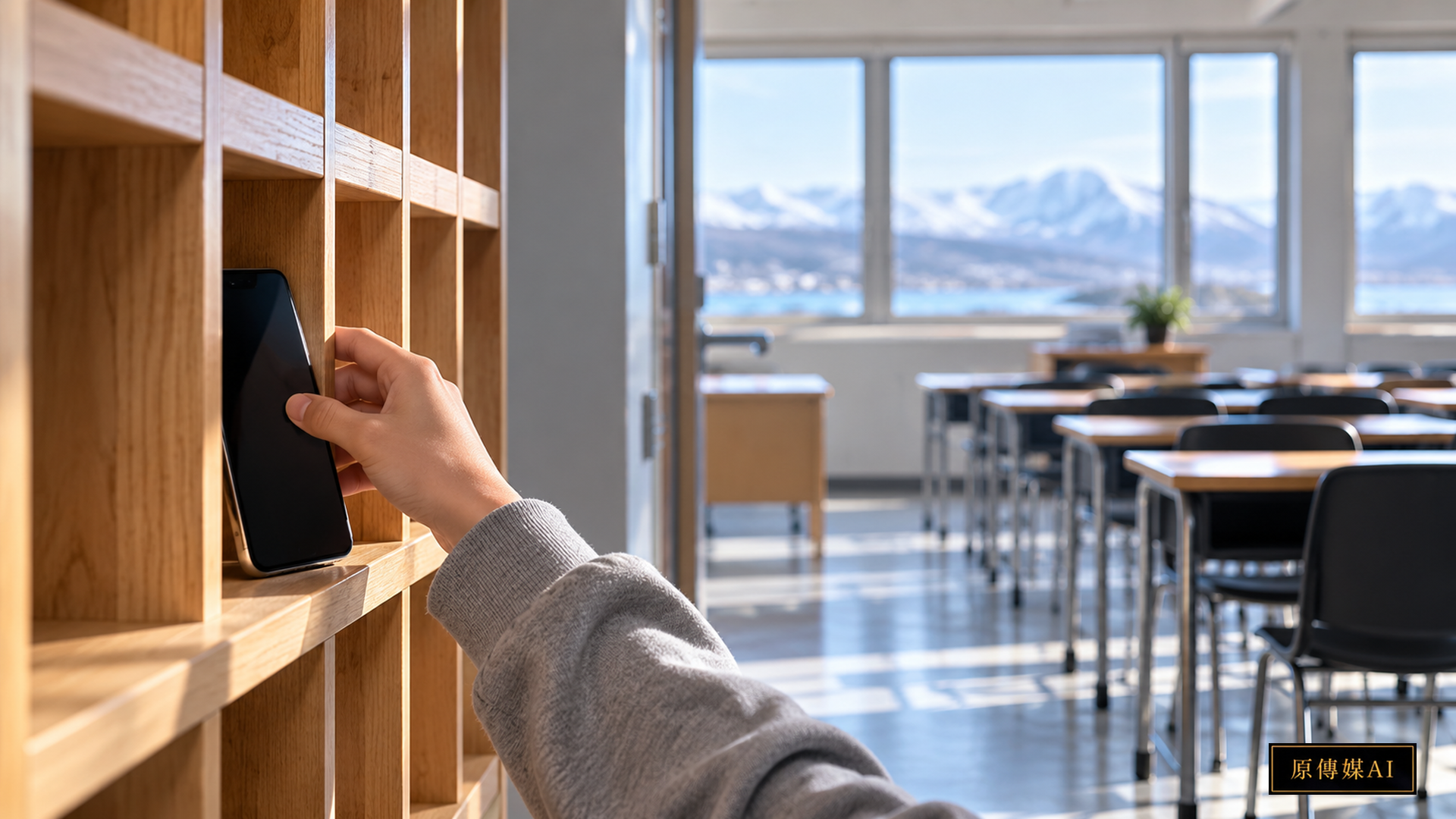
This article was assisted by AI in organizing public research and institutional data; research findings, limitations, and editorial analysis are explained separately. The cover is an AI-generated concept image.