AI Can Identify a Suspicious Detail, but Cannot Sign a Museum's Attribution: Explainable Models in Art Research
Original Chinese title: AI 可以指出「可疑的手」,卻不能替博物館簽名:可解釋模型如何加入畫作歸屬調查
A close look at explainable AI for Rembrandt attribution, and the roles of model confidence, material evidence, and accountable museum judgment.
陳錦瑜
Professor at National Taiwan University of Science and Technology, teaching chatbot development and cultural exploration, focusing on cultural diversity, international trends, and SDGs.
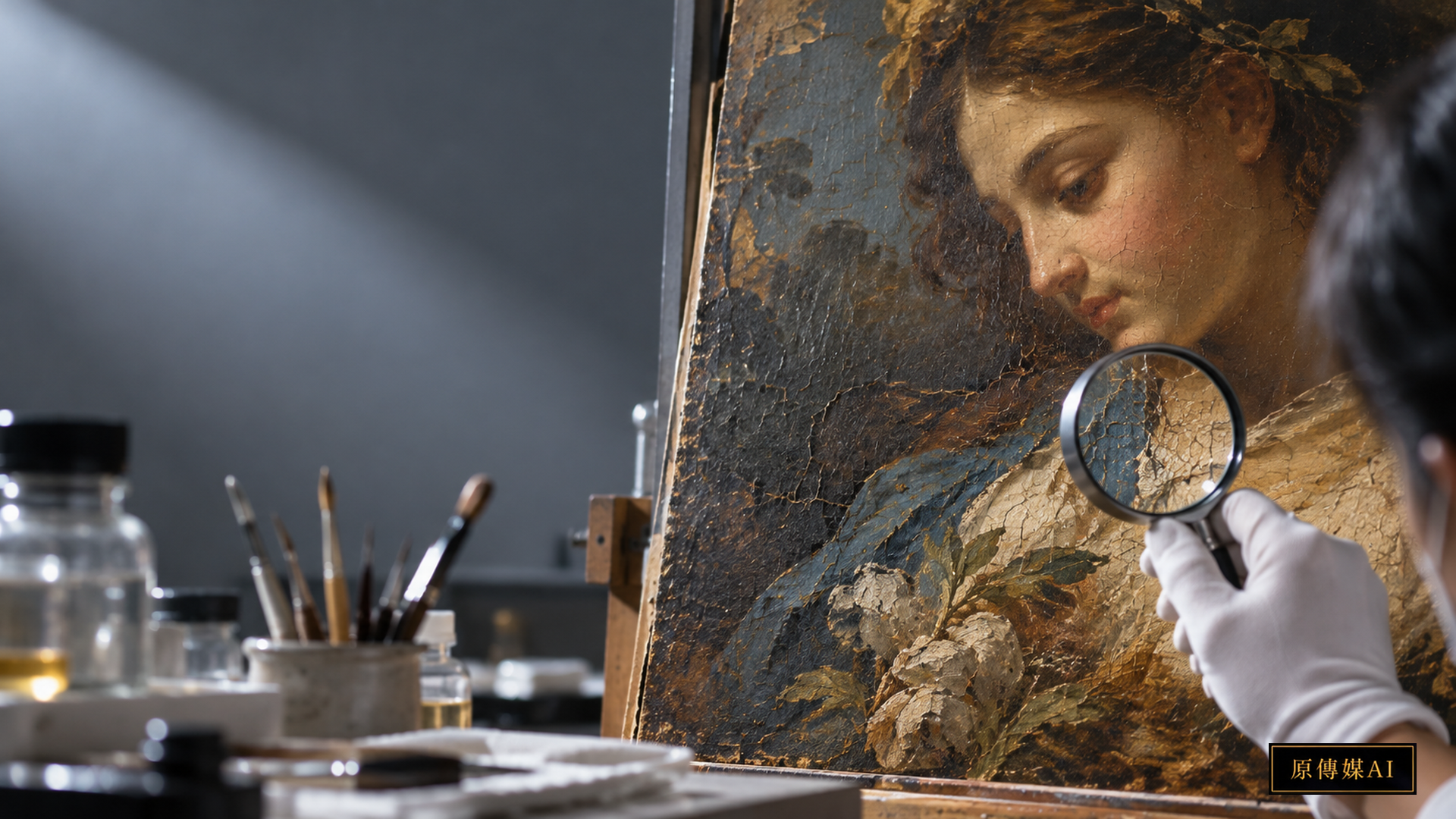
# AI Can Identify a Suspicious Detail, but Cannot Sign a Museum's Attribution: Explainable Models in Art Research
Why an Algorithm Cannot Settle a Painting's Authorship in One Sentence
A museum label naming a great master may stand at the end of decades, or even centuries, of debate. A painting might involve the artist, pupils, assistants, or other workshop members. Later owners and restorers may have cut it down, overpainted it, cleaned it, or reframed it. Resemblance to an artist's style therefore provides only part of the evidence. A 2026 study in the Proceedings of the National Academy of Sciences explores how artificial intelligence can contribute to this continuing investigation. Its contribution is a set of statistical clues that specialists can question and examine, rather than a replacement for curatorial judgment.
According to the Carnegie Mellon research team's account, researchers assembled more than 1,300 high-resolution painting images, including 311 images attributed to Rembrandt. The model examines visible features such as color, edges, lighting, and brushwork. The reported accuracy of 95.8 percent applies when the system is highly confident under the study's classification conditions. It does not promise equivalent performance on any painting submitted for analysis. Nor does it mean that a museum has established a 95.8 percent probability that a particular disputed work is authentic.
Attribution Brings Several Forms of Evidence Together
Traditional attribution considers provenance, collection records, dates, workshop organization, and style. Conservation research and scientific examination can reveal underlying compositions, pigments, canvas or panel construction, later retouching, and damage. These sources may agree or conflict. If a painting was extensively overpainted in the nineteenth century, the colors and marks photographed today may not represent only the original artist's surface.
AI can find statistical patterns across more images than a person can systematically compare. It nevertheless depends on the material supplied to it. Lighting, resolution, conservation history, and image provenance can introduce signals unrelated to authorship. This makes image quality, the choice of comparison artists, confidence calibration, and the interpretation of influential image regions essential research questions. A high accuracy figure alone cannot resolve them.
The Model Detects Patterns, Not Historical Truth
Explainable methods can indicate which parts of an image most influence a classification. Such maps may direct specialists toward a shadow, a hand, a fabric detail, or a passage of brushwork worth examining again. An influential region is an explanation of the model's computation. It is not direct evidence that the master painted that region, and it cannot replace physical analysis of pigments or supports. If an influential region coincides with later restoration, the appropriate response may be further conservation research.
High-confidence accuracy also requires a clear denominator. Which test images met the confidence threshold? How were uncertain cases handled? Does performance hold on works outside the development data? Showing only the cases on which a model feels most certain cannot establish equal reliability across all paintings. Public reporting should place these conditions beside the number, rather than turn a classification score into a certificate of authenticity.
A National Gallery Case Shows How Attributions Change
The National Gallery of Art's research on The Descent from the Cross documents a work once considered a Rembrandt and subsequently reassessed. Historical records, X-radiography, canvas evidence, and conservation history reveal extensive alterations. Parts of the surface previously used in stylistic judgments had been affected by later treatment. This historical case does not demonstrate that the new AI model has authenticated this painting. It illustrates why attribution combines several kinds of evidence and remains open to revision when new material findings emerge.
Collectors and visitors also need to distinguish labels such as a work by an artist, a workshop production, a follower's painting, a copy, and a disputed attribution. These terms carry different professional meanings. A headline announcing that AI has exposed a fake can flatten a complex historical investigation into a binary verdict. More useful reporting explains the questions the model raises and how specialists decide which questions warrant further examination.
Designing Collaboration Between People and Models
A responsible museum process could begin with a curator's research question. Conservators would document image quality and the object's condition; the technical team would explain the data and model limitations; specialists would then examine the regions highlighted by the system. Conflicting evidence should be recorded and investigated. Neither a model's vote nor a person's authority should automatically erase another line of evidence. A traceable record would identify the model version, images, confidence threshold, and the person responsible for the eventual judgment.
Museums must also establish rights and access conditions for high-resolution images. Access to a set of digital photographs does not by itself authorize unrestricted redistribution or every form of commercial model training. For collections subject to cultural restrictions, these questions may be more consequential than recognizing a maker. AI tools should help institutions respect the applicable boundaries.
Lessons for Cultural Institutions in Taiwan
Museums, local history institutions, and Indigenous cultural collections in Taiwan also investigate provenance, creators, conservation histories, and image reuse. Explainable models may initially be most useful for organizing information and supporting research. A system might help locate photographs of the same object taken at different times, identify details for human comparison, or surface contradictions in records. Decisions involving cultural rights, interpretation, or public access must continue through the institution's established governance arrangements.
Indigenous cultural objects cannot simply be treated as another instance of Western oil-painting attribution. Their significance may depend on relationships, ceremonial authority, location, and use, as well as maker and date. Recognizing a pattern accurately does not grant permission to explain or publish it. An approach informed by Two-Eyed Seeing would allow technology to contribute verifiable information while cultural knowledge holders retain authority over boundaries and interpretation.
Better Explanations Increase the Need for Human Responsibility
Explainability does not automatically turn an answer into truth. It helps people ask why a model reached a conclusion and under what conditions it may fail. A highlighted detail may justify an examination. Material findings may then contradict the model's suggestion, in which case the interpretation should change. Mature collaboration accommodates different evidence and uncertainty instead of relying on an impressive confidence percentage.
The study is best understood as a way to help art historians identify questions within large image collections. It cannot assume the museum's combined historical, material, legal, and scholarly responsibilities. Valuable cultural technology makes judgments more transparent and more open to discussion and revision as evidence develops.
Returning the 95.8 Percent Figure to Its Research Conditions
Science reporting often retains a study's highest figure while dropping its conditions. Here, high-confidence performance arose from the team's assembled, cleaned, and evaluated image data and classification setting. Results depend on which works were labeled as Rembrandt, which stylistically similar artists supplied comparisons, how development and test material were separated, and how confidence thresholds were set. Success on a particular evaluation set does not establish general competence across every historical period, material, or conservation condition.
Institutional adoption would also require external validation. An appropriate evaluation could involve institutions outside model development, varied photographic conditions, works with documented restoration histories, and cases whose disputed attribution remains explicitly unresolved. Where scholarship has no single accepted answer, forcing a binary label merely to calculate accuracy would misrepresent the problem. A system should be allowed to indicate insufficient evidence and identify useful additional examinations.
Helping Visitors Understand How Attributions Are Formed
A museum exhibiting AI research can place the computational result inside a fuller account of evidence. It could begin with collection history, then show underlying changes identified by conservators, stylistic comparisons made by art historians, and regions suggested for examination by the model. Visitors would see why the same object can attract different judgments and how new findings change a label. This offers more public educational value than displaying an unqualified statement that AI has authenticated the work.
When errors arise, institutions should explain whether they involve biased data, image quality, algorithmic limitations, or a research assumption. Quietly changing a conclusion misses an opportunity to make the reasoning accountable. Museums preserve public trust in knowledge as well as objects. As AI enters exhibitions, collections, and research, transparent correction procedures should accompany the tool, making its role as research assistance clear.
The account of the new research here relies on its published abstract and the research institution's announcement. The National Gallery material provides a separate historical case. These sources answer different questions and cannot substitute for one another. Model classification performance, material findings about an individual painting, and a museum's formal label carry distinct evidential conditions and responsibilities; they should not be presented as a single completed authentication.
A separate National Gallery study of the structural conservation of Man with a Sheet of Music reviews successive interventions and their later effects. It reinforces the need to trace the history of an object's condition. Like the attribution case above, this conservation research provides context for material evidence; it is not a validation result for the new AI model.
Sources
Role-Driven Inquiry
Yuan Media AI | Guided Questions by Role
Select a role first, then review the complete questions from that perspective; clicking a question will display Yuan Media AI’s response in real time.
Select a role
Curators
Examine the article's evidence, governance boundaries, data rights, and actionable steps from the perspective of a Curators.
Choose a question
AI use and content-safety disclosure
This article was assisted by AI in organizing public research and institutional data; research results, limitations, and editorial analysis are explained separately. The cover is an AI-generated conceptual image.