Models Can Talk While Substations Gasp: The Invisible Infrastructure Crisis Behind the AI Boom
Original Chinese title: 模型會說話,變電站在喘氣:AI熱潮背後的隱形基礎設施危機
Discussions of generative AI tend to focus on model capabilities, corporate competition, and product innovation. But what truly determines whether the AI industry can continue to expand is not algorithms but power, cooling systems, land, and capital. AI is not just a software revolution; it is a hardware and infrastructure revolution.
Yuan Media AI Editorial Desk
Models Can Talk While Substations Gasp: The Invisible Infrastructure Crisis Behind the AI Boom
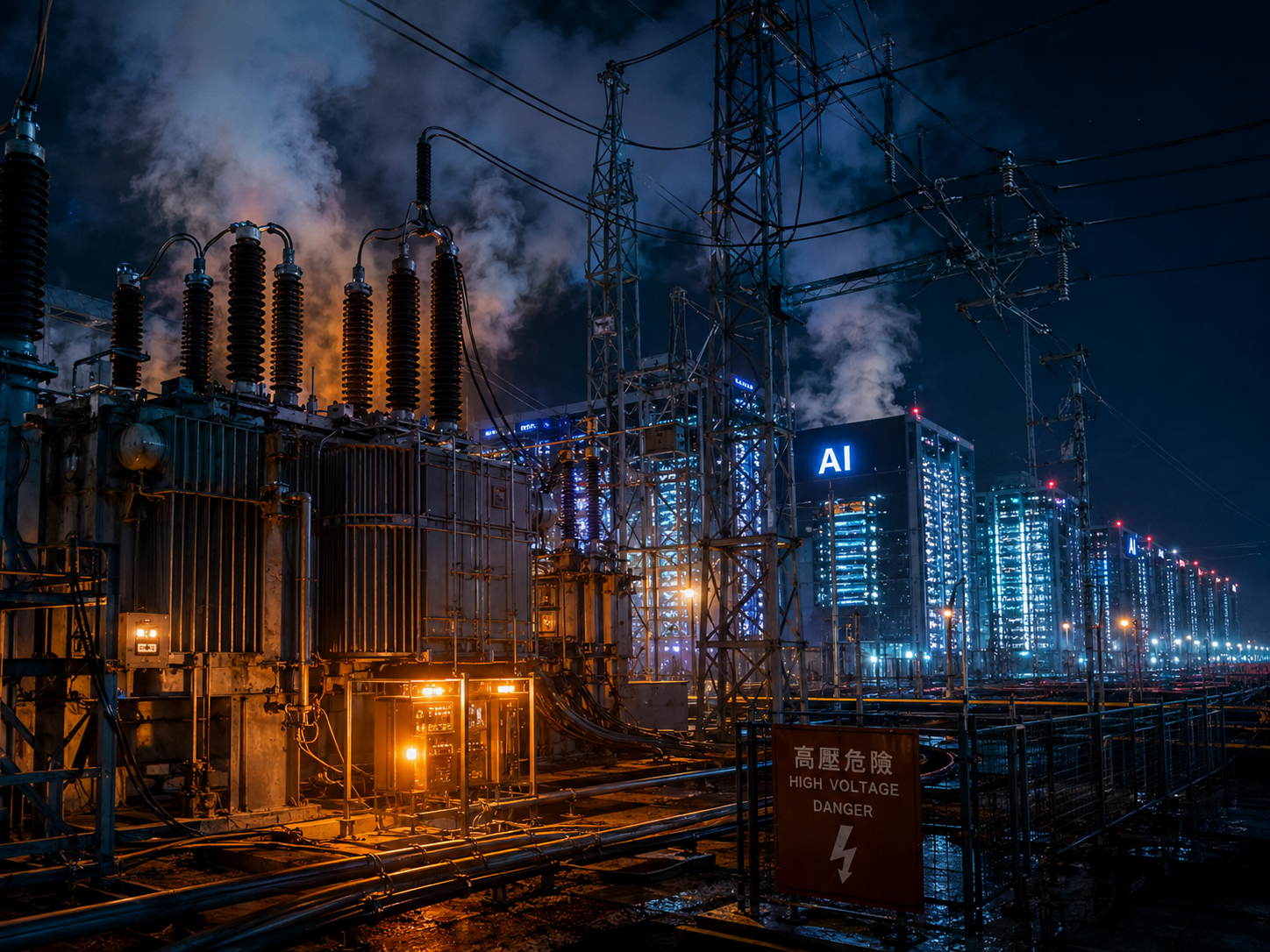
If we compare the current AI industry to a gold rush, model companies are the miners, chip firms are the shovel sellers, and those who truly collect steady fees may well be the people selling electricity.
Over the past two decades, the tech industry has very successfully packaged data centers as "the cloud." That word is so beautiful it makes us forget that the cloud actually has an address, land, substations, cooling towers, and a power bill that never quite looks romantic.
When someone types a prompt and sees a model spit out elegant text, they see language magic. What remains unseen are rows of GPUs heating up in distant server rooms, the cooling systems running day and night, and local grids quietly taking a deep breath during peak demand.
AI is not an oracle floating in the sky. It is a modern industry that consumes enormous amounts of electricity, capital, and supply chains.
From Model Competition to Compute Arms Race
Competition among large models has moved beyond whose algorithms are smarter or whose slide decks draw better curves. The new competition is about who can secure more GPUs, stable power, larger data centers, and the ability to keep cooling, networking, security, and capital costs low enough to continue scaling.
This shift brings AI industry logic closer to traditional heavy industry. Steel mills need blast furnaces; AI factories need chips and grids. Oil refineries need pipelines; model companies need data pipelines. People once thought AI was a pure software revolution, but now we see it is actually a hardware revolution wrapped in software language.
Who Bears the Public Costs of AI?
One of tech industry's most skilled words is "innovation." But innovation does not mean costs disappear. Often, the cost of innovation simply shifts onto those less likely to take the stage and speak.
Large data centers require land, power supply, water, cooling, roads, transmission and distribution systems, and security facilities. All these needs intersect with public resources. The question is not whether companies should develop AI, but whether public discourse is sufficient: when local communities bear energy and land pressures, do they receive corresponding benefits? Who bears the cost of grid expansion? How are water demands assessed? Are the taxes, jobs, and environmental costs brought by data centers honestly disclosed?
If these questions are not placed at the level of public policy, AI becomes a high-end version of "develop first, remediate later." Only this time the slogan is prettier and the slides glow brighter.
Local Communities Cannot Be Mere Backdrops
For Indigenous Peoples and local communities, energy, water resources, and land planning have never been abstract issues. Many large infrastructure developments worldwide have entered local lives under banners of "national development," "industry needs," or "public interest." AI data centers may not be built directly beside a community, but the energy allocation, land development, and grid construction they trigger can still indirectly affect local life.
Therefore, AI governance must discuss not only copyright, privacy, and misinformation, but also infrastructure justice. Whose land is planned? Whose rivers are diverted? Whose electricity costs are shifted onto others? Whose living environments become backdrops for industrial upgrading?
Black Humor Moment
AI is often promoted as a tool to improve efficiency. Yet sometimes people consume vast amounts of energy asking AI: "How can I save energy?" The model answers seriously, while data centers continue to draw power on the other end.
This does not mean AI is necessarily hypocritical; it serves as a reminder that efficiency does not equal sustainability. Faster generation, cheaper inference, smoother chat do not automatically represent better society. If a system generates more content, more interaction, and more automated tasks for humans, total energy consumption may also rise.
AI Needs Energy Transparency
Future discussions of AI governance must include not only model transparency but also energy transparency. Responsible AI systems should explain data sources, model limitations, and safety risks, as well as power use, carbon emissions, water resources, and local impacts.
Model cards are gradually becoming basic documents in AI ethics discourse. The next step may require energy cards, data center impact statements, and mechanisms for community feedback. Do not just tell society how smart a model is; also tell it how much electricity it consumes, how much water it uses, and which public resources it occupies.
This is not anti-AI; it demands AI keep its accounts complete.
Conclusion
The future of AI exists not only in code but also in power grids, land, rivers, chip supply chains, and public policy.
As models become more articulate, we need to ask the less pretty questions: Who supplies power? Who lacks water? Who benefits? Who bears risk? Who has the right to decide local futures?
If we only worship model capabilities while ignoring the real conditions that support them, we may end up creating a very smart system serving an increasingly clueless society.
AI use and content-safety disclosure
This article was generated as a draft by Yuan Media AI Daily Article Factory, then published after manual editorial verification by Aciang Iku-Silan; data on energy, industry, and public policy should continue to be corrected against the latest publicly available information.