AI chips may waste more on moving data than computing it: 7,378 photonic neurons put memory in the light path
Original Chinese title: AI 晶片最浪費的也許不是「算」,而是一直搬資料:7,378 個光子神經元開始把記憶直接放進光裡
FLARE integrates 7,378 photonic memory neurons on one chip to explore sensing, state retention and computing in one physical layer, while leaving system-scale reliability and energy questions open.
鄭淑禎
鄭淑禎 is an assistant professor at Shih Chien University who focuses on industrial transformation, agricultural value chains, local economies and technology applications.
The costly part is moving information
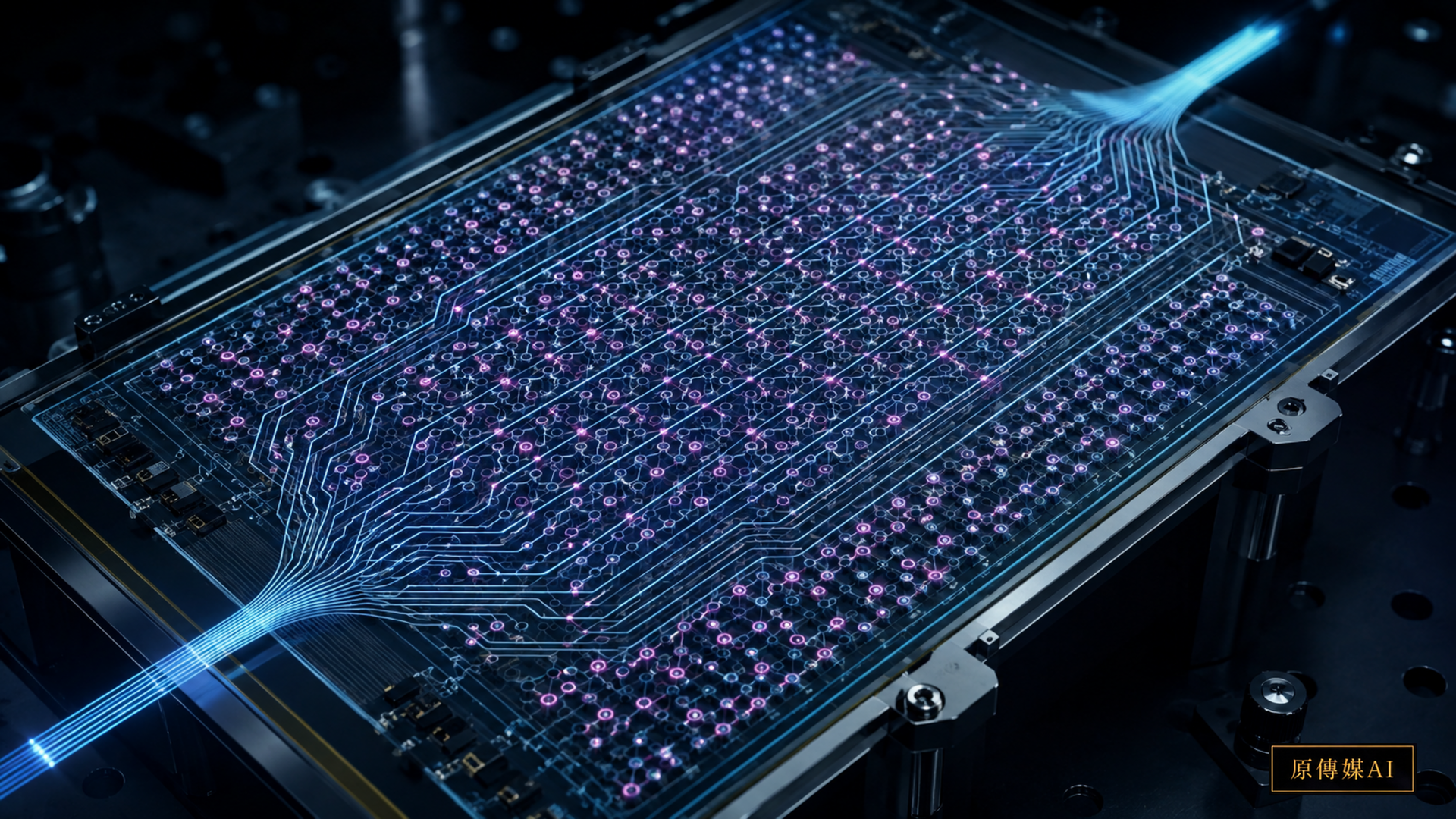
Conventional systems separate processors from memory, so every inference moves weights, intermediate state and sensor data. As models grow, the time and energy of movement can become as difficult as arithmetic itself. FLARE’s point is not simply to replace electrons with light. It explores whether memory and computation can remain in the same photonic neuron structure.
What 7,378 neurons means
The reported system integrates 7,378 photonic memory neurons on one chip and seeks to hold long-lived states on the scale of seconds alongside short dynamics at gigahertz rates. That combination can make a device more than an instantaneous matrix operator. The count is important, but it cannot be equated directly with biological neurons or general AI capability.
Keeping memory in the optical device
Optical components can represent information through phase, intensity and material state. If a state persists in the component, a new input can interact with it without reading and writing an external memory. The potential value is a shorter data path. The new obligations include drift, noise, fabrication variation and readout calibration.
What the drone demonstration does and does not show
A ten-core system was demonstrated for racing-drone visual navigation, indicating an architecture that can process continuous sensing and fast decisions rather than only classify a static dataset. It remains a research-system demonstration. It is not evidence of mass production, all-weather flight or safety certification, and it should not be described as a replacement for GPUs.
How to read 61.87 aJ per operation
An extremely low operation-energy figure can show device potential, but a complete system also contains lasers, modulators, drivers, analogue-to-digital conversion, cooling and control. Fair comparison requires the measurement boundary, precision and task to be stated. A chip-internal operation is not automatically comparable with whole-system power.
Packaging may become the next bottleneck
If data movement is reduced, constraints may move to light-source efficiency, coupling loss, temperature stability, package density and calibration. Photonic devices can be sensitive to process and environmental change. Whether a large array remains consistent will decide whether a paper result can become a product. Competition therefore includes optical, electrical, material and software integration.
A changing industrial value chain
If photonic in-memory computing matures, wafer fabrication, optical packaging, control ICs, compiler work and sensing companies could take different roles. Local industry does not have to pursue only the most advanced process node; it may build capacity in testing, packaging, calibration equipment or vertical applications. Investment should distinguish a research result, an engineering prototype and a commercial supply chain.
The boundary is being redrawn, not simply light replacing electricity
FLARE asks whether sensing, memory and inference must be performed in three separate places. Keeping state in a photonic component could help an AI system respond to a continuous world with lower latency, but reliability, scaling and complete energy use still require evidence. It is an experimental route for redesigning data flow, not a declaration that existing accelerators have ended.
Metrics have to return to a system boundary
When reading an energy number for photonic computing, ask what it includes: an internal operation, laser input, modulation, readout, control electronics, data conversion, packaging cooling or calibration. Precision, throughput and workload also matter. Reliability must be measured over time because temperature, process variation, ageing and noise can add calibration and redundancy costs that change the useful latency and energy of a deployed system.
Aligning industrial investment with verifiable work
Photonic hardware is not a single race to an advanced chip. Optical packaging, coupling tests, thermal management, calibration software, design tools and focused sensing applications are all capability nodes. Better decisions start with a target workload and end-to-end limits for latency, power, precision, reliability and cost. Transparent benchmarks and reports on exclusions and failed cases make the technology easier to procure, maintain and scrutinise.
Turning uncertainty into information for the next decision
A new technology, environmental observation or engineering design should not be judged only by its most successful demonstration. A useful record also preserves its operating conditions, measurement method, unexplained observations and results that did not meet expectations. This does not weaken a conclusion. It tells readers what can guide a present decision and what still needs other evidence.
The next step can be a small set of directly relevant indicators that can be checked over time. In addition to whether one performance metric improves, the record should ask whether it remains stable across conditions, whether it shifts cost or risk to someone else, and who can pause or change the work when results depart from expectations. Those questions turn innovation into work that can be maintained and held accountable.
Public communication should distinguish what is known from what remains unknown. Readers need to know whether evidence comes from a study, a demonstration or an observation, but they should not be asked to accept guarantees beyond that evidence. Stating a limitation does not erase potential value; it gives later evidence a clear route to improve the judgment.
These records do not require a large programme. Even a small trial can specify the minimum context, decision responsibility, response time and stopping condition, while retaining adverse results until the next review. Participants should know what they may see, how they can correct it and when they may refuse later use. Shared review makes the reasons, responsibilities and room for revision visible rather than allowing short-term results to hide longer-term risk.
Sources
AI use and content-safety disclosure
This English edition is a local AI-assisted translation of the Chinese article. It preserves source links and distinguishes reported evidence from broader interpretation or possible application.