A forest is not a weather station, yet flowering trees can tell Ogiek families that rain is near
Original Chinese title: 森林不是氣象站,但樹開花時族人知道雨要來:Ogiek 如何把種子、鳥況與森林變成一套活的氣候觀測系統?
Ogiek communities around Mount Elgon connect seeds, flowering, animals, water and forest change into an observation network that can guide action while respecting knowledge rights.
Two-Eyed Seeing Lab
Co-authors: ["劉展瑞"]
雙向知識實驗室 works on Indigenous knowledge, data sovereignty, cultural governance and AI applications; co-author 劉展瑞 focuses on disability rights, accessible public services, Indigenous social participation and digital inclusion.
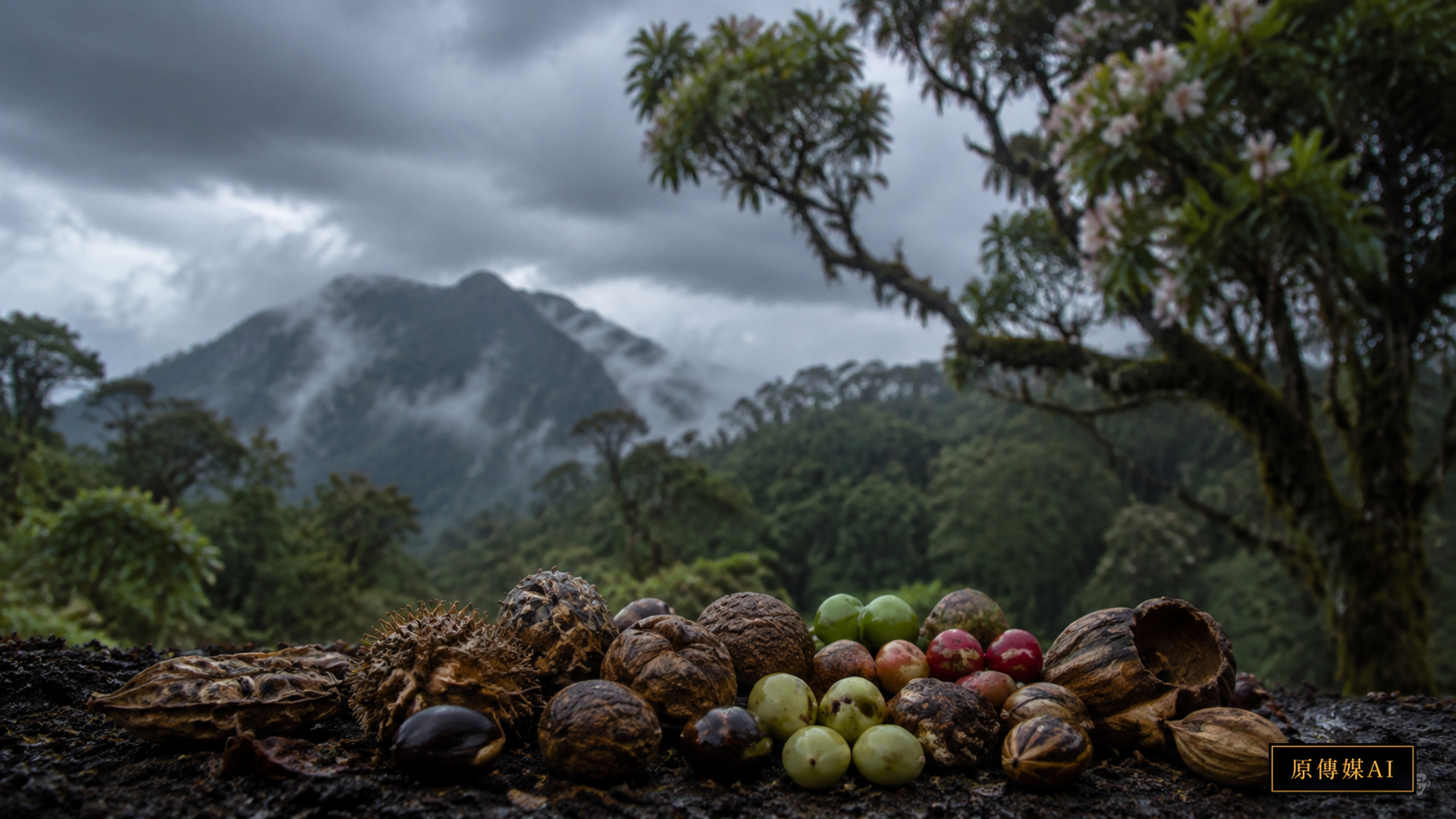
When the forest speaks, data are not a single number
Weather stations turn rainfall, temperature and wind into continuous series. Ogiek communities living around Mount Elgon read the environment through the timing of flowering, seed maturity, animal movement, water change and wild foods. This is not a romantic substitute for science. It is a long-practised way of observing conditions that is connected to gathering and cultivation decisions. Its scale can be as specific as one slope, spring or seed type, which can reveal variation that large grids average away.
Seeds are memory and risk management
Maintaining diverse seeds is not simply a matter of displaying varieties. Differences in maturity, drought tolerance, taste and soil fit help households spread risk when seasons become irregular. Seed exchange also carries planting timing, storage practice, land experience and kin responsibilities. If seeds are merely numbered in a database while being separated from their holders, use conditions and duties of return, digitisation can erase the knowledge that matters most.
Flowering is not a universal formula
The observation that a particular tree flowers before rain cannot be compressed into a permanently true rule. Local judgments commonly combine an early or late bloom with cloud direction, soil moisture, bird calls and changes over preceding weeks. These can be treated as phenological indicators, but validation should retain place, year and uncertainty rather than selecting only successes. That is how a community can learn when an indicator is reliable and when climate change has altered it.
How two observation systems can work both ways
Satellite products and models can compare regions and offer forecasts several days ahead, while local observation provides fine-grained context and actions that can be taken immediately. A genuine Two-Eyed Seeing arrangement does not treat community statements as free labels for a model, nor does it reject instruments. Communities decide which phenomena may be recorded and who interprets them; researchers return rain-gauge or remote-sensing results for collective review. Disagreement can itself reveal a mismatch of scale or a changing relationship.
A cross-border mountain needs cross-institutional work
Mount Elgon spans Kenya and Uganda, while water, seeds, wildlife and markets do not stop at an administrative line. Agroecological work that lasts only as long as one project can break when funding ends. Long-term governance needs community organisations, protected areas, agricultural agencies and research institutions to design observation, seed stewardship and benefit sharing together. Knowledge holders should be decision-makers, not merely interview subjects.
Rights must be answered before a digital platform
Before oral accounts, images, locations or species names are placed in an AI system or map, participants need access levels, withdrawal routes, use limits and benefit return. Sensitive places do not need public coordinates, and some knowledge may remain inside the community. A record should also retain who spoke, when, in which season and under what conditions it applied, so that a conditional observation is not converted into an unsupported universal claim.
From indicators to actionable warning
Observation has value when it changes action: choosing a planting date, changing seed, moving livestock, protecting a spring or preparing food earlier. A practical design lets a community select a small number of key indicators, pair them with low-cost rain gauges and public forecasts, and review false alarms and missed signals each season. The aim is not a louder alert. It is information that can be understood, trusted and linked to resources.
A forest is not a weather station, but it can complement one
A mature system does not force scientific data and local knowledge into one format. Scientific data retain comparability; local knowledge retains relationships, language and responsibility. They meet in shared decisions. In a rapidly changing climate, any single source can fail. Treating Ogiek living knowledge as a foundation for governance rather than a cultural appendix can strengthen resolution, trust and adaptive capacity.
Making observation reviewable rather than extractable
For forest observation to remain useful, each entry should retain time, an appropriately coarse location, an agreed form of attribution, seasonal context and the decision it is meant to support. Missed expectations should remain in the record as well as successful ones. Communities can use different access levels for rare species, family knowledge and sensitive places, and researchers should state purpose, retention, reuse limits and how results return before using the material.
Seasonal review instead of one-off validation
The purpose of combining local observation with rainfall, remote sensing or forecasts is not to declare one system correct. A seasonal review can compare a small set of community-selected indicators with available weather data, identify helpful and unhelpful judgments, and decide what needs revision. Success should include timely and understandable information, practical choices for households, fair distribution of benefit and continuing control by knowledge holders.
Turning uncertainty into information for the next decision
A new technology, environmental observation or engineering design should not be judged only by its most successful demonstration. A useful record also preserves its operating conditions, measurement method, unexplained observations and results that did not meet expectations. This does not weaken a conclusion. It tells readers what can guide a present decision and what still needs other evidence.
The next step can be a small set of directly relevant indicators that can be checked over time. In addition to whether one performance metric improves, the record should ask whether it remains stable across conditions, whether it shifts cost or risk to someone else, and who can pause or change the work when results depart from expectations. Those questions turn innovation into work that can be maintained and held accountable.
Public communication should distinguish what is known from what remains unknown. Readers need to know whether evidence comes from a study, a demonstration or an observation, but they should not be asked to accept guarantees beyond that evidence. Stating a limitation does not erase potential value; it gives later evidence a clear route to improve the judgment.
These records do not require a large programme. Even a small trial can specify the minimum context, decision responsibility, response time and stopping condition, while retaining adverse results until the next review. Participants should know what they may see, how they can correct it and when they may refuse later use. Shared review makes the reasons, responsibilities and room for revision visible rather than allowing short-term results to hide longer-term risk.
Sources
AI use and content-safety disclosure
This English edition is a local AI-assisted translation of the Chinese article. It preserves source links and distinguishes reported evidence from broader interpretation or possible application.