Why humpback flippers have a row of bumps, and why engineers care more about stall resistance than speed
Original Chinese title: 鯨魚胸鰭為什麼長了一排「凸點」?工程師把它搬到航空發動機葉片,結果最重要的可能不是更快,而是更不容易失速
The leading-edge tubercles of humpback flippers inspire blade research, but useful biomimicry requires staged evidence about flow, scale, structural reliability and operating conditions.
山海資料庫
Co-authors: ["馬耀"]
馬耀 is a Malan Amis coastal community and fisheries culture worker writing for Yuan Media AI’s ecology, ocean and environmental data column; co-author 馬耀 has long focused on coastal communities, fisheries culture and local sea knowledge.
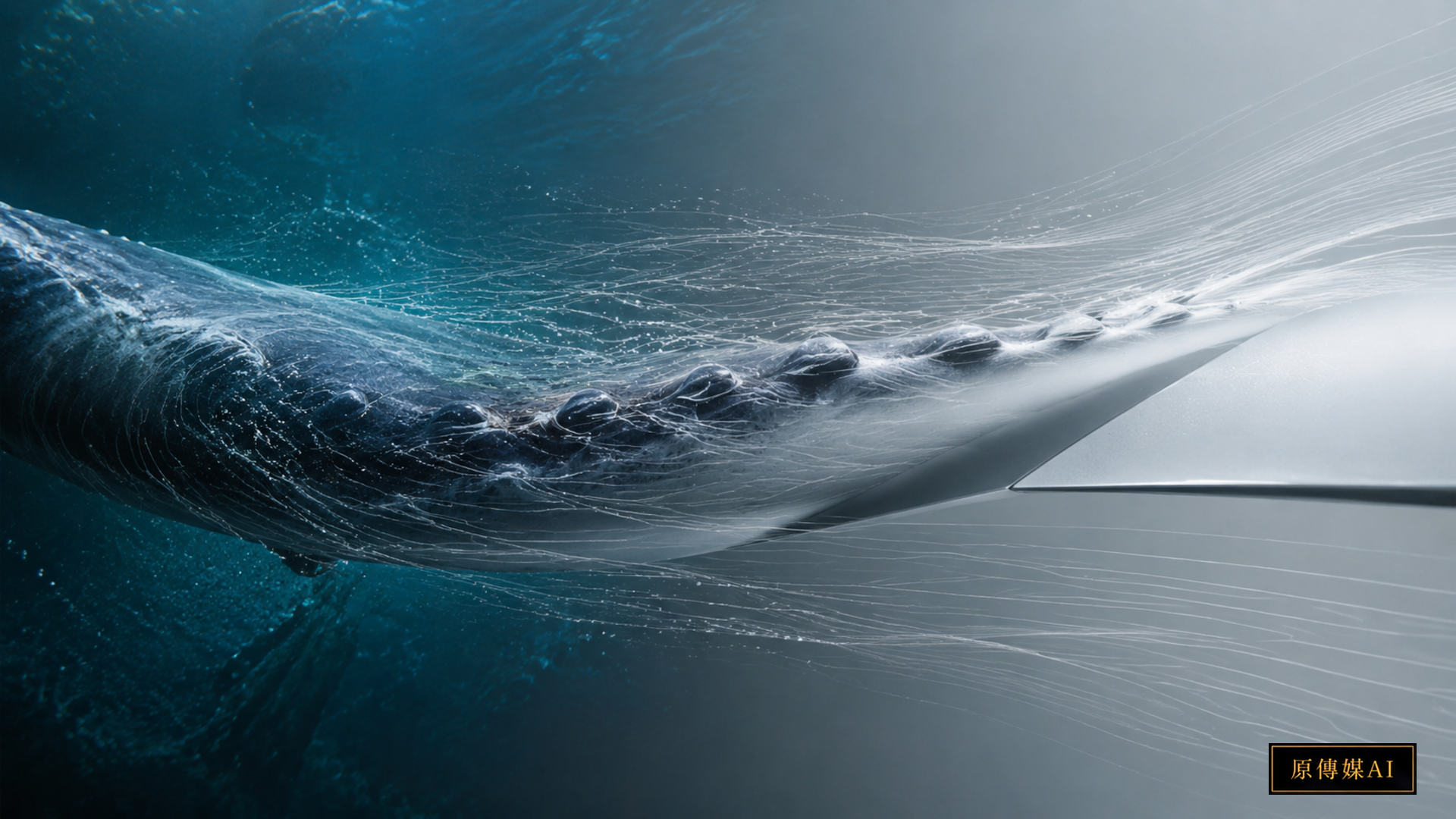
A row of bumps is not decoration
The regularly spaced tubercles on a humpback whale’s flipper have long attracted biological fluid-dynamics research. They may divide incoming flow into regions, create vortices and change separation so the flipper retains control at larger angles of attack. The engineering question is not what machine a whale resembles. It is under which conditions the structure changes stall behaviour.
New work brings the question to a blade
A 2026 study modified a fan blade in an aviation or turbine-power simulation with humpback-inspired tubercles. Its numerical fluid-structure results reported improvements in flow rate, pressure ratio and efficiency. That is engineering evidence worth examining, but it remains design and simulation validation. The authors also identify structural optimisation and reliability testing as future work, so it is not proof that commercial engines can now use the blade.
Why stall may be delayed
A smooth leading edge can develop broad separation at high angle of attack. Streamwise vortices associated with tubercles may bring higher-momentum flow toward the near-wall region and divide a large separation into smaller zones. The outcome depends on tubercle height, spacing, airfoil and flow speed. Some conditions may improve control while others add drag; biomimicry is not a shape that works automatically everywhere.
Water and air cannot be treated as identical
A whale swims in water while an engine blade rotates in fast air. Density, viscosity, Reynolds number, Mach number and boundary conditions differ. Geometric similarity does not guarantee dynamic similarity. Engineering translation needs non-dimensional analysis, scale testing and wind-tunnel or rotating-rig evidence rather than copying a flipper outline onto metal.
The actual chain of knowledge transfer
A credible sequence is morphological observation, a flow hypothesis, a controllable airfoil, numerical simulation, wind-tunnel measurement, structural analysis, then fatigue, noise, manufacturing and certification. Any stage can overturn an earlier intuition. Nature supplies a question and a possible mechanism; engineering has to establish repeatable, manufacturable and accountable evidence.
Coastal knowledge keeps observation from stopping at shape
People who live with the sea observe how animals use their bodies with waves, currents, seasons and behaviour rather than collecting an attractive form alone. Such contextual observation can remind researchers that a flipper works with a whole body, speed, turning and environment. Local sea knowledge can help formulate questions, but its source, context and holders must remain visible when any part enters a research record.
Reliability is as important as efficiency
A blade experiences fast rotation, vibration, temperature and cyclic fatigue. Tubercles can also add stress concentration or manufacturing difficulty. Reporting aerodynamic efficiency alone cannot establish whole-system value without lifetime, maintenance and noise. The more important breakthrough may be stable control near stall and a lower control burden rather than a higher peak speed.
Biomimicry teaches conditions, not a shortcut
A humpback whale did not invent an aviation engine. It offers a counterintuitive prompt: a non-smooth leading edge may be more stable in particular flows. Mature biomimicry respects biological context and accepts strict engineering limits. When form, flow, materials and responsibility are connected in one evidence chain, an aesthetic inspiration can become a credible technology.
Separating flow mechanisms from product claims
The jump from a shape that changes flow to a product that is necessarily more efficient ignores scale, speed, airfoil, disturbance, material thickness and operating range. Reports should state the baseline, the metric, the trade-off and whether evidence comes from simulation, a wind tunnel, a rotating rig or a real machine. The leading edge is also a manufactured and loaded surface, so tolerances, erosion, fouling and fatigue can change the result.
Putting natural observation into a responsible research relationship
Coastal communities can raise questions about how an animal uses a body in waves, current and seasonal conditions that a laboratory may not pose first. Collaboration must retain the questioner, context and sharing boundary rather than extracting a form. For a blade, useful long-term indicators include control margin near stall, fatigue life, noise, maintenance frequency, manufacturing consistency and failure modes, not efficiency peak alone.
Turning uncertainty into information for the next decision
A new technology, environmental observation or engineering design should not be judged only by its most successful demonstration. A useful record also preserves its operating conditions, measurement method, unexplained observations and results that did not meet expectations. This does not weaken a conclusion. It tells readers what can guide a present decision and what still needs other evidence.
The next step can be a small set of directly relevant indicators that can be checked over time. In addition to whether one performance metric improves, the record should ask whether it remains stable across conditions, whether it shifts cost or risk to someone else, and who can pause or change the work when results depart from expectations. Those questions turn innovation into work that can be maintained and held accountable.
Public communication should distinguish what is known from what remains unknown. Readers need to know whether evidence comes from a study, a demonstration or an observation, but they should not be asked to accept guarantees beyond that evidence. Stating a limitation does not erase potential value; it gives later evidence a clear route to improve the judgment.
These records do not require a large programme. Even a small trial can specify the minimum context, decision responsibility, response time and stopping condition, while retaining adverse results until the next review. Participants should know what they may see, how they can correct it and when they may refuse later use. Shared review makes the reasons, responsibilities and room for revision visible rather than allowing short-term results to hide longer-term risk.
Sources
AI use and content-safety disclosure
This English edition is a local AI-assisted translation of the Chinese article. It preserves source links and distinguishes reported evidence from broader interpretation or possible application.