Why ESA chased a burning satellite with an aircraft to record Samba’s last minute
Original Chinese title: 一架飛機追著一顆正在燒掉的衛星:為什麼 ESA 要把 Samba 的最後一分鐘拍到每一塊碎片?
ESA used its ROSIE aircraft to observe the controlled re-entry of Cluster satellite Samba, creating image, infrared and spectral evidence for re-entry engineering models.
山海資料庫
Co-authors: ["李文驤"]
山海資料庫; co-author 李文驤 is a geography teacher at St. Francis High School.
Why the last minute is worth following
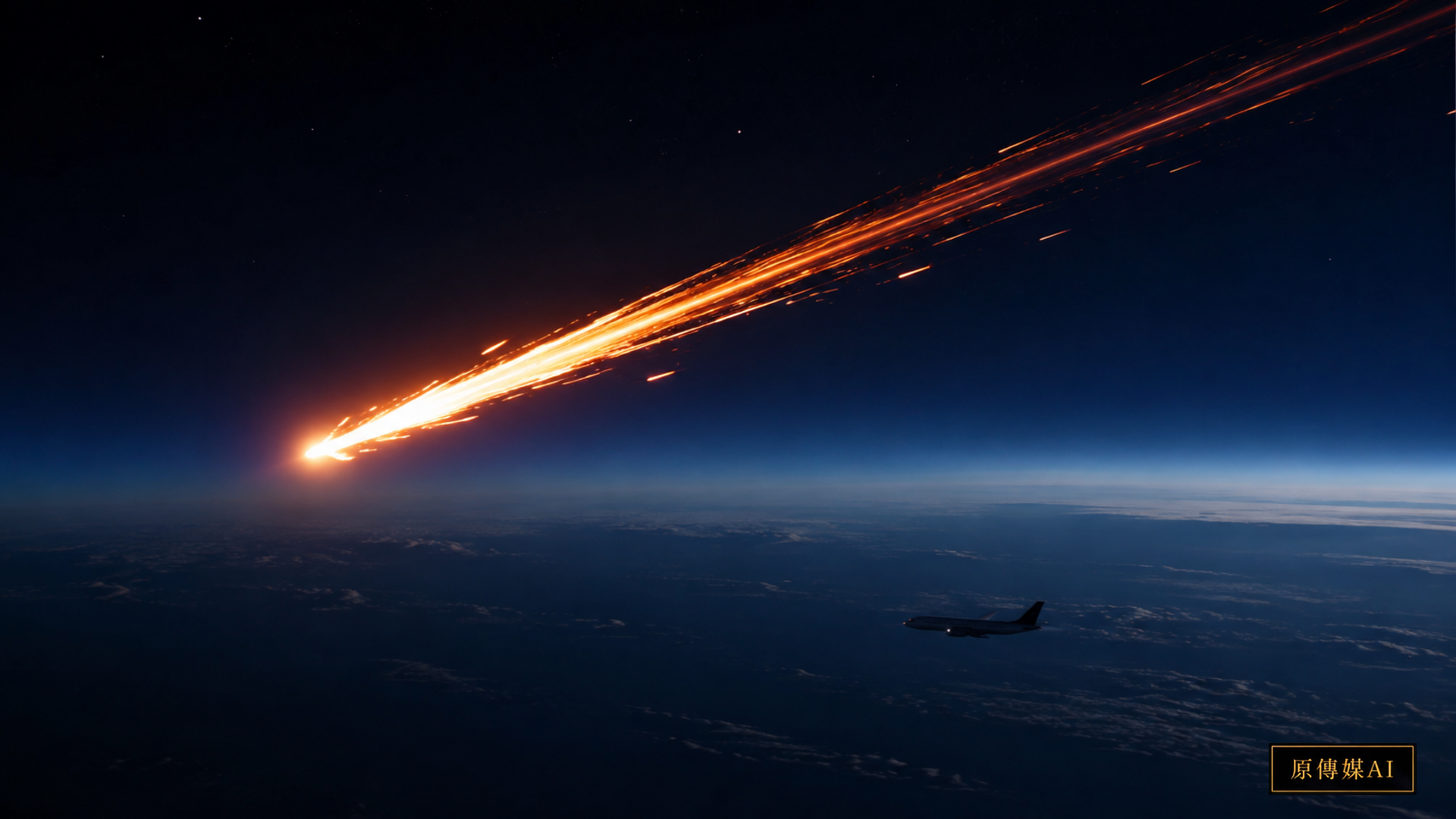
On 31 August 2026 ESA confirmed that Cluster satellite Samba re-entered above the South Pacific. Its ROSIE research aircraft recorded the fire, fragmentation and spectra from a safe distance. The purpose was not a dramatic video. It was to obtain rare evidence about when a spacecraft loses structural integrity, how materials ablate, and where model predictions differ from what occurs.
Second-level predictions require continuous revision
Re-entry time depends on orbital altitude, attitude, solar activity and density in the thin upper atmosphere. Tracking data narrow the time window as re-entry approaches. A prediction expressed in seconds is therefore the product of repeated observation and model updates; it does not mean that every uncontrolled satellite can be given an early, equally precise impact forecast.
What visible, infrared and spectral data each show
Visible imagery describes fragmentation geometry and brightness, infrared data follow hot regions, and spectroscopy can identify glowing materials and reaction products. When these records are aligned with tracking, radar and a spacecraft material inventory, engineers can reconstruct an event sequence. They learn not only that a satellite disappeared, but which components failed first and which materials may not have fully burned up.
Designing a spacecraft to disappear safely
Design for Demise aims to ensure that a future spacecraft ablates as completely as practical at mission end, reducing the chance that fragments reach the ground. Material choices, joints, pressure vessels and layout all matter, so the issue cannot be repaired only at the end of a life cycle. Real observations can calibrate test standards and turn an assumption that something will burn up into a design requirement that can be checked.
Atmospheric cost matters as well as ground safety
As satellite numbers rise, the question is not only whether one fragment reaches the ground. Ablation products from aluminium, titanium, composites and coatings enter the upper atmosphere and may form particles or chemical reactions. Uncertainty remains, so it is not responsible to describe a demonstrated catastrophe, nor to ignore cumulative effects because one event has low risk. Material inventories, re-entry frequency and atmospheric observation must be assessed together.
A two-way correction between model and observation
A model first guides an aircraft to a location and waiting time. The aircraft’s images and spectra then correct the model. That is the useful engineering loop. Images without time synchronisation, calibration and material context have much less value, while simulations without high-quality observations can conceal bias for years. Both parts are needed for evidence that can be independently examined.
Public governance is not only about a low probability
The chance of one satellite harming someone on the ground is low, but public governance also concerns transparency, allocation of responsibility and accumulated effects. Operators should disclose disposal plans, regulators should require traceable end-of-mission design, and international bodies should improve notice and data sharing. Risk communication must avoid both panic and minimisation.
Samba leaves a verifiable death record
A satellite’s final minute connects materials, orbit, weather, remote sensing and public safety into one evidence chain. It reminds the space industry that completing a mission does not end responsibility. A good satellite must work in orbit, but it should also be predictable and observable at the end of life, disappear as safely as possible, and account for environmental cost in the full design.
Building comparable re-entry evidence from one observation
ROSIE becomes especially valuable when imagery, infrared, spectra, tracking and material inventories share a time axis. Each observation should preserve its method, precision, gaps and use limits so later researchers can distinguish a material effect from a viewing or instrument effect. Comparison with prediction can reveal which assumptions are overconfident and which configurations need further testing without claiming that every spacecraft behaves the same way.
Making mission termination part of the responsibility chain
Safe re-entry needs more than a plan written before launch. Operators must track orbit, propulsion, attitude capability, disposal windows and contingencies throughout a mission. Clear decisions, notifications and data-sharing responsibilities matter near retirement. As re-entries become more common, material types, frequency and atmospheric observations should support cumulative assessment rather than treating the removal of an object from orbit as the end of accountability.
Turning uncertainty into information for the next decision
A new technology, environmental observation or engineering design should not be judged only by its most successful demonstration. A useful record also preserves its operating conditions, measurement method, unexplained observations and results that did not meet expectations. This does not weaken a conclusion. It tells readers what can guide a present decision and what still needs other evidence.
The next step can be a small set of directly relevant indicators that can be checked over time. In addition to whether one performance metric improves, the record should ask whether it remains stable across conditions, whether it shifts cost or risk to someone else, and who can pause or change the work when results depart from expectations. Those questions turn innovation into work that can be maintained and held accountable.
Public communication should distinguish what is known from what remains unknown. Readers need to know whether evidence comes from a study, a demonstration or an observation, but they should not be asked to accept guarantees beyond that evidence. Stating a limitation does not erase potential value; it gives later evidence a clear route to improve the judgment.
These records do not require a large programme. Even a small trial can specify the minimum context, decision responsibility, response time and stopping condition, while retaining adverse results until the next review. Participants should know what they may see, how they can correct it and when they may refuse later use. Shared review makes the reasons, responsibilities and room for revision visible rather than allowing short-term results to hide longer-term risk.
Sources
AI use and content-safety disclosure
This English edition is a local AI-assisted translation of the Chinese article. It preserves source links and distinguishes reported evidence from broader interpretation or possible application.