Two-Eyed Seeing AI: One Eye on the Model, One Eye on Why Ancestors Frown
Original Chinese title: 雙眼看AI:一眼看模型,一眼看祖先為什麼皺眉
Two-Eyed Seeing is not about stuffing Indigenous knowledge into AI; it demands that AI admit it only sees half.
Yuan Media AI Editorial Desk
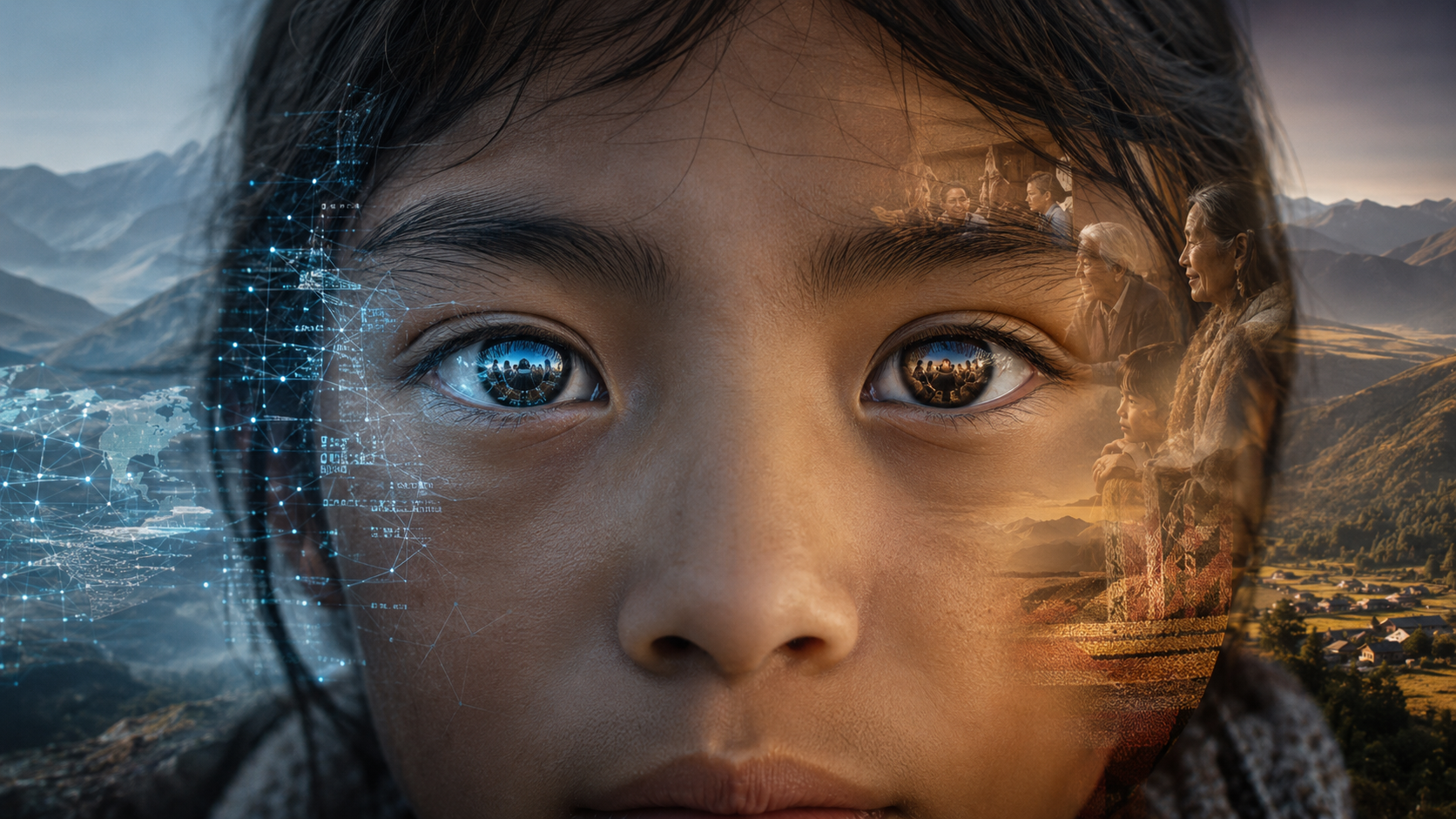
Two-Eyed Seeing is often translated as 'seeing the world with two eyes': one eye sees the power of Indigenous knowledge, the other sees the power of Western science, learning to let both run side by side. But in the AI era, this concept can easily be misused as a pretty multicultural decoration.
True Two-Eyed Seeing for AI is not about feeding Indigenous community stories into models, nor putting a few mountain photos in presentations and adding a few words like 'respect culture' to call it done. It demands that we redesign AI problem settings, governance processes, data rights, and educational methods.
AI's first eye sees efficiency, prediction, and scaling. It can quickly classify, generate at scale, organize corpora, recognize images, transcribe sound, and help medical systems identify risks, giving remote students more learning resources. This eye is charming; it sees speed, automation, 'scale'.
But this eye also has blind spots. AI often doesn't know where data comes from, what silence means, or why people not recorded are missing. Models only see patterns that exist in the data, but struggle to see power outside the data.
In Indigenous contexts, this blind spot is deadly. Colonial governance already produced many incomplete, unequal, biased datasets. If AI directly ingests these, it can repackage historical harm as modern prediction. The black humor: before, administrative systems couldn't see you; now models missee you faster.
AI's second eye should see relationships, responsibilities, and context. It must recognize that knowledge is not just information, health is not just medical records, education is not just grades, language is not just vocabularies, culture is not just generatable image styles.
Two-Eyed Seeing is most easily misunderstood as 'fusion'. As if mixing Indigenous knowledge with Western tech yields a delicious innovation soup. The real difficulty is parallelism, not blending.
Parallelism means both knowledge systems retain their authority. AI models can provide analysis but cannot replace elders' judgment; data science can visualize but cannot erase ethnic classifications and self-identification; edtech can generate materials but cannot rewrite ritual knowledge into cute interactive games.
More importantly, parallel governance must allow different answers to coexist. Western tech often pursues a single optimal solution; Indigenous knowledge emphasizes place, relationships, seasons, identity, and responsibility. If AI systems only output one confidently looking answer, they may violate the ethics of knowledge itself.
Taiwan media discussing AI often swing between two extremes: treating AI as a national competitiveness god or an unemployment apocalypse monster. When talking about Indigenous peoples, also two extremes: festival scenery or disadvantaged tragedy.
Two-Eyed Seeing for AI demands a third kind of journalism: asking how power operates. When governments push AI education, media should ask whether remote schools have stable internet, equipment, teachers, and cultural material governance mechanisms. When companies launch multilingual models, media should ask where Indigenous language data comes from, who authorized it, who corrects translation errors. When AI generates 'Indigenous-style' images, media should ask if this is creation, plagiarism, or high-resolution cultural laziness.
A more responsible Two-Eyed AI must meet at least five minimum standards: co-design with communities, not after-the-fact consultation; clear data provenance, not 'publicly available online so usable'; sensitive knowledge can be refused entry to models; human cultural review of AI outputs; benefits and capacity building returned to communities.
These standards sound troublesome. Yes, cultural ethics are inherently more complex than API documentation. But if technology is only efficient when ignoring others' rights, that's not innovation—that's colonialism in the cloud.
AI use and content-safety disclosure
This article is published according to the approved draft; the cover image was generated by AI without text overlay. Interpretations of Two-Eyed Seeing and Indigenous knowledge should respect their community contexts and governance rights.