Forests Are Not Green Pixels: Biodiversity Monitoring, Open Science, and Indigenous Data Sovereignty
Original Chinese title: 森林不是綠色像素:生物多樣性監測、開放科學與原鄉資料主權
AI makes it easier to analyze forest sounds, satellite imagery, camera traps, and species data; however, if data governance does not respect tribal consent, sensitive species locations, or taboo knowledge boundaries, open science may become a new form of data collection.
Two-Eyed Seeing Lab
Consultant: 陳勝
The Two-Eyed Seeing Lab focuses on Indigenous Peoples' knowledge, cultural data sovereignty, AI applications, and Two-Eyed Seeing translation. Consultant 陳勝 is a former mayor of Maolin Township and an elder from Maolin of the Western Rukai Zhuokou River group. He has long worked on medicinal-plant culture, Indigenous-language teaching materials, and community cultural guidance.
One: When Forests Begin to Be Heard, They Also Begin to Be Downloaded
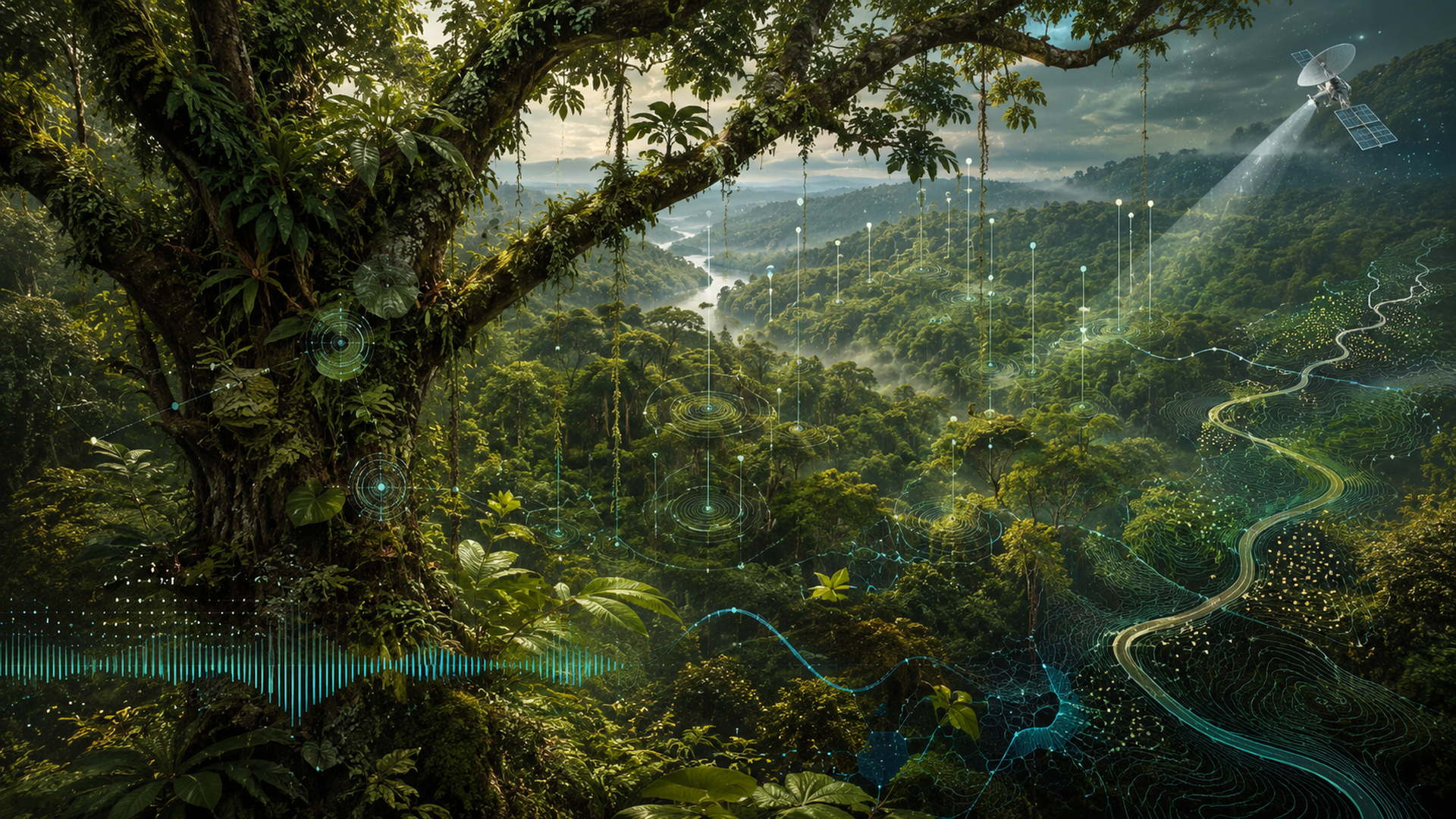
Biodiversity monitoring is rapidly entering the AI era. Satellite imagery can track forest fragmentation; acoustic sensors can identify birds, frogs, and insects; camera traps can record wildlife presence; eDNA can read species clues from water or soil samples. Work that once required long-term fieldwork, identification, and organization can now be accelerated by models. This is certainly promising, especially under pressures of habitat loss, climate change, and invasive species spread—we indeed need to know faster what is happening in the natural world.
But the problem lies here: as forests are seen, heard, and marked more quickly, they also become easier to download, copy, trade, and misuse. For urban research institutions, a set of species location data may only be coordinates; for tribes, it could represent hunting paths, ceremonial landscapes, taboo zones, ancestral stories, food sources, or sensitive knowledge that should not be disclosed publicly. If open science merely shouts "the more open the data, the better," without asking who has the right to decide openness, who bears the risks, and who benefits from it, then openness may become a polite version of plunder.
Forests are not green pixels; tribes are not data suppliers. For AI biodiversity monitoring to truly have public value, two things must be addressed simultaneously: first, enabling science to better grasp environmental changes; second, ensuring that data governance respects local communities, Indigenous knowledge, and cultural boundaries. Without the latter, even the most advanced first step may only replace old colonial collecting with cloud formats.
Two: Blind Spots in Open Science: Data Flows, Power Also Flows
Open science has its progressive significance. Shared research results supported by public funds can indeed reduce redundant sampling, promote international collaboration, enhance transparency, and provide a stronger evidence base for environmental policies. Biodiversity databases, remote sensing platforms, citizen science data, and open-source models allow more people to participate in environmental knowledge production. The problem is that once data flows, power follows suit. Who can analyze the data, who can turn it into policy or products, and who gains research recognition and commercial benefits are not evenly distributed.
In Indigenous areas, this issue becomes even sharper. Many high-biodiversity regions are also traditional territories of Indigenous peoples. External researchers entering to collect specimens, photograph images, record species, and build databases often carry the name of science but fail to establish equal relationships. Even without malicious intent, data leaving the local area may be used in ways unknown to the community: conservation zones, tourism marketing, drug development, land control, or even policy design that excludes traditional use. Data may seem neutral, yet consequences are very concrete.
The CARE principles for Indigenous data governance remind us that data governance should not only consider FAIR—findable, accessible, interoperable, reusable—but also collective benefit, authority to control, responsibility, and ethics. In plain terms, the data must bring collective benefits to the group; the group must have control over it; users of the data must be responsible; and the entire process must adhere to ethical standards. This is not a rejection of science but an insistence that science stop pretending it has no power.
Three: AI Monitoring Is Not Only About Accuracy, But Also Landscape Relationships
AI biodiversity models are often asked about accuracy—whether bird calls are correctly identified, camera trap classifications are accurate, or satellite interpretations have errors. These matters are important; however, in Indigenous landscapes, accuracy is not the only issue. Some data should not be published at precise coordinates; some species' presence should not be commercialized for tourism; certain locations should not be marked as photo spots; and some sound recordings may capture human activities, rituals, or private lives. If models pursue more data without considering these implications, they might absorb local life into their analysis.
For example, acoustic monitoring can help understand forest health but could also record sounds of tribal residents, hunters, gatherers, or ceremonies. Camera traps can document animals but may also capture people who do not wish to be photographed. Satellite imagery can analyze land changes but could also be used to accuse local traditional use while ignoring external development, historical land dispossession, and institutional constraints. AI is not a simple tool; it amplifies certain observation methods and excludes others.
Using the mountain experiences of different Indigenous groups such as the Rukai, Paiwan, Amis, and Atayal as examples, landscapes are not backdrops but relationships. A path is not just a route—it may be related to migration, marriage, hunting, sheltering, ceremonies, or plant knowledge; a plant is not merely a species—it can simultaneously serve as food, medicine, craft materials, taboos, and stories. If AI only converts them into Latin names, GPS coordinates, and photo tags, the data becomes clean but relationships are washed away. The most common mistake in scientific databases is not insufficient data but turning living relationships into dead fields.
Four: Sensitive Data Needs Layering, Not All Open or All Closed
Biodiversity data governance should not fall into a binary approach—either fully open or completely secret. A more reasonable method is to establish layered permissions and contextual governance. General habitat trends, non-sensitive species distribution, de-identified acoustic indicators can be opened under appropriate authorization; precise locations of endangered species, ceremonial landscapes, collection routes, internal tribal knowledge, and data that may cause poaching or tourism pressure should be restricted from public disclosure, or even retained only within local governance systems.
This layering is not a hassle but responsible data design. Many scientific databases have already blurred sensitive species coordinates; Indigenous data governance merely further reminds us: sensitivity is not just about species but also cultural relationships. A location may be sensitive not because it has rare animals but due to ancestral stories, family memories, taboo norms, or historical trauma. External researchers who only ask "Is this scientific data?" often miss the point. The more important question is: who will be affected after this data is disclosed?
AI systems should also embed these rules rather than remediate afterward. Datasets should indicate licensing conditions, tribal governance requirements, whether models can be trained, commercial use allowed, cross-border transfer permitted, and if local feedback is required. If model outputs involve sensitive locations, resolution should automatically decrease or prompts for community consent should appear. These designs will not make AI less intelligent but rather more like a tool that knocks before entering someone else’s home.
Five: Medicinal Plants and Biodiversity Data Are Not Unclaimed Material Libraries
When discussing biodiversity, the cultural depth of plant knowledge is often overlooked. Medicinal plants, edible plants, dyes, weaving materials, construction materials, and ceremonial plants are not just natural resources but also accumulations of group classification, bodily experience, seasonal observation, and ethical norms. Elders in tribes know when to harvest certain plants, which parts can be used, who should avoid them, what to say or do before and after harvesting—this knowledge is hard to simplify into three fields: "efficacy," "components," and "location." If research only extracts commercializable aspects, cultural context gets stripped away.
Therefore, open science entering the field of medicinal plants must be particularly cautious. Not all plant uses are suitable for public disclosure; not everything elders have said can go online; not every image can train models. Certain knowledge may require family, tribal, or specific identity access; certain content can be used for teaching but not commercialization; some can be preserved locally but should not flow across borders. Data sovereignty is not about locking up knowledge but allowing groups to decide how it is stored, shared, taught, and protected.
This is why "consultant" roles are not formalities. Elders who have long participated in cultural, mother tongue, and medicinal plant records in the Maolin area provide more than raw materials—they offer the ability to judge boundaries: what can be said versus what should be retained; what constitutes a plant name versus landscape relationships; what external researchers understand versus what only communities know about ethics. Without such cultural guidance, AI easily turns respect into pretty slogans and data collection into high-tech straws.
Six: From Data Collection to Data Co-Governance
The direction worth looking forward to is shifting biodiversity monitoring from "researchers collecting local data" to "local co-governed data." Tribes can participate in setting monitoring goals: tracking hunting ground health, stream changes, invasive species, traditional foods, post-disaster habitat recovery, or tourism pressure? Different objectives will determine different data designs. Tribes can also participate in interpreting the data: a decrease in certain bird calls could be due to climate factors, road construction, changed hunting paths, seasonal misalignment, or reduced human activity during taboo periods. Without local context, models easily translate complex worlds into simplified charts.
Data feedback is equally important. Too many studies treat locals as sample sites while results only return to journals. Responsible monitoring should provide local-use dashboards, Indigenous language or Chinese explanations, school curricula, patrol tools, and policy recommendations. Data is not just for international reports but also needs to reach those who care for the land. Otherwise, the more precisely forests are measured, the less power locals have—this precision becomes ironic.
AI can become a tool of Two-Eyed Seeing, but only if it acknowledges it is not the master. It should assist tribes in preserving publicly shareable environmental memories, help young people understand landscape changes, aid public agencies in recognizing local governance capabilities, and guide scientists to avoid treating data as unowned property. Forests are not green pixels; they have voices, paths, names, and generations of people who live with them. If biodiversity monitoring wants to protect nature, it must not first remove those who care for nature from data governance.
Sources retained from the Chinese original
AI use and content-safety disclosure
This article was assisted by AI in organizing data, structuring content, and polishing sentences; human editorial staff set the perspective and fact-checking direction