Antibiotics Are Not Just a Hospital Matter: Rethinking Antimicrobial Resistance through Decolonial One Health
Original Chinese title: 抗生素不是醫院的私事:從去殖民 One Health 重新理解抗藥性
The new Global Action Plan on Antimicrobial Resistance (2026–2036) reminds us that antimicrobial resistance has never been merely a prescribing issue within hospitals. It concerns people, animals, plants, water, food systems and environmental governance. Adding a decolonial perspective allows One Health to move from 'cross‑departmental cooperation' toward 'respecting local knowledge and community agency'.
Two-Eyed Seeing Lab
The Two-Eyed Seeing Lab focuses on Indigenous knowledge, public health, disaster resilience, environmental governance, and science, technology, and society studies.
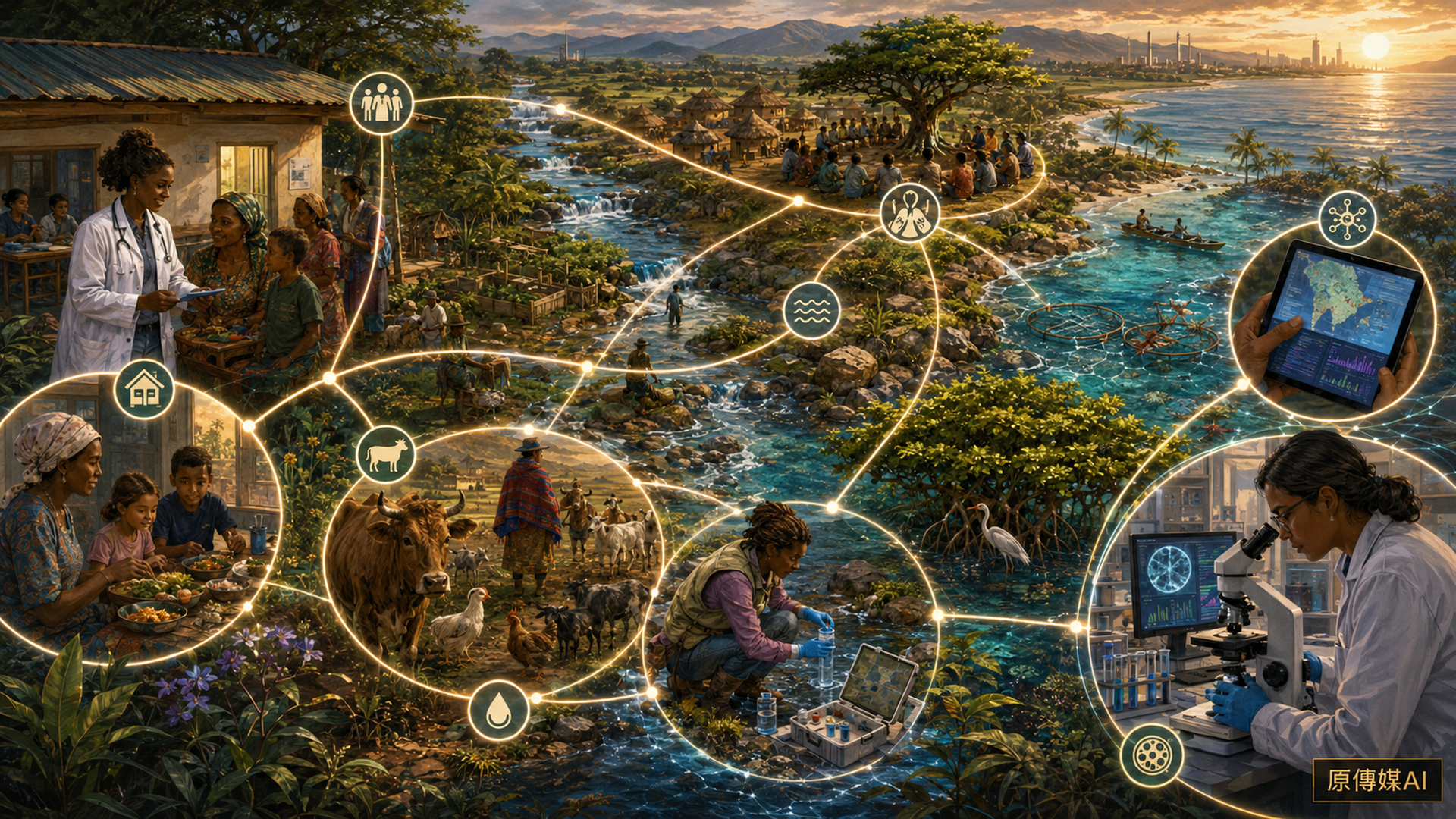
When antimicrobial resistance (AMR) is mentioned, most people respond with two direct questions: Are doctors prescribing too many antibiotics? Are patients failing to complete their courses as directed? These are certainly part of the problem. But if the discussion stops at dividing responsibility between hospitals and patients, the true shape of AMR is drastically narrowed. AMR has never been the private concern of a single hospital. It is the combined outcome of how people use medicines, manage livestock and aquaculture, handle wastewater and the environment, and design primary care and community health.
WHO Stretches the Timeline and Expands the Scope of the Problem
The most important signal from the 2026–2036 Global Action Plan on Antimicrobial Resistance adopted by the World Health Assembly is not that AMR is serious; that has long been understood. The important change is that international governance is placing people, animals, plants, food systems, and the environment more explicitly within the same framework. AMR is no longer treated merely as an extension of clinical prescribing. It sits at the intersection of public-health infrastructure, agri-food systems, and ecological management.
This shift has two implications. First, it acknowledges that no single sector can solve AMR. Second, it recognizes that without clean water, adequate water, sanitation, and hygiene facilities, dependable primary care, and sufficient vaccine coverage, people are more likely to rely on medication as a last resort, increasing the risk of resistance. AMR is therefore not only a consequence of inappropriate medicine use; it is also produced by the inequitable allocation of public resources.
One Health Often Promises Integration Without Recognizing Local Realities
The term One Health has become increasingly common. Its premise is compelling: human, animal, and environmental health are interconnected and therefore require cross-sector collaboration. Yet a sound concept does not guarantee fair practice. Many One Health projects remain deeply top-down. International organizations propose a framework, national agencies set indicators, and expert teams enter a community to collect samples and conduct outreach. The community is then treated as a population expected to comply, rather than as a partner in defining both the problem and the relevant knowledge.
This is why recent research has begun to discuss decolonial One Health. The point is not to reject scientific monitoring. It is to recognize that many projects have treated communities merely as implementation sites, without acknowledging their long-term observations of disease, ecology, and water conditions or giving them sufficient authority over data, priorities, and interventions. If One Health links medicine, veterinary science, environmental science, and administrative agencies while leaving communities outside the center of decision making, it becomes little more than a larger interagency bureaucracy.
The Value of Bali's 'Antibiotic-Wise Village' Lies in Placing Living Conditions Back into the Antimicrobial Resistance Picture
Bali’s Antibiotic-Wise Village is noteworthy because it does not reduce AMR to prescriptions and patient behavior. It examines at the village level how households, schools, healthcare, agriculture, water use, and everyday hygiene are connected. This kind of community intervention recognizes that medicine use is shaped by living conditions. If care is difficult to reach, access to medicines is unreliable, household water quality is poor, or poultry are raised too close to living spaces, a single information leaflet cannot change how residents use antibiotics.
More importantly, this approach moves monitoring beyond the laboratory. A community knows which well turns cloudy after the rainy season, which households repeatedly see sick poultry, when gastrointestinal illness becomes more common, and which stream smells different from a decade ago. These observations may not initially exist in statistical form, but they are often the earliest signals of risk. Public health gains real depth when they are considered alongside laboratory tests, prescription monitoring, and environmental samples.
Amazon Research Reminds Us: Without Addressing Power, One Health Is Just a More Beautiful Input Platform
Multinational research in the Amazon makes a direct critique: if outside institutions define diseases, monitoring priorities, and research questions in advance, local communities can remain passive providers of data no matter how often they are invited to “participate.” This warning matters because public-health programs can too easily bypass a community’s claims over data, risk, and intervention priorities in the name of acting “for everyone’s good.”
Decolonial One Health neither opposes monitoring nor leaves every decision to local experience alone. It requires science and local knowledge to move beyond a relationship of one-way extraction. Who decides whether water or livestock should be monitored first? Who decides that one disease deserves to be a primary indicator more than another? Who may use community data? Do the results return to the community? These are not peripheral concerns. They determine whether One Health can be trusted.
Implications for Taiwan and Indigenous Communities: Public Health Must Extend Beyond Medical Facilities to Landscape Governance
These international discussions are highly relevant to Taiwan’s Indigenous, coastal, and remote communities. Many risks do not fit within a single agency: torrential rain and debris flows alter water sources; tourism and aquaculture change patterns of environmental exposure; greater distance from healthcare intensifies unequal access to medicines; and farming and animal-management practices affect the movement of pathogens. If public health remains limited to clinic reporting, hospital education, and after-the-fact response, systems will continue to see only the final symptoms and miss the upstream structural causes.
Here, Two-Eyed Seeing provides more than cultural respect; it offers a practical method of governance. The eye of public health and microbiology supports sampling, surveillance, culture-based testing, and risk analysis. The eye of local and Indigenous knowledge explains how seasons, waterways, animal activity, everyday practices, care networks, and community trust shape health together. Each eye sees an incomplete picture on its own. Placed side by side, they can produce a risk map closer to lived reality.
Conclusion: What Antimicrobial Resistance Truly Tests Is Our Ability to Reconnect the World
AMR is difficult precisely because it does not remain within one sector. It moves through clinics, farms, kitchens, schools, waterways, laboratories, and markets, crossing scales as it goes. It therefore forces us to rethink public health itself. Health is not merely a professional service delivered inside a hospital; it is a shared concern entangled with the environment, industry, living conditions, and justice in governance.
If One Health means only interagency coordination, its power will remain limited. If it can also move toward decolonization, community agency, and shared authority over data and interpretation, it can become more than another slogan: it can become a more resilient method of public health. Antibiotics matter, but reducing AMR often depends not on a single medicine. It depends on whether society is willing to place people, animals, water, and land back within the same picture.
Antimicrobial Resistance Also Reminds Us: Public Health Cannot Leave Primary Care and Social Trust Behind
A further point is essential. AMR worsens in many places not only because medicines are misused, but because primary-care systems are inadequate. Without dependable family physicians, community nursing, and health-education support, people facing an infection or other symptoms are more likely to self-medicate, buy the same medicine repeatedly, or assemble treatment from several sources. An unstable care environment makes antibiotic use more chaotic and surveillance less accurate.
Decolonial One Health therefore returns to a practical question: Will governments invest in local primary care, the public-health workforce, and networks of community trust, rather than strengthening testing and reporting only when a crisis appears? Without long-term community relationships, even the best laboratory cannot repair living conditions neglected for years. AMR is difficult because institutions, environments, and relationships of care must be repaired at the same time. This is precisely where One Health has real value.
Local knowledge is therefore not an emotional garnish for One Health; it is a practical early-warning system. Which stretch of river has suddenly lost fish? Which kind of poultry is dying more often? Which well smells different after heavy rain? During which market season do diarrhea and skin infections become more common? If these signals are documented carefully and connected to scientific monitoring, public health can respond faster and make better judgments. Decolonization does not remove professional expertise. It teaches professionals to work with communities.
That is why community participation is not an optional gesture of goodwill, but a necessary condition for successful governance.
Further Reading and Sources
- World Health Organization: Global action plan on antimicrobial resistance (2026–2036) | Verification considerations: new action plan release date, policy priorities and One Health framework.
- WHO/FAO/UNEP/WOAH: Integrated surveillance guidance for AMR|Verification considerations: official name of the four‑party cooperation document and human–animal–environment integrated monitoring principles.
- PubMed: Antibiotic-Wise Village in Bali|Verification considerations: study design, sample size, community intervention methods and conclusions.
- PubMed: Decolonising One Health in the Amazon|Verification considerations: research region, methodology, main arguments and decolonial points.
- World Organisation for Animal Health (WOAH)|Verification considerations: animal health, antimicrobial use and One Health governance documents.
- UNEP: AMR and the environment|Verification considerations: policy explanation on environmental pollution, water resources and antimicrobial resistance.
AI use and content-safety disclosure
AI assisted with research organization, structural drafting, and language refinement. Human editors determined the perspective and fact-checking priorities, with verification considerations retained for item-by-item human review.