No Tailpipe Does Not Mean No Particles: Euro 7 Brings Brake and Tyre Wear into Emissions Policy
Original Chinese title: 電動車沒有尾氣,就沒有顆粒排放?Euro 7 開始把煞車與輪胎磨耗算進「排放」
Electric vehicles remove tailpipe combustion from the streets and can reduce important exhaust pollutants. But “no tailpipe” is not the same as “no particles.” Every acceleration, turn, brake event, and tyre contact wears material away. Brake discs and pads release metal and friction-material particles, while tyres rel
Two-Eyed Seeing Lab
Co-authors: ["劉展瑞
Two-Eyed Seeing Lab; co-author: 劉展瑞; Taiwan Association for the Welfare Promotion of People with Disabilities; Atayal.
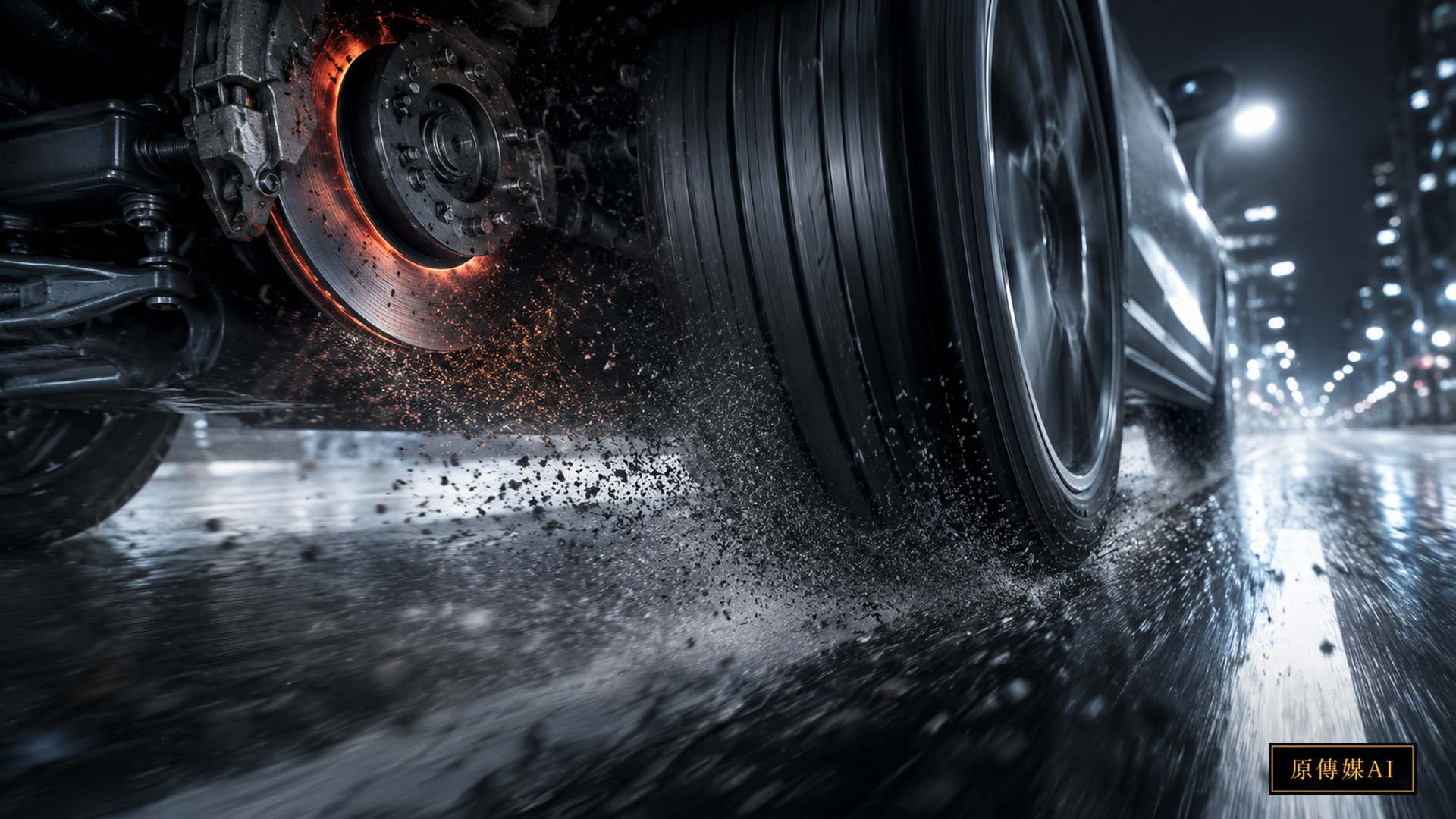
Electric vehicles remove tailpipe combustion from the streets and can reduce important exhaust pollutants. But “no tailpipe” is not the same as “no particles.” Every acceleration, turn, brake event, and tyre contact wears material away. Brake discs and pads release metal and friction-material particles, while tyres release rubber, polymers, and additives. These non-exhaust emissions used to sit beside the main emissions regime; they are now entering formal regulatory attention.
In March 2026, UNECE adopted tyre-abrasion limits and test methods for new C1 tyres used on cars and vans, with practical sales obligations expected from 30 June 2028. The significance is larger than a new durability test. Tyre wear is becoming a type-approval issue connected to microplastics and particulate pollution, so compound design, casing, tread, and vehicle matching will be judged through a measurable product indicator. The official regulatory starting point is UNECE | Vehicle Regulations.
The brake side is moving quickly as well. The European Commission Implementing Regulation (EU) 2026/1762 establishes procedures, test methods, and administrative requirements for brake-particle emissions from M1 and N1 vehicles. Euro 7 therefore asks vehicle engineers to address not only NOx, PM, and carbon dioxide from exhaust systems, but also particles generated when the braking system wears under a standardized cycle. See EUR-Lex | Commission Implementing Regulation (EU) 2026/1762 and the broader EUR-Lex | Regulation (EU) 2024/1257 — Euro 7.
Electric vehicles create a two-sided engineering effect. Regenerative braking can recover kinetic energy and reduce the frequency of friction-brake use in many situations. Battery mass can also increase vehicle weight, while instant torque and acceleration can change tyre loading and wear. It is not safe to conclude that electric-vehicle tyres are always dirtier or that regenerative braking solves the problem. Comparisons need the same vehicle class, tyre, road, load, tyre pressure, control strategy, and driving condition.
This is why laboratory standards and real roads need a two-way relationship. A repeatable test is necessary for fair market comparison; without it, one brand can claim a lower result simply because it used a gentler route. But drivers, tyre shops, fleet mechanics, and road-maintenance teams see conditions a test rig may miss: mountain descents, repeated bends, heavy loads, rough pavement, misalignment, low pressure, high heat, stop-and-go traffic, and kerb impacts. These observations should influence the next monitoring design rather than being dismissed as user error.
This is a practical form of Two-Eyed Seeing: standardized measurements and lived road knowledge are both needed to understand non-exhaust emissions.
The road environment also becomes part of emissions policy. Surface roughness, street cleaning, rainfall runoff, traffic signals, speed limits, start-stop patterns, and the share of heavy vehicles affect both particle generation and where particles finally go. Tyre wear can remain on the road, enter the air, wash into drainage, or accumulate at the roadside. An air-quality program that measures only airborne PM can miss material moving through water and sediment.
For Taiwan, the lesson is not simply whether to copy a European number. It is to update the boundary of vehicle-pollution accounting before tailpipe emissions decline further. Buses, waste trucks, delivery fleets, taxis, and mountain shuttles often have fixed routes, mileage, maintenance, tyre replacement, and driver records. They can provide a practical baseline for vehicle weight, load, pressure, alignment, brake-pad life, tyre wear, gradient, pavement, temperature, and rain.
A public-fleet pilot should start with a small number of routes that represent urban traffic, long-distance service, heavy loads, and mountainous Indigenous-township connections. Record a baseline before changing products, then compare wear, safety, service interruptions, energy, noise, and maintenance. The purpose is not to create a new administrative burden for its own sake. It is to let mechanics and drivers identify where the standard model fails and where a design change actually helps.
Procurement can then move beyond the lowest purchase price. A tyre tender can request wear per ten thousand kilometers, wet grip, noise, energy efficiency, material traceability, and end-of-life information. A bus or delivery-fleet contract can ask manufacturers to provide regenerative-braking strategy, tyre-load data, and maintenance records, followed by a real-route review after a year. The regulatory summary in EUR-Lex | Euro 7 technical requirements summary is useful for the formal framework, while fleet data supply the second layer of evidence.
Safety must remain a non-negotiable boundary. A tyre that lasts longer still needs wet grip, braking distance, and aging performance. A low-particle brake material cannot reduce emergency braking reliability. Euro 7 is therefore not a contest in which the smallest particle number wins by itself. It is a multi-objective engineering problem in which pollution, durability, energy, maintenance, and safe mobility have to be evaluated together.
The future of non-exhaust governance should make its conditions visible: vehicle and tyre specifications, load, pressure, test cycle, route, weather, mileage, wear measurement, uncertainty, and maintenance history. When standard data and field knowledge correct one another, electric mobility can keep its exhaust advantage without creating a new blind spot around materials that vehicles and roads wear away.
Main reference sources
AI use and content-safety disclosure
This English version is an AI-assisted translation of a Yuan Media AI editorial feature and should be read together with the Chinese source article and cited public references.