Not Moving the Counseling Room into the Forest: If the Relationship with Land Is Part of Trauma, Can Therapy Treat Only the Individual?
Original Chinese title: 不是把診間搬進森林:當「土地關係」本身就是創傷的一部分,心理治療還能只治療一個人嗎?
A 2026 study co-designed with First Nations partners makes mental-health services confront a basic question: if trauma also comes from forced separation from land, language, and networks of relationship, recovery cannot occur only in an individual counseling room.
王莉如
王莉如 | Counseling psychologist supervisor at the Life Expression and Creation Lab; focuses on emotional regulation, relationship repair, trauma-informed care, and psychological resilience in everyday life.
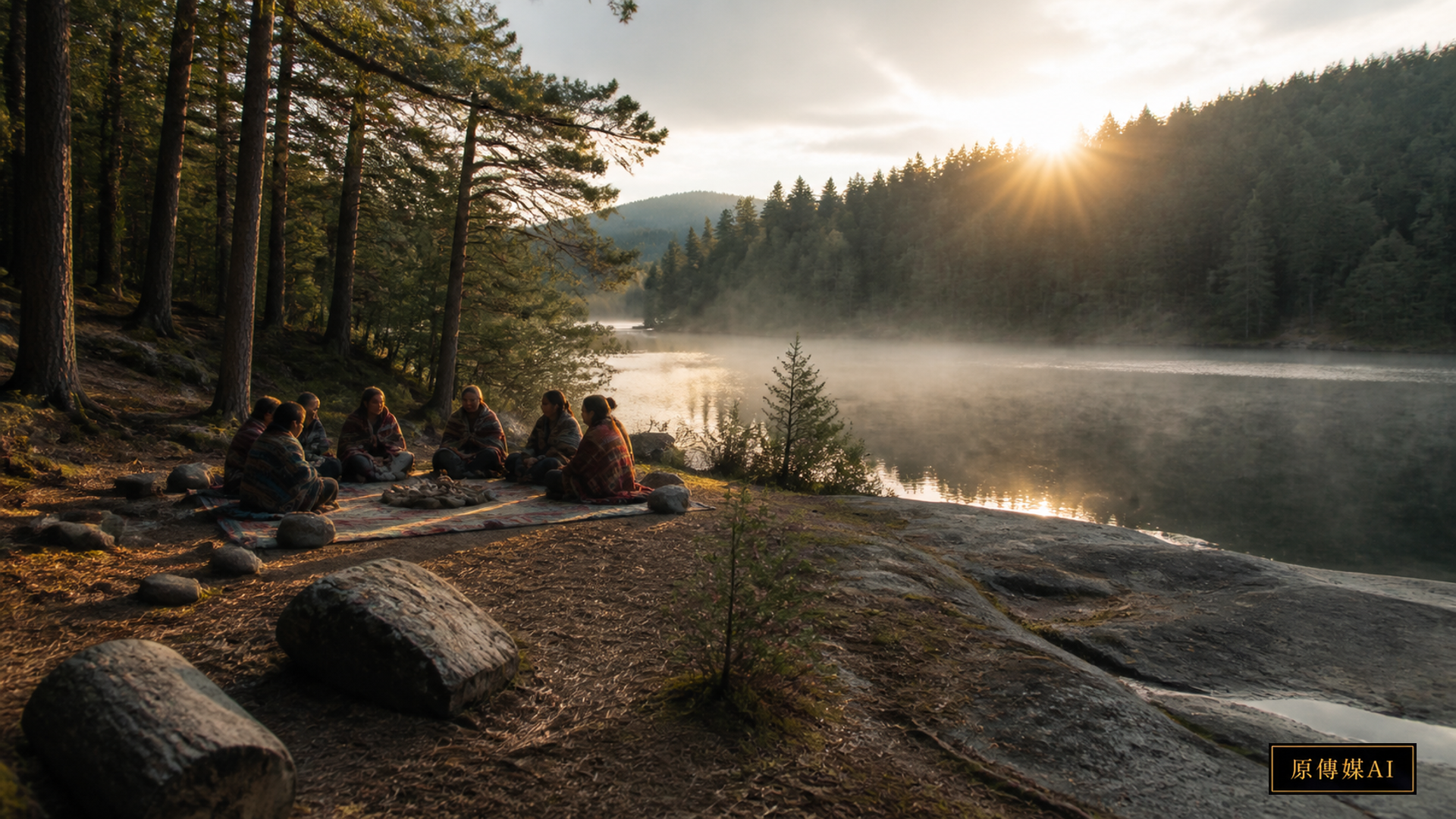
In the perspective of the Life Expression and Creation Lab, when a person's trauma is entangled with forced removal from land, disrupted language, damaged family relationships, and enduring institutional discrimination, placing all suffering inside an individual diagnosis can turn historical and political injury into an alleged failure of personal adjustment. Land-based support matters not because forests possess magical healing powers, but because it requires mental-health services to acknowledge that relationships with land, kin, seasons, language, and shared memory have always been part of psychological life.
A mixed-methods study published in the Canadian Journal of Public Health in 2026 describes the Gwekwaadziwin Miikan land-based mental-health and addiction-treatment program. The research was co-designed with participants, an Elders' council, and knowledge keepers. It included interviews and group-activity observation during a ninety-day land-based program, followed by a six-month follow-up. The Canadian Journal of Public Health mixed-methods study of land-based treatment reports four main themes: connection with Indigenous identity, connection with land, trauma, and peer relationships.
The numbers require careful reading. Thirty-nine interviews were completed during the study and twenty people participated in the six-month follow-up. All follow-up participants said they were not using substances at that time, although five had relapsed and later stopped again. These findings illuminate participants' experiences and possible directions for support, but they do not prove that the land-based program is superior to every other treatment. The study itself clearly identifies its limits: it is an observational study without a control group, follow-up participation was limited, and both the interview setting and the research team's position may have influenced the results.
What Taiwan should learn is not a copied ninety-day curriculum but the method of co-design. If an outside institution chooses the site, activities, image recording, and success indicators and then invites community residents to attend, land may remain merely a new therapeutic backdrop. If the community can decide which knowledge may be shared, who may lead, where entry is permitted, when activities are inappropriate, and how records are kept, land can instead be treated as a respected subject within a relationship.
Canada's TCPS 2 (2022) guidance on research involving Indigenous Peoples emphasizes community engagement in research affecting Indigenous community welfare and respect for community customs, governance, and reciprocity. This principle also guides helping professions: community agreement cannot replace an individual's consent, yet obtaining an individual's signature does not grant unrestricted use of land knowledge, ceremonies, stories, or images. Individual safety, collective rights, and professional responsibility must all remain visible.
Clinical safety cannot be set aside. When a participant faces risk of self-harm, harm to others, severe withdrawal, worsening psychiatric symptoms, or inability to care for themselves, land-based activities cannot replace necessary medical care or crisis intervention. A mature program needs explicit procedures for transportation, medication, emergency contacts, severe weather, gender- and age-related safety, staff supervision, and multidisciplinary referral. Participants must know when they may withdraw, refuse an activity, or choose another form of support.
Data governance is also part of treatment ethics. Once land locations, harvesting knowledge, family stories, addiction experiences, and trauma narratives enter assessment forms or digital platforms, they may be analyzed and circulated outside their context. The ownership, control, access, and possession principles highlighted by the First Nations Information Governance Centre's OCAP training offer an important reminder: data are not merely material gathered by researchers. Communities should be able to decide who owns and controls them, who may access them, and who physically holds them.
Taiwan could begin with a small, reversible pilot. A community organization, local psychological and social-service workers, cultural knowledge holders, and medical services could jointly define the scope. They should resolve transportation, confidentiality, crisis referral, and staff support before deciding the activities. Evaluation should extend beyond symptom scales to changes participants define for themselves, such as speaking with family again, being willing to return to a place, restoring daily routines, becoming more able to seek help, or feeling safer in their cultural identity.
The program described in the study was more than a period of outdoor activity. Gwekwaadziwin Miikan is a partnership among six First Nations, Manitoulin Island communities, and the Ontario government. Participants may move through a ninety-day land-based program, residential aftercare, and outpatient support after returning to their communities. This structure shows that connection with land can easily be interrupted at the end of a program without continued relationships at home, addiction treatment, and practical assistance. The study's account of the program stages also records that some interviewees felt their support relationships suddenly disappeared after leaving three months of communal living, a warning that discharge must not be treated as completion.
Outcome evaluation should therefore have at least three levels. The first is immediate safety, including crisis events, the right to leave, and continuity of medication and referrals. The second is relational change, including relationships with peers, family, land, language, and cultural identity. The third is whether work, study, housing, and help-seeking can be sustained after returning home. None of these levels substitutes for another. A person's scale score may improve while they return to an unsupported or discriminatory environment; the system should not then place all responsibility for relapse on that person. Someone may rebuild cultural connection and still need psychiatric or addiction treatment. The two are not contradictory.
The research design also warns readers not to treat the self-reports of twenty follow-up participants as an overall success rate. Only twenty of the thirty-nine research participants completed the six-month follow-up, and the circumstances of those who were lost to follow-up are unknown. A knowledge keeper supportive of the program sometimes attended interviews, which may also have shaped responses. The team disclosed that the analysts were not specialists in Indigenous health and asked Elders and knowledge keepers to verify interpretation. These limitations do not invalidate the study; they define what the evidence can say. It offers detailed experience and feasible directions, but it does not establish causation or guarantee the same results after transplantation elsewhere.
For psychological practice, trauma-informed care and cultural safety are not interchangeable. Trauma-informed care commonly seeks to prevent re-traumatization, provide choice, and build predictable relationships. Cultural safety additionally asks who sets service rules, whether clients encounter racialized assumptions, and whether professionals appropriate cultural knowledge. Even a gentle therapist may reproduce unequal power by flattening community differences into one activity package, requiring clients to explain their culture, or using a scale to dismiss how they experience land. Professional competence includes knowing when to step back, when to refer, and when local knowledge holders should lead.
Confidentiality must also be redesigned. Group circles, family participation, and cultural activities may strengthen support, but participants still need to decide what stays in individual sessions, what may be shared in a group, and what must not be recorded. Staff should explain in advance the exceptions for crisis reporting, the purposes of images and audio, whether research and service data are separated, and whether leaving the research affects access to services. Under the TCPS 2 principles for community engagement in Indigenous research, community governance and free individual consent must coexist; neither can erase the other.
If Taiwan establishes a pilot, its first year should not pursue rapid expansion. One willing local team could co-write a service charter naming the responsible people for cultural activities, clinical care, crisis response, and data governance. Every three months, participants, families, local organizations, and multidisciplinary workers should review reasons for withdrawal, interrupted services, and complaints rather than displaying only satisfaction scores. Records involving land locations, family stories, and cultural knowledge should use stricter authorization and storage based on the OCAP principles of ownership, control, access, and possession, with the community deciding whether any material may enter outside research or a model.
Resource equity must also be answered. Land-based programs require transportation, accommodation, outdoor safety, substitute caregiving, time away from work, and follow-up services. If only people with time, income, and suitable physical conditions can attend, those most in need may be excluded. Funding should support not only one event and a promotional video but also local facilitators, interpretation, supervision, crisis coverage, and long-term follow-up. A genuinely culturally responsive approach does not merely add symbolic elements; it returns resources, decision-making authority, and continuity of care to networks of relationship.
Land must not be romanticized. It may also carry loss, conflict, forced displacement, and dangerous memories. Returning to a particular place may not be safe for everyone and must never become a test of cultural loyalty. Therapists need to permit different distances: some people reconnect through walking on land, some through language, food, song, maps, or family narrative, and others choose not to approach for now. The person in recovery, not the designer's idea of cultural correctness, remains the subject of recovery.
The final question is not whether a forest can cure illness, but whether the mental-health system is willing to broaden its view. When suffering is related to dispossession, severed relationships, and cultural devaluation, treatment must move beyond individual techniques and connect with community resources, cultural rights, housing security, and public policy. Land-based support can be an important option, but its credibility comes from shared governance, clinical safety, and long-term accompaniment—not from packaging cultural symbols as a short-term wellness product.
Sources and Further Reading
- Canadian Journal of Public Health | Mixed-methods study of land-based treatment
- Canada TCPS 2 (2022) | Research involving Indigenous Peoples
- First Nations Information Governance Centre | OCAP principles
Yuan Media AI | Continue Asking from Your Role
This article provides four role-based entry points, each with five questions, for twenty pre-generated role-based follow-ups. The interface displays the relevant questions and answers for each role. Every answer retains embedded source links, and no model is called live in the browser.
AI use and content-safety disclosure
This English version is an AI-assisted translation of an article based on public 2026 research and Indigenous research-ethics materials. It is general educational information and does not replace individual counseling, psychotherapy, psychiatric care, addiction treatment, or crisis intervention.