Future Breeding Will Select Not Only Plants but Cooperative Rhizospheres: Microbial Relationships Are Becoming Crop Traits
Original Chinese title: 未來育種不只挑植物,也在挑「會合作的根圈」:微生物關係正成為作物的新性狀
A 2026 framework for beneficial microbial associations links plant breeding, soil management and microbial inoculation as one ecological-engineering problem.
鄭淑禎;專家諮詢:陳振義博士
鄭淑禎 | Assistant Professor at Shih Chien University; expert consultation: Dr. Chen Zhen-yi, Taitung District Agricultural Research and Extension Station.
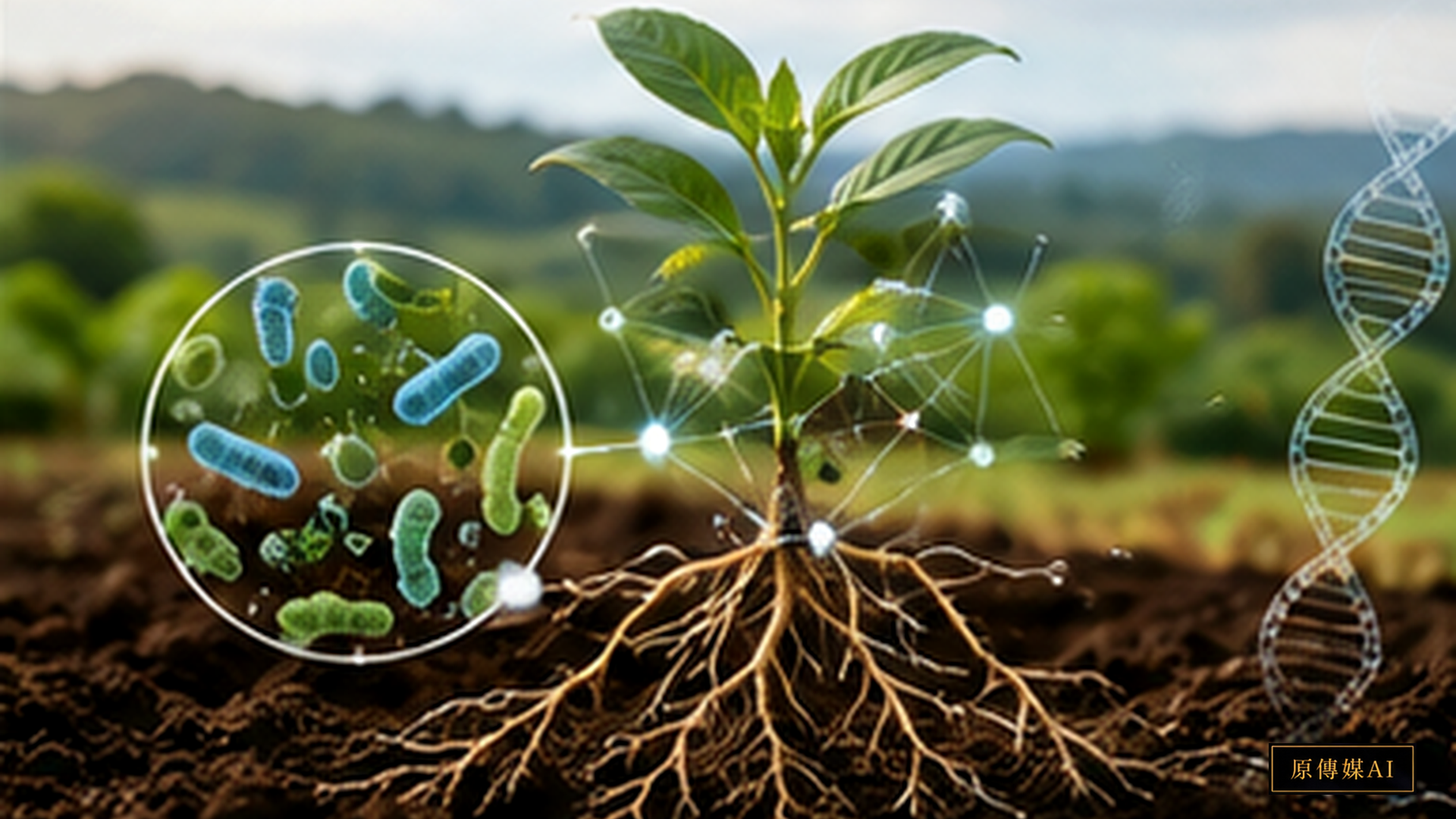
Breeding may begin to select who a plant can work with
Plant breeding traditionally focuses on yield, resistance, maturity, quality and tolerance to drought or salinity. A 2026 Nature Communications perspective argues for adding another target: the ability of plants to recruit and sustain beneficial microbial associations. The breeding unit is therefore no longer only the plant genotype; it can become a plant–microbe functional system.
The rhizosphere is an active interface. Roots release sugars, organic acids, amino acids and secondary metabolites that influence microbial attraction, competition and colonization. Root architecture and immunity also help determine which organisms can persist. Research in sorghum has shown that some rhizosphere taxa have heritable associations with host genotype and that GWAS can identify plant loci associated with microbial abundance.
Microbiome genes are promising, but they are not simple switches
The idea of microbiome genes, or M genes, reframes microbiome engineering as a breeding problem as well as an inoculation problem. Yet a gene that recruits a useful organism in one soil may have little effect in another. A strain that performs well in a greenhouse may fail in field communities. The relevant unit of selection is therefore genotype × microbiome × environment × management.
The 2026 framework describes a dual ecological-engineering strategy: plant breeding can improve root traits and exudation, while soil management and microbial inoculation can maintain the organisms needed for those traits to matter. This matters for low-input agriculture, where the realistic goal may be reduced or more efficient fertilizer and pesticide use rather than complete replacement.
Local varieties can become hypothesis generators
Landraces and locally maintained varieties may contain root and microbiome-related traits that were not prioritized in high-input breeding environments. That does not mean traditional varieties are automatically “better microbiome plants.” It means farmer observations can identify meaningful phenotypes for scientific testing.
If growers repeatedly observe that a local line performs reliably under poor soils, drought or low fertilizer, researchers can compare root architecture, exudates, microbiome profiles, nutrient acquisition and genotype. Local knowledge identifies which contrasts matter; molecular tools test mechanisms; results return to the field for validation.
A Taiwan pathway
Taiwan can begin with small, multi-season trials in specialty crops and locally conserved germplasm. Each trial should record genotype, soil chemistry, rhizosphere microbiome, management, yield and quality. Data and germplasm governance should be agreed before sampling, especially when local or Indigenous varieties are involved.
The deeper shift is philosophical. A crop is not an isolated machine. Its performance emerges from relationships among genes, soils, microbes, climate and management. Future breeding may therefore reward plants that are especially good at forming stable, useful partnerships in the environments where farmers actually grow them.
The rhizosphere is an interface actively shaped by roots
The rhizosphere is not simply soil beside a plant. Roots release sugars, organic acids, amino acids and other compounds that alter microbial competition and settlement, while root form, immunity and nutritional state also influence which organisms can approach. Studies in sorghum using 16S rRNA sequencing and genome-wide association analysis show that some rhizosphere patterns are partly associated with inherited host variation, even though soil, weather and management can be stronger drivers.
Microbiome genes put recruitment capacity into breeding language
The proposed idea of microbiome genes, or M genes, is that host genes affecting microbial recruitment or function may be breeding targets. That is not a single switch for a universal beneficial microbe. A gene can behave differently across soils; an inoculant that works in a greenhouse can be outcompeted in a field; and an exudate that recruits a partner can also change carbon costs or pathogen risk. The useful unit is an interaction among genotype, microbes, environment and management.
The 2026 framework calls for dual ecological engineering
Plant-side work can improve roots, exudates and colonization through conventional breeding, genomic selection or new breeding tools. Microbe-side work can improve conditions through rotations, organic matter, lower disturbance, inoculation or designed communities. Neither side is sufficient alone: a variety cannot benefit from a partner that farm management prevents from surviving, and a rich soil community may not help a root system that does not recruit it.
Low-input agriculture is about reduction and stability, not magic replacement
Beneficial associations may improve nutrient access, growth, disease resistance or tolerance of non-biological stress, but they do not announce the end of fertilizer or crop protection. More credible goals include lower inputs or steadier performance under low phosphorus, drought or specific disease pressure. Such claims need multi-site, multi-year testing under contrasting management before they become traits farmers can rely on.
Local varieties are hypotheses, not proof of superior microbial cooperation
Materials maintained in low-input or difficult environments may retain different root and recruitment strategies that highly standardized breeding can overlook. That possibility must not be romanticized. A farmer's observation that a line remains stable on a dry slope or with less fertilizer can guide comparisons of roots, exudates, microbial communities, nutrient uptake and genotype; it does not by itself prove a microbiome mechanism.
Two-Eyed Seeing lets local experience decide what is worth measuring
Two-Eyed Seeing does not translate local agricultural knowledge into a claim that microbiome science merely confirms what was already known. Farmers may observe soil smell, root colour, season, slope position, previous crops, insects, weeds or harvest stability in their own system of knowledge. Those observations can set the next research question, while sequencing, metabolomics and genotype data test mechanisms and send unexpected results back to the field for further inquiry.
Breeding trials need an environmental record for what cannot be seen.
If microbial interaction is to become a predictable trait, trials need more than plant height and yield. They should record sampling dates, prior crops, fertilizer and pesticide use, organic matter, water conditions and key microbial communities. Farmers then contribute long-term management history as well as land, and breeders can distinguish a stable host effect from a fortunate field background. This shared record is the infrastructure that can make future genomic selection more informative.
Sources
AI use and content-safety disclosure
This English translation was prepared with AI assistance for organization, drafting and language editing. Human editorial verification remains responsible for viewpoint, factual review and publication.