A typhoon can be priced when it takes a house, but where should a lost ancestral place name, gathering path or ceremony appear in the loss ledger?
Original Chinese title: 颱風帶走一棟房子可以估價,但帶走一個祖先地名、一條採集路徑、一場儀式,要填在「損失」的哪一欄?
Non-economic losses are not losses that matter less because they cannot be reduced to one price. UNFCCC LCIPP processes show why climate policy needs records that make cultural relationships visible while preserving community authority, privacy and the right not to disclose sensitive knowledge.
Aciang Iku-Silan
Aciang Iku-Silan is an Indigenous Two-Eyed Seeing and digital-technology practitioner focused on Indigenous knowledge, education governance, AIGC reasoning and reciprocal knowledge practice.
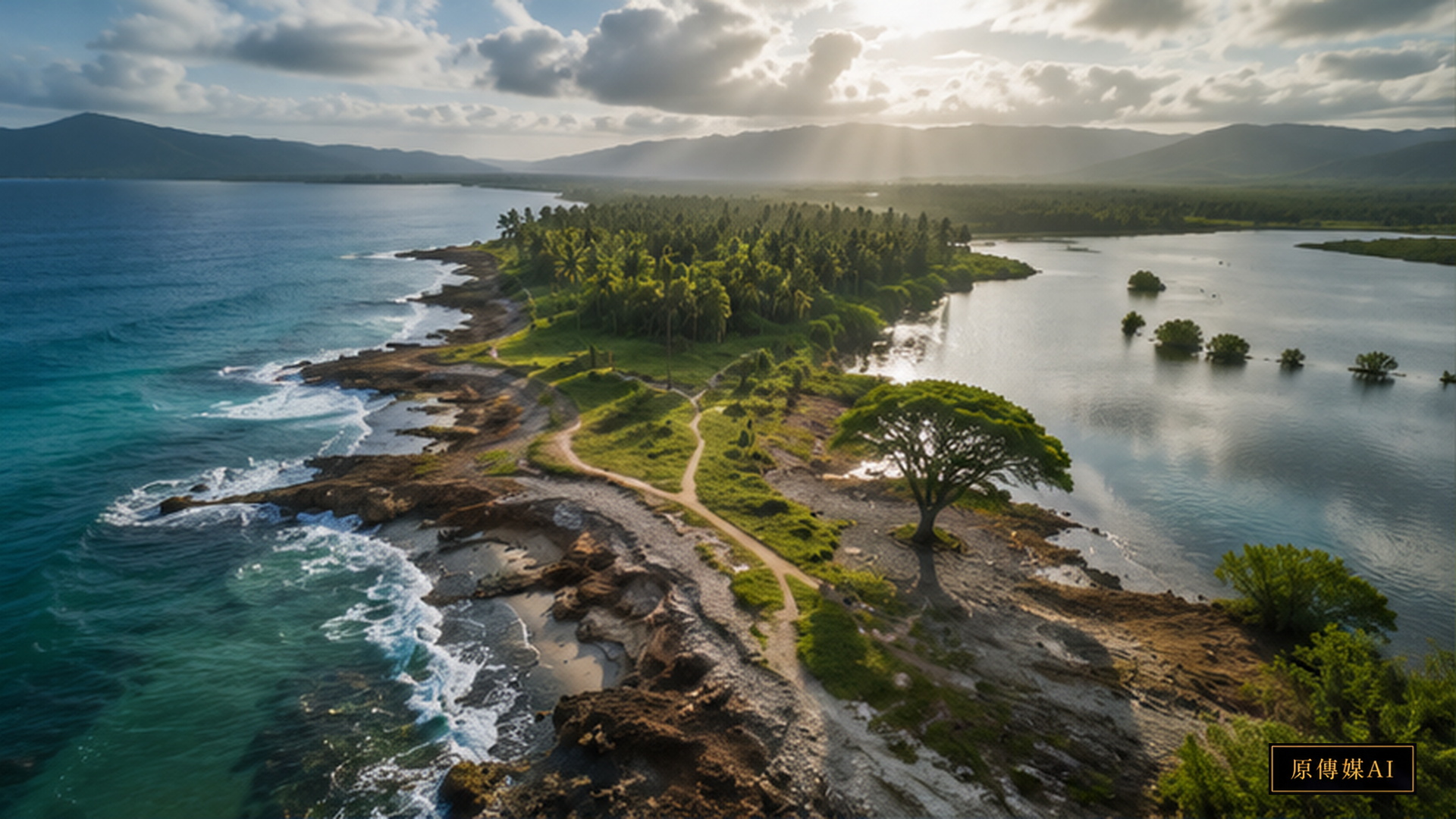
Physical damage is usually easy for institutions to price. A damaged house can be counted, a road can be measured, crops can be assessed and a repair budget can be assigned. Those numbers matter, but climate hazards also damage relationships that do not fit neatly into an asset register. A typhoon, flood, coastal erosion or prolonged drought may make an ancestral place name difficult to locate, break a gathering route, isolate a ceremonial site, change the arrival of a bird or plant, or prevent children from following an elder along a familiar path of knowledge.
These impacts are difficult to convert into one monetary value, yet they can affect cultural continuity, identity, community governance and psychological safety. This is the central challenge of non-economic losses in the climate Loss and Damage discussion. The Pacific Regional Gathering of the UNFCCC Local Communities and Indigenous Peoples Platform places Indigenous knowledge holders, local governance, cultural heritage, biodiversity, traditional livelihoods and climate resilience in the same conversation. Decision 14/CP.29 provides the formal LCIPP decision context for moving these questions from climate negotiation into data design, public policy and evaluation practice.
Non-economic loss does not mean that a loss should be ignored because it cannot be priced. If a public system records nothing, it effectively treats the loss as if it did not exist. The difficult design question is how to create enough evidence for a policy response without converting every piece of knowledge shared inside a community into open data. A place name may carry history, routes, kinship, stories, prohibitions, resource practices and memories of hazard. When erosion removes the landscape associated with the name, the loss is not only a missing label. A whole set of memory coordinates has been weakened.
A gathering route is also more than a line between two points. It may encode the season in which travel is safe, where a person should pause, which plant appears on a particular slope, which areas must be avoided and who has authority to bring another person there. If an access road is closed and the event is recorded only as transport inconvenience, the interruption of knowledge transmission can disappear from the official record. Cultural loss therefore has to be defined with the community, rather than classified after the fact by an outside expert.
Datafication creates a second risk. In order to make a loss visible to government, a community may be pressured to place sensitive locations, ceremonies, sacred spaces or gathering routes into a map or spreadsheet. Those records might later be reused by researchers, tourism operators, companies or other departments. The connection between Indigenous knowledge sharing and free, prior and informed consent is important precisely because the existence of knowledge does not automatically give an outside institution permission to collect it.
A responsible non-economic-loss system should therefore have several levels of access. One record might state only that a category of cultural relationship has been harmed, without disclosing a precise location. Another record might remain under community custody and provide government only with the summary needed for a decision. Some information may be relevant to recovery funding but still be inappropriate to publish because of cultural rules. A mature system must be able to preserve a deliberate blank field and accept that a community can say that something should not be recorded.
Indicators also need more nuance than asking whether an activity happened. A ceremony might still take place even though its route, species, site or season has changed. Does that mean culture was unaffected? A simple binary measure can conceal a major change in quality and relationship. A stronger assessment could combine comparable indicators, such as days of interruption, the number of important places that cannot be reached, and shifts in the season of a livelihood, with qualitative indicators defined by the community. The qualitative part can ask whether a place has lost meaning for identity, family relationships or intergenerational teaching.
Discussions of Indigenous knowledge and early warning systems also show that communities monitor risk through biological indicators, animal behaviour, weather patterns, hydrology, wind direction and historical memory. These are not necessarily rivals to modern monitoring. They are observation systems operating at different scales. Satellites and weather stations can describe regional rainfall, wind fields and sea temperature, while local knowledge may recognize which stream changes colour after a particular rain, which bird call or insect activity signals a seasonal transition, or which slope becomes dangerous after repeated rainfall.
Two-Eyed Seeing is useful when it allows both observation systems to change a warning threshold, rather than placing local knowledge in a public-information brochure as decoration. For Taiwan's Indigenous townships, a practical first step would be to add new questions to post-disaster assessments. Which cultural routes were interrupted? Which important places became inaccessible? Which seasonal activities were postponed or cancelled? Which phenological indicators changed? Which teaching relationships were disrupted by relocation or evacuation?
Those fields do not all need to be public. The important point is that a community should have an institutional entry point when a cultural relationship is harmed, instead of having to compress the experience into one sentence about cultural impact. Recognizing non-economic loss also does not mean that recovery support is impossible. Policy can support the restoration of capacity without pretending to calculate a price for a route. Funds might support safe access, knowledge documentation under community control, training for younger guides, or the repair of transport and environmental conditions.
The hardest part of Loss and Damage is often what cannot be fully restored. A house can be rebuilt and a road can be repaired, but a coastal landform, ancestral place name or seasonal relationship may not return through engineering alone. Non-economic loss forces policy to acknowledge that some impacts change how a community understands itself and its place. Once place names, routes, phenology, ceremonies, identity and relationships with land are treated as part of disaster impact, climate governance can move beyond hardware repair and begin addressing cultural continuity itself.
The policy lesson is not that every cultural relationship should become a new administrative score. It is that a record should be designed around authority, purpose and protection. A community-defined category can be useful even when its underlying story stays private. A summary can support a funding decision without exposing a sacred site. A refusal to provide a location can be valid evidence about governance rather than a data-quality failure. These choices make the record more honest and reduce the incentive to disclose more than is needed.
The same principle applies to digital tools. A map, database or AI system should not be allowed to infer that information is available for any use merely because it has been entered once. Access rules, provenance, consent status, retention periods and community review should travel with the record. The system should also make it possible to correct a category, withdraw an item or revise an interpretation when new evidence or community instruction appears.
International examples can inform Taiwan, but they cannot become an automatic answer for every township. A responsible translation of policy must recheck law, place, population, resources, data governance and failure conditions. People affected by the record should be able to change the question, reject unnecessary collection and revise an earlier judgment when evidence changes. That is the difference between making cultural loss visible and making culture administratively extractable.
Findings and safeguards
Sources:
AI use and content-safety disclosure
This English edition is an AI-assisted translation of the Chinese article, checked for evidence boundaries and source parity. It uses public UNFCCC LCIPP materials and presents policy questions for Taiwan without treating Indigenous knowledge as unrestricted data.