From Treaty to Co-Learning: Taiwan and Hawaiʻi Indigenous Peoples Partner to Exchange Language, Voyaging, and Traditional Knowledge, Letting Outcomes Be Defined Together
Original Chinese title: 從締盟走向共學:臺灣與夏威夷原住民族攜手交換語言、航海與傳統知識,讓成果由彼此共同定義
The Council of Indigenous Peoples, Taiwan and Kamehameha Schools in Hawaiʻi have established an alliance focusing on language, voyaging, education, reciprocity, and knowledge governance, with contemporary communities jointly defining outcomes and data boundaries.
雙向知識實驗室
Two-Way Knowledge Lab; Advisory Consultant: focusing on Indigenous knowledge, environmental monitoring, data sovereignty, cultural governance, and artificial intelligence applications, advocating the juxtaposition of digital tools with community knowledge rooted in reciprocity, auditability, and shared decision-making.
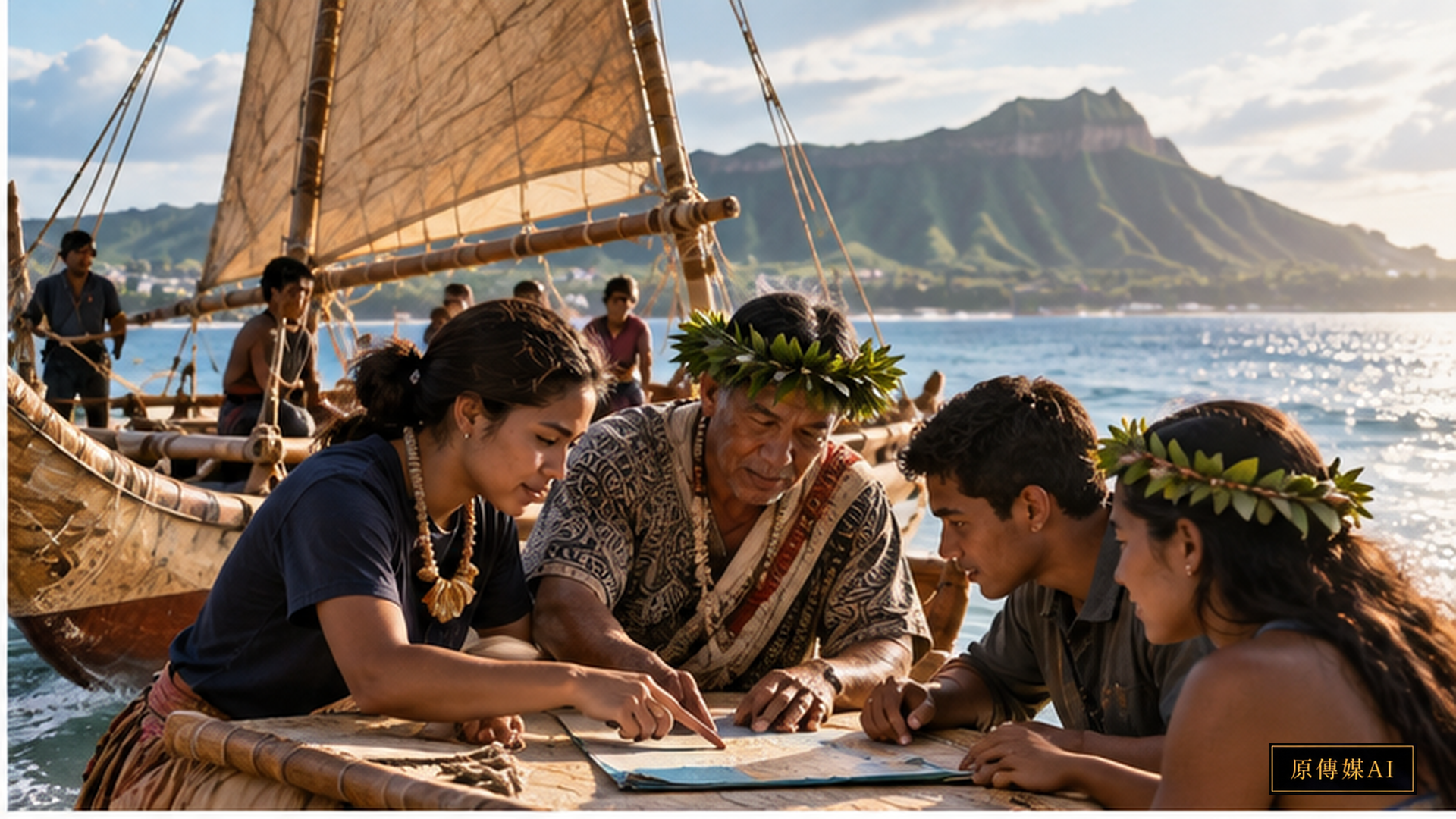
On September 9, 2026, the Council of Indigenous Peoples, Taiwan and Kamehameha Schools in Hawaiʻi signed the "Austronesian Peoples Alliance and Declaration for Pacific Co-Prosperity" in Honolulu. Official announcements published on September 11 indicate that both parties committed to advancing language and cultural revitalization, safeguarding and practicing traditional voyaging knowledge and navigation arts, and establishing cooperation anchored in sharing, mutual prosperity, and sustainable development. Viewing this event merely as an episodic cultural exchange vastly underestimates the systemic horizon it unlocks: an institutional opportunity to map language revitalization, non-instrumental voyaging, school curricula, and Indigenous knowledge governance onto a unified cooperative framework.
Kamehameha Schools is not a conventional cultural exchange organization. Its official mission is explicitly dedicated to advancing the well-being of Native Hawaiian people by cultivating future generations through education, embedding Hawaiian culture-based education, mālama ʻāina (stewardship of the land), ʻōlelo Hawaiʻi (Hawaiian language), and civic responsibility into every learning environment. This institutional foundation elevates collaboration between Taiwan and Hawaiʻi beyond ceremonial cultural presentations, steering it toward sustained, multi-year co-learning encompassing curriculum development, teacher exchanges, student immersions, open-ocean voyaging practice, and sovereign knowledge preservation.
Voyaging represents a particularly vital operational nexus. Kamehameha Schools maintains a deep institutional partnership with the Polynesian Voyaging Society, utilizing educational portals like Holomoana to connect traditional wayfinding and maritime culture with interdisciplinary, multi-age curricula. The historic voyages of the traditional double-hulled canoe Hōkūleʻa demonstrate that ancestral navigation is not an ethnographic relic confined to museum display cases, but a living practice of cultural sovereignty, environmental science, leadership formation, and intergenerational education. For Taiwan's Indigenous peoples, this provides not a carbon-copy blueprint to imitate, but a profound interlocutor: an example of how traditional knowledge can enter modern formal education without being hollowed out into superficial cultural flavoring.
Taiwan possesses its own rich traditions of language revitalization, ocean and mountain knowledge, seasonal phenology, ancestral migration narratives, and community-based educational innovations. When the two regions establish formal alliances, the most meaningful inquiry shifts from "what cultural similarities do we share" to "how do we teach, how do we learn, and how do we collectively determine which knowledge assets can be documented and shared." This exemplifies the essence of Two-Eyed Seeing and authentic reciprocity: knowledge exchange is never a unidirectional export, but an equitable dialogue where both partners retain the agency to interpret, adapt, and govern their own epistemologies.
For instance, linguistic exchange can transcend isolated vocabulary lists or performance showcases, investigating how Indigenous mother tongues can become the primary medium of instruction in natural sciences, marine navigation, geography, climatology, and community livelihood curricula. Voyaging exchanges need not stop at celestial orientation, but can expand into systematic methodologies for observing wind swells, wave patterns, cloud formations, pelagic seabirds, ocean currents, and seasonal transitions, reading these Indigenous indicators alongside modern meteorology, satellite imagery, and geographic information systems. The pedagogical virtue of this approach is not proving which epistemology is "more accurate," but teaching students how distinct knowledge traditions assemble empirical evidence and navigate real-world environments.
Digital technologies can play a constructive role in this partnership, provided data governance precedes data harvesting. If collaborative initiatives generate audiovisual recordings, linguistic corpora, voyaging logs, teacher instructional guides, or datasets for machine learning, strict protocols must be established from day one regarding who holds access rights, what content may be made public, what materials remain restricted to classroom immersion, whether generative AI training is permitted, and explicit procedures for updating or revoking consent. Far from obstructing cooperation, robust governance guarantees sustainability. Indigenous knowledge does not simply need to be gathered more extensively; it must be anchored in transparent relationships, ethical duties, and sovereign stewardship.
This elevates the definition of programmatic "outcomes." Conventional international exchanges measure success through headcounts, banquet ceremonies, press coverage, and signed memoranda. In contrast, Indigenous educational partnerships demand more authentic metrics: Have educators established ongoing co-planning mechanisms? Do students genuinely comprehend one another's histories through immersive language and maritime practice? Are voyaging curricula co-taught by experienced navigators? Do jointly developed teaching materials return directly to community schools? Does the alliance nurture a new generation of Indigenous leaders? These metrics may not glitter in press releases, but they accurately measure whether knowledge genuinely flows between communities.
Official communications from the Council of Indigenous Peoples, Taiwan highlight forthcoming maritime cultural activities and long-term planning, indicating that now is the optimal moment to construct an enduring governance architecture. Taiwan can examine its network of Indigenous experimental schools, tribal community colleges, Indigenous language centers, and cultural cultural institutions to establish durable peer partnerships with Hawaiʻi counterparts, avoiding the trap of reinventing programs from scratch with each election cycle. While Hawaiʻi offers mature institutional frameworks in culture-based education and wayfinding pedagogy, Taiwan contributes profound multi-tribal diversity, varied topographies, and extensive localized ecological knowledge. The mutual complementarities are immense.
Viewed across the broader Pacific basin, this partnership transcends romanticized narratives of "searching for shared ancestral origins." Linguistics, archaeology, and population genetics provide scientific clues regarding Austronesian seafaring dispersals, but contemporary Indigenous alliances are forged by living communities defining their own destinies. Shared heritage can serve as a welcoming point of departure, but it should not circumscribe the collaborative horizon. What sustains long-term alliances is confronting shared contemporary realities: educational autonomy, climate resilience, ocean stewardship, youth empowerment, and cultural resurgence.
Consequently, this alliance warrants enthusiastic and active support: it opens a pathway to bridge formal state institutions with sovereign community knowledge. If future curricula, voyaging expeditions, language immersions, and digital repositories are co-designed, with outcomes mutually defined and editorial rights preserved by both nations, this declaration will evolve from symbolic ink into a thriving, self-sustaining Pacific co-learning network. For the rising generation, the greatest triumph is not recalling a ceremonial signing, but navigating their own oceans, speaking their ancestral languages, and creating living knowledge upon their native lands.
Bringing Collaboration Directly into Classrooms, Oceans, and Communities
If this alliance is to yield enduring value, subsequent phases should begin with concrete, focused initiatives rather than attempting to execute all ambitions at once. Language initiatives can initially target shared thematic domains—such as the ocean, wind directions, celestial bodies, wayfinding bearings, and seasonal cycles—enabling Taiwanese and Hawaiian educators to co-develop bilingual and multilingual teaching modules. Maritime initiatives can pair master navigators with formal educators to structure experiential observation camps, demonstrating to youth that ancestral seafaring is not a romantic motif, but a rigorous discipline demanding physical stamina, mental discipline, and collective accountability.
A second priority is sustained teacher co-planning. What transforms education is rarely a one-off keynote lecture, but regular collaboration among frontline teachers on instructional design, pedagogical materials, student assessments, and classroom feedback. Establishing structured online co-planning cohorts and periodic in-person residencies, accompanied by shared revision logs, will progressively curate a shared educational repository. Furthermore, these materials need not be universally open-access; specific cultural or ritual teachings can be restricted to participating schools or designated community elders, calibrating access tiers according to the sacredness or sensitivity of the knowledge.
A third pillar is meaningful youth agency. Language revitalization and maritime resurgence will falter if managed exclusively by adult administrative bodies. Youth should participate directly in environmental monitoring, waypoint navigation, elder oral interviews, digital cartography, and short-form documentary production—with each output scrupulously documenting sources, consent terms, and dissemination boundaries. The objective is not exploiting youth as unpaid field collectors, but mentoring them to understand that knowledge carries relational accountability, ethical duties, and communal stewardship.
A fourth imperative is community restitution of outcomes. A persistent failure of international cooperation is that deliverables remain trapped in conference slide decks or ministerial portals. Every collaborative milestone must incorporate a direct return pathway to the community: a mother-tongue curriculum module, a student-led community presentation, a localized coastal navigation map, a teacher field handbook, or community-governed audiovisual archives. When results directly enrich the originating communities, partnerships do not terminate when grant cycles conclude.
This is the true essence of "jointly defining outcomes." Taiwan does not need to treat the Hawaiian experience as an absolute dogma, nor does Hawaiʻi need to reduce Taiwan's sixteen officially recognized Indigenous nations into a single template. The most fertile engagement occurs when both sides compare how each community navigates language preservation, school curricula, open-ocean wayfinding, data sovereignty, and cultural duties in the face of modernity. Such an alliance not only builds international diplomacy across Oceania, but prompts domestic educational systems to reflect: what knowledge capacities do we truly wish our youth to inherit—the fleeting memory of a ceremonial treaty, or the living, self-correcting ability to navigate their world and serve their people?
Sources and Further Reading
Role-Driven Inquiry
Yuan Media AI | Guided Questions by Role
Select a role first, then review the complete questions from that perspective; clicking a question will display Yuan Media AI’s response in real time.
Select a role
Taiwan Indigenous teacher and student
Examine the article's evidence, governance boundaries, data rights, and actionable steps from the perspective of a Taiwan Indigenous teacher and student.
Choose a question
AI use and content-safety disclosure
This article was compiled from official and research sources; established facts, observational associations, institutional boundaries, and extended analyses are presented separately. The cover is an AI-assisted concept illustration.