Bringing Stories of Home into Public History: How Taiwan's National Museum of History Uses Documents, Objects, and Multilingual Narratives to See Today's Non-citizens
Original Chinese title: 讓「家」的故事走進公共歷史:臺史博如何用證件、物件與多語敘事看見當代臺灣非公民?
The National Museum of Taiwan History uses documents, everyday objects, and multilingual narratives to present how non-citizens live within institutional boundaries. Its public value lies in making service frictions and multiple meanings of home visible while protecting participants through consent, anonymity, and shared interpretation.
鄭淑禎|實踐大學專任助理教授
A full-time assistant professor at Shih Chien University whose work concerns industrial transformation, long-term care, public-service design, and technology, with a focus on how institutions reach users and frontline settings.
# Bringing Stories of Home into Public History: How Taiwan's National Museum of History Uses Documents, Objects, and Multilingual Narratives to See Today's Non-citizens
How a Document Determines Whether Everyday Life Can Feel Ordinary
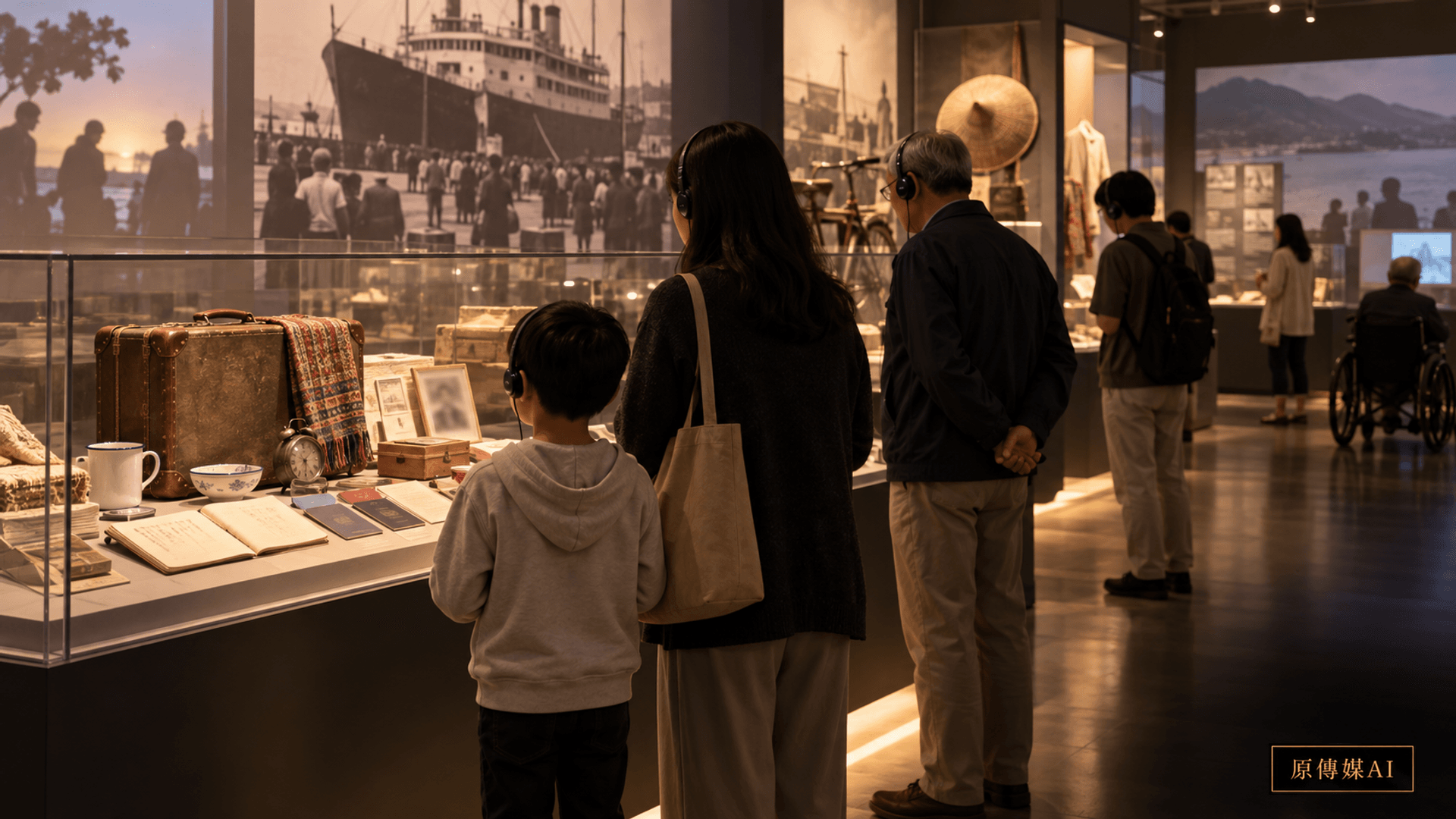
Passports, residence papers, requests for supplementary documents, school records, and medical records may look like administrative paper. For a non-citizen, they can determine access to work, education, health care, housing, and a stable life. The National Museum of Taiwan History's special exhibition “Beyond Borders, Within the Island: Stories of Non-citizens in Contemporary Taiwan,” running from September 15, 2026, through April 11, 2027, brings these institutional interfaces and everyday objects into public history. Visitors encounter not an abstract population category but traces of people arranging their lives under rules, language barriers, and time pressure.
Non-citizen Is Not One Uniform Status
The exhibition uses non-citizen broadly. It includes stateless people and people who formally possess a nationality but cannot receive effective protection because of politics, war, or institutions. UNHCR's legal definition of statelessness is narrower: a person whom no state considers a national under the operation of its law. The concepts are not interchangeable. Calling every mobile person stateless erases different legal positions, while looking only at possession of a passport misses the lived reality of documents that exist but do not provide protection.
From a History Classroom to an Unfinished Journey
The official exhibition page lists sections translated as a non-citizen history classroom, movement in historical currents, invisible borders, “At Home,” and unfinished journeys at the border. It engages contexts including Tibet, Myanmar, Hong Kong, and Ukraine. The arrangement need not compress different places into one story. It can let visitors compare why people move, where documents cease to work, how home is redefined, and how waiting becomes ordinary life. Responsible comparison preserves difference while making institutional friction visible; it does not cast every individual in a predetermined role as victim or hero.
Objects Can Bear Witness and Can Also Expose Their Owners Again
A suitcase, textbook, household object, or request for additional documents can return large-scale history to a bodily, tangible scale. Yet identity papers and records may contain names, birth dates, numbers, addresses, relatives, case status, and routes of movement. Before display, a museum must ask more than whether an object has a story. Staff and participants should review what may be released, what needs masking or reproduction, whether images may be photographed, and whether the participant can later withdraw. In an ongoing case, even a combination of precise date and place can re-identify someone.
Multilingual Work Is More Than Translating Chinese into Several Lines
Multilingual interpretation concerns rights of access and interpretation. If a museum writes every label and narration on behalf of participants, the grammar may be polished while experience is absorbed into administrative language. A stronger process involves community members in word choice, recording, review, and narrative order, and permits some material to remain audio-only, anonymous, or untranslated. Accessibility should also include plain-language versions, captions, audio description, and clear service information so that multilingual presentation is not merely decorative.
Two-Eyed Seeing: Professional Stewardship and Lived Experience Set the Boundary Together
Museums contribute methods of collection care, preservation, research, and public interpretation. Non-citizen and diaspora communities know which terms are harmful, which objects affect family safety, and when silence itself carries meaning. Two-Eyed Seeing asks both sides to determine selection, context, anonymity, retention, and reuse rights together. Co-creation is not the extraction of stories followed by complete institutional control. Participants should see the final presentation, be able to correct it, and know how digital records may later be searched and cited.
An Exhibition Can Test the Usability of Public Services
Requests for documents, waiting, language barriers, and travel among agencies have direct implications for public-service design. Frontline agencies can examine whether forms appear in needed languages, applicants know the next step, notices explain deadlines and appeal routes, and interagency processes force people to submit the same evidence repeatedly. A museum cannot replace legal aid or casework, but it can organize fragmented user journeys into a public problem. If service teams enter the gallery with their process maps, the exhibition can become an observatory for institutional improvement.
Ethics Is Not a Signature Collected Once Before Opening
The International Council of Museums' ethical framework emphasizes professional responsibility and social trust. For participants who may still face risks related to status, consent should be ongoing. A change in use, an extended exhibition, online publication, or media reproduction calls for renewed confirmation. Institutions need a contact point, a withdrawal process, and incident response so participants do not discover only after publication that exposure exceeded their understanding. Anonymity does not require stripping a person of individuality; it allows that person to choose a safe degree of identifiability and form of narration.
Public History Ultimately Asks Who Can Be Seen Within the Island
The exhibition's value does not lie in imposing one definition on all non-citizens. It places the ways home is formed through documents, objects, language, friendship, and waiting into Taiwan's public memory. A visitor can leave with a concrete question: do our schools, health services, local agencies, and cultural institutions assume that everyone arrives with the same document and the same language? When the answer is no, public history becomes more than a view of the past. It becomes a method for identifying service gaps in the present.
Moving from a Visit to Service Improvement Requires Transferable Observations
When teachers bring students to the exhibition, they can avoid asking classmates to disclose family migration or status. Anonymous scenarios can instead ask how a service should respond when a person cannot understand a request for additional documents, is sent back and forth between agencies, or cannot use an online system because of a document category. The task is not to guess a person's country of origin. It is to find where a process assumes that every user has the same language, identity paper, and digital ability. Before observations are given to a museum or agency, identifiable details should be removed and consent obtained; a classroom conversation must not become a new case database.
A public agency can adopt a “one change after the exhibition” process. It selects one form, notice, or counter procedure; invites users with different languages and status situations to test it; records completion time, points of failure, and required assistance; and names an owner and correction date. Legal eligibility questions need qualified advice. Interface and language failures should not force users to bear the cost of coordination among agencies. A museum creates space to see and discuss; the institution must convert observations into trackable improvement and tell participants which recommendations were accepted, which were not, and why.
Relationships do not end when the exhibition closes. Before deinstallation, the institution should contact lenders and collaborators about return of objects, digital copies, retention, and future research use, and provide an understandable report. If content later enters teaching materials, a touring exhibition, or an artificial-intelligence system, staff must check whether the original consent covers the new use. This follow-through determines whether co-creation built durable trust or merely collected stories once. A museum can also publish a correction record without personal data, explaining which labels changed after community review, which choices remained, and why. This is professional transparency and evidence that participation leaves an institutional effect.
Continue by Asking from Your Role
- If you are among General visitors, teachers, and students, continue by asking about evidence boundaries, governance responsibility, and the next verifiable action.
- If you are among Museum curators, collections staff, and educators, continue by asking about evidence boundaries, governance responsibility, and the next verifiable action.
- If you are among Non-citizens in Taiwan and diaspora-community collaborators, continue by asking about evidence boundaries, governance responsibility, and the next verifiable action.
- If you are among Public-service, migration, and human-rights practitioners, continue by asking about evidence boundaries, governance responsibility, and the next verifiable action.
Sources and Further Reading
- National Museum of Taiwan History: Beyond Borders, Within the Island special exhibition
- National Human Rights Museum / FIHRM-AP: co-creating an exhibition with non-citizen communities in Taiwan
- UNHCR: the definition and consequences of statelessness
- International Council of Museums: Code of Ethics for Museums
Role-Driven Inquiry
Yuan Media AI | Guided Questions by Role
Select a role first, then review the complete questions from that perspective; clicking a question will display Yuan Media AI’s response in real time.
Select a role
General visitors, teachers, and students
Examine the article's evidence, governance boundaries, data rights, and actionable steps from the perspective of a General visitors, teachers, and students.
Choose a question
AI use and content-safety disclosure
This article was compiled from official and research sources. Established facts, limitations, local context, and analysis are presented separately. The cover is an AI-assisted concept illustration.