When a Miniature Horse Can Approach or Walk Away: How Teenagers Can Read Animal Signals and Share Care
Original Chinese title: 當小馬可以靠近,也可以走開:青少年讀懂動物訊號,如何讓陪伴成為彼此的照顧?
A brief study of 61 adolescents and rescued miniature equines puts animal choice at the center of emotional research and of responsible service design.
王莉如|諮商心理師督導
A counseling psychology supervisor focused on trauma recovery, couple and family relationships, professional ethics, and social and emotional support.
# When a Miniature Horse Can Approach or Walk Away: How Teenagers Can Read Animal Signals and Share Care
An encounter with room to leave
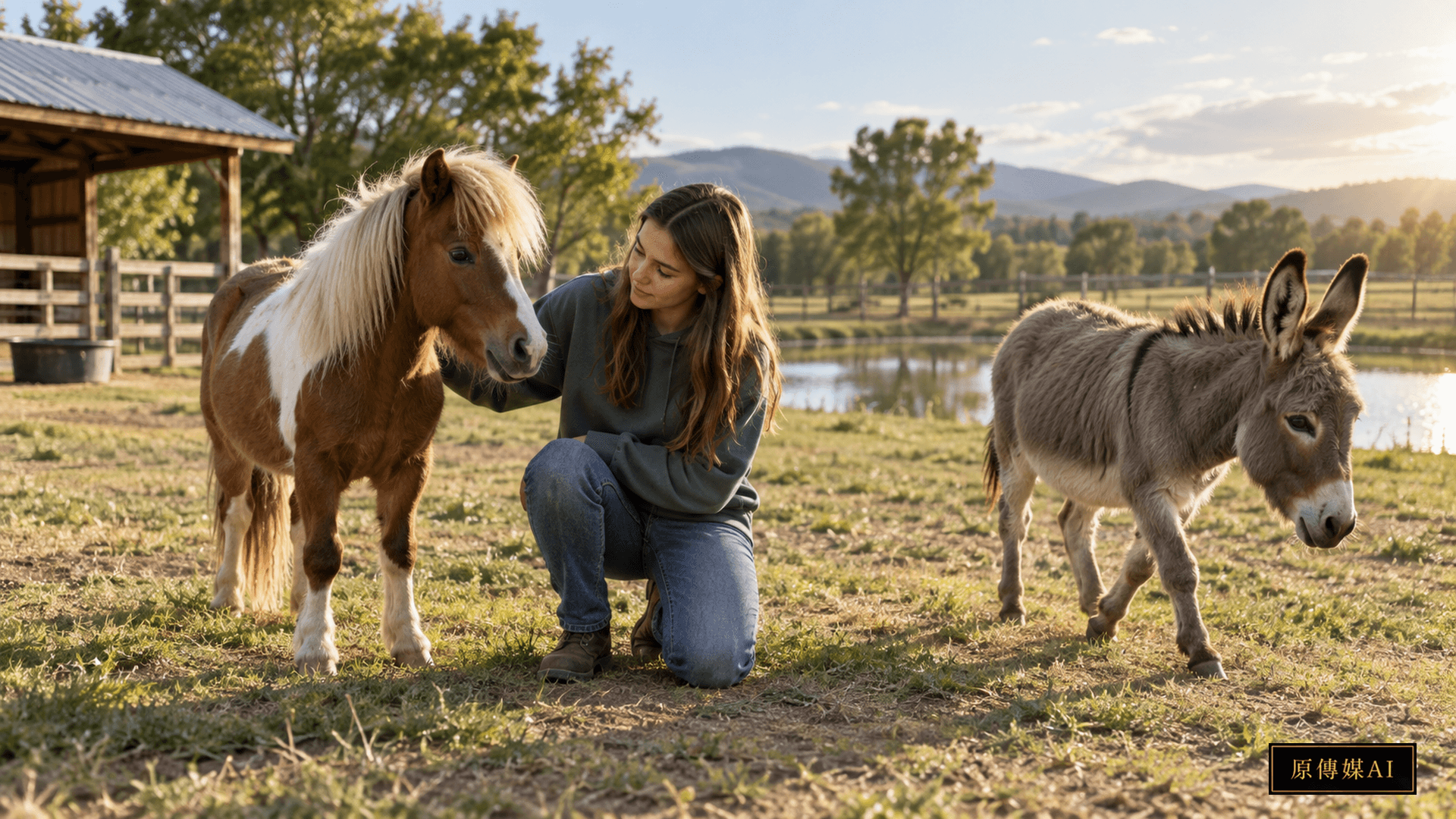
A teenager extends a hand beside a pasture. A miniature horse approaches for a moment, then turns toward another animal. It is tempting to label this a success or a rejection. The movement itself is information. Did the person recognize that the animal was choosing a distance? An encounter that does not require the animal to stay may also teach a young person to notice boundaries and to allow feelings to change.
How the three minutes were studied
The 2026 Scientific Reports study enrolled 61 adolescents at an animal behavior summer program in California. They had a standardized interaction of about three minutes with rescued miniature horses and donkeys. Beforehand they learned that lip movement could indicate a positive response and walking away could mean a wish for space. Researchers assigned either gentle back stroking or neck scratching, asked about emotions before and after, and recorded animal behavior. This defined, short experiment does not establish outcomes for ordinary schools or clinical services.
Touch changed animal responses
Neck scratching was associated with more lip movement and less voluntary departure than back stroking. That does not prescribe one gesture for every horse. These were behavioral indicators chosen for this study, to be interpreted in each animal and setting. Practitioners must also watch posture, ears, movement, and stress. Ending contact when an animal declines it is a meaningful response.
What the emotional reports can say
Adolescents immediately reported greater calm and less nervousness, sadness, and loneliness. Seeing lip movement was associated with larger reductions in loneliness, while seeing an animal walk away was associated with larger reductions in sadness. This surprising association does not mean rejection is beneficial. It suggests that an authentic encounter in which an animal can choose may matter to a person’s experience. Immediate self-reports cannot establish duration or show that three minutes treats depression or trauma.
The animal is an active participant
The study’s two-way hypothesis follows human touch, animal response, and the person’s emotional experience. Welfare is therefore an ongoing relationship, not a box checked before the activity. If an animal is made to stand still and cannot turn away, a key signal of voluntary disengagement disappears. Respecting that choice also makes the encounter more honest for adolescents.
Questions a small study leaves open
The sample comprised only 61 adolescents in a specific camp, and the encounter was brief. Participants had already learned the two signals under study. Prior experience, expectations, group setting, and individual animal preferences could influence reports. The work does not identify a service model that improves mental health over time or settle long-term animal welfare. More settings, longer follow-up, and independent welfare measures are needed.
Two-Eyed Seeing: two-way knowledge: observation and consent
Adolescents can describe feelings, carers can explain an animal’s ordinary behavior, and researchers can record interactions consistently. None replaces the others. A person familiar with the animal should explain what rest or disengagement looks like for that individual. Participants can practice asking, waiting, and stopping. Measurements should return to carers for comparison with experience. An animal cannot sign a human consent form, but approaching, staying, and leaving can express choice when a safe exit is available.
A conversation for schools and families
A parent or teacher planning an animal activity should first ask whether the young person wishes to join, whether the animal can choose contact, and who will recognize stop signals. Persistent low mood, sleep problems, or safety concerns call for qualified assessment and support; an enjoyable activity cannot replace it. An animal walking away need not mean the child did something wrong. Discussing the changing distance can show that respect for boundaries is not a failed relationship.
Making welfare checkable
A service can record each animal’s schedule, rest, water, exit route, and stress signals, and authorize carers to stop a session immediately. Participants can learn to observe at a distance before approaching under guidance. A photograph, hug, or continuous touch is not a success metric. Follow-up should include the person’s experience, the carer’s animal assessment, and sessions without contact. Counting human smiles while ignoring repeated avoidance gives an incomplete result.
Making waiting part of the activity
Waiting is part of observation, not dead time. Adolescents can watch how miniature horses and donkeys approach, avoid, drink, and rest before a carer judges whether contact is suitable. A session spent observing from afar is still a complete learning experience. Animals should not be pursued to satisfy an expectation of a photograph. Planning for no contact gives their choice a real place in the program.
Leaving is not failure
If an animal walks away, an adult can lower their hand, leave the route open, and describe the observed movement with the teenager rather than guess the animal’s feelings. It may need rest or simply turn toward another animal; one gesture needs context. This protects the young person from making the encounter a test of self-worth. The useful question is how to give the animal comfort and space.
Who speaks for the animal
Animal carers know feeding, activity, medical history, and individual preferences and should help set the number of daily sessions. A reported average response to one type of touch cannot override their judgment. Repeated avoidance, tension, or appetite changes call for a pause and review, not more practice imposed on a teenager. Pre-agreed welfare records let staff compare observations over time.
People also need to choose
Reciprocity also protects the adolescent’s choice. A young person may fear animals, dislike touch, or prefer to watch from a distance. Offer observation, drawing, discussion with a carer, and supervised contact without ranking them. Stop immediately when a participant asks, without demanding a public explanation. Respecting boundaries must apply to both sides.
Communicating results responsibly
Public accounts should specify the participants, the three-minute duration, the two touch conditions, the immediate self-reports, and how animal behavior was recorded. A headline about improved mood alone may mislead families seeking treatment. Service materials should also describe uneventful or difficult sessions, qualified support, rest, and how discomfort is handled. Transparency lets participants choose with adequate information.
What to study next
Future work could ask whether adolescents of different ages and backgrounds read signals similarly, whether animals still approach voluntarily after repeated sessions, and what distant observation can offer. Independent welfare ratings, longer follow-up, and varied settings would strengthen evaluation. Mixed findings would identify the conditions under which encounters work for different people and animals.
Why reciprocal care matters
The most useful question may be less about a score after three minutes than whether a designer accepts another living being’s agency. For adolescents, companionship can include expectation, disappointment, waiting, and new understanding. For animals, welfare requires space and attentive carers. Both sides need a way to leave. Larger services should report human outcomes, animal welfare, and experiences of those who did not benefit, rather than market one moving encounter as a proven therapy.
Continue asking by role
- Adolescent or parent: Ask about evidence, limits, and feasible action.
- Counselor or school support worker: Ask about evidence, limits, and feasible action.
- Animal behavior or welfare worker: Ask about evidence, limits, and feasible action.
- Animal-assisted service designer or supervisor: Ask about evidence, limits, and feasible action.
Sources and further reading
Role-Driven Inquiry
Yuan Media AI | Guided Questions by Role
Select a role first, then review the complete questions from that perspective; clicking a question will display Yuan Media AI’s response in real time.
Select a role
Adolescent or parent
Examine the article's evidence, governance boundaries, data rights, and actionable steps from the perspective of a Adolescent or parent.
Choose a question
AI use and content-safety disclosure
This article draws on official and research sources. Evidence, limitations, and analysis are distinguished. The cover is an AI-assisted concept image.