AI Can Learn Our Languages, but Who Permits It to Remember Our Knowledge? First Nations Pivot AI Education Toward Data Sovereignty
Original Chinese title: AI 可以學我們的語言,但誰准它記住我們的知識?First Nations 把 AI 教育轉向資料主權
The First Nations Technology Council releases cutting-edge AI learning resources, pushing digital literacy into data sovereignty and cultural safety. This feature examines four-tier RAG architectures, edge speech recognition, and collective Indigenous consent frameworks.
鍾靜蓉|台科大數位教育博士
鍾靜蓉 holds a Ph.D. in Digital Education from Taiwan Tech, specializing in generative AI applications in education, digital learning systems architecture, and digital data sovereignty.
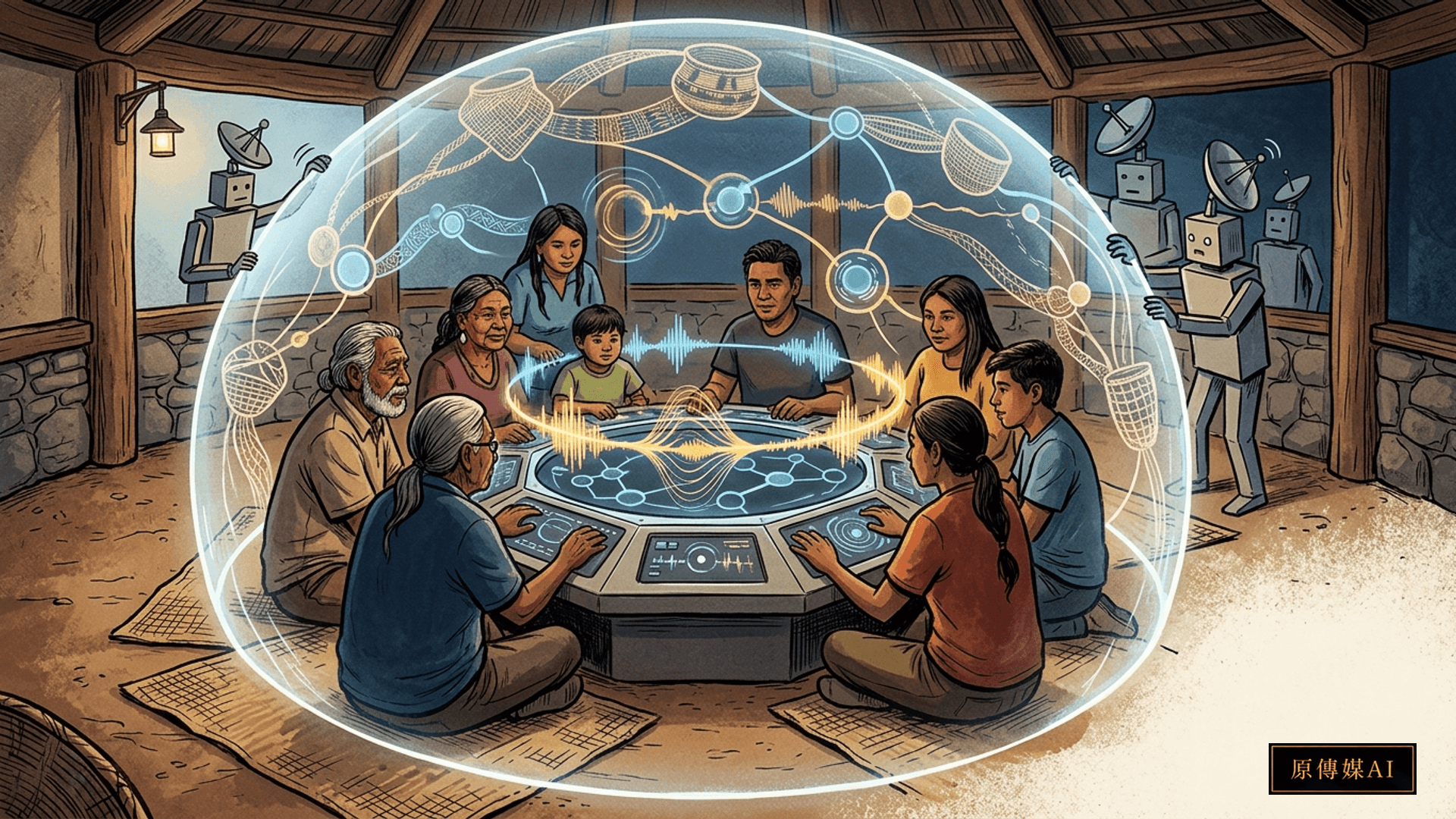
Beyond Operational Tools: Fundamental Reconstruction of AI Literacy
As generative artificial intelligence rapidly permeates basic education, public administration, multimedia production, and institutional policymaking, mainstream digital literacy initiatives remain overwhelmingly focused on mechanical skills: drafting prompts, generating slide decks, or calling API endpoints for automated translation. Yet for Indigenous communities enduring generations of cultural appropriation and uncompensated knowledge extraction, technological literacy begins with entirely different questions: whose data trained these algorithms, whose worldviews do they reflect, and who granted machines the right to memorize ancestral knowledge?
On September 17, 2026, the First Nations Technology Council (FNTC) in British Columbia released a comprehensive suite of AI learning resources, advancing its dialogue on First Nations Approaches to AI. This curriculum unhesitatingly places privacy, data governance, cultural safety, algorithmic bias, historical accuracy, and community control at the core of technological literacy. The initiative represents a decisive paradigm shift: Indigenous peoples refuse to remain passive consumers of commercial proprietary models, claiming their rightful authority as governing decision-makers who define ethical technological boundaries.
The urgency of this mobilization stems from the unchecked scraping practices of multinational tech conglomerates. Commercial foundation models synthesize statistical word associations across billions of web parameters, systematically stripping away the ethical obligations and relational contexts in which Indigenous knowledge was born. Under the shield of Western intellectual property regimes and broad interpretations of the public domain, recorded elder oral testimonies, transcribed sacred cosmologies, and ceremonial protocols are treated as free training fuel. Once ingested into multi-billion-parameter neural networks, proprietary platforms repackage ancestral wisdom into cheap automated queries, divorcing cultural protocols from hereditary community obligations.
Relationality and Context: Visibility Is Not Free Licensing
The fundamental divide between Indigenous knowledge systems and Western information science lies in the inescapable relationality and situated nature of traditional knowledge. Within Indigenous ontologies, knowledge is not disembodied data floating in an abstract ether; it is an active life relationship bound to specific territories, ancestors, kinship clans, and sacred seasons. An ancestral origin account may be spoken only during winter gatherings around hearth fires by designated clan orators; a ceremonial chant may be sung only by initiated individuals fulfilling lifelong communal duties; and pharmacopeial preparations remain bound by strict clan covenants.
When these living traditions are digitized as plain-text corpora and ingested into indiscriminately trained large language models, sacred protocols dissolve. Mathematical algorithms cannot experience spiritual reverence, recognize social kinship status, or respect seasonal taboos. A remote web user querying a commercial chatbot with a casual prompt can effortlessly compel an algorithm to assemble fragmented cultural teachings into fluent mimicry.
Equally alarming is the structural inadequacy of individualist copyright law. Conventional data privacy and terms of service frameworks rely exclusively on individual consent checkboxes. Yet in Indigenous governance, no individual storyteller or research participant possesses the authority to unilaterally alienate collective knowledge belonging to entire clans or Nations. The CARE Principles (Collective Benefit, Authority to Control, Responsibility, Ethics) formulated by the Global Indigenous Data Alliance and the OCAP® principles (Ownership, Control, Access, Possession) championed by the First Nations Information Governance Centre serve as essential defenses: data governance cannot be reduced to a one-time transactional click, but must operate as an enforceable, collective oversight mechanism.
Four-Tier Permission Architecture in Retrieval-Augmented Generation
Rather than retreating into defensive isolation, Indigenous technologists and governance leaders actively build concrete engineering architectures that enforce data sovereignty. Compared to permanently embedding community data into unalterable foundation model weights via fine-tuning, Retrieval-Augmented Generation (RAG) offers a viable governance framework because it decouples external vector databases from generative engines, enabling real-time access controls and data revocation.
Standard commercial RAG configurations, however, offer only coarse administrative user roles incapable of reflecting nuanced cultural governance. In response, advanced digital governance architects developed a four-tier semantic retrieval infrastructure:
Tier 1: Public Domain Layer, containing fully vetted public language primers, published historical studies, and statutory government notices, accessible to all users;
Tier 2: Educational Outreach Layer, featuring cultural histories, approved pedagogical curricula, and everyday conversational lexicons accessible to registered educational institutions and community educators;
Tier 3: Community Governance Layer, encompassing tribal council proceedings, customary territory boundary surveys, clan genealogies, and specialized artisanal practices, restricted strictly to verified community members and authorized research partners;
Tier 4: Sacred and Sensitive Layer, preserving ceremonial details, sacred origin geographies, and confidential elder accounts. Raw text and media in this layer are strictly prohibited from indexing into external vector spaces; only administrative provenance metadata is retained on secure local air-gapped servers. When users query sensitive topics, the system explicitly responds: "This knowledge belongs to designated sacred clan domains; automated generative responses are restricted. Please consult the community cultural council or designated elders directly."
The profound virtue of this engineering model is that it teaches computational systems to maintain honorable silence. In Indigenous knowledge ecosystems, an articulate hallucination is vastly more hazardous than an honest void. Only when algorithmic systems are bound by humility and clear operational limits can they serve as trustworthy digital guardians rather than vectors of cultural erasure.
Edge Computing and Biometric Protection of Audio Datasets
Beyond textual retrieval, the surge of automated speech recognition (ASR) and voice synthesis tools pushes data sovereignty into the sensitive arena of human biometric identity. Audio recordings are never mere acoustic frequencies or phonetic tokens; they capture an elder's unique vocal timbre, cadence, breath control, clan dialect, and generational emotional memory. In many Indigenous cultures, the voice itself embodies ancestral presence and authority.
Uploading raw audio files of tribal elders to hyperscale commercial cloud platforms surrenders vocal biometrics and cultural frequencies to corporate brokers. Malicious actors can utilize voice cloning tools to replicate an elder's voice, fabricating unauthorized commercial promotions or counterfeit pronouncements. The First Nations Technology Council emphasizes that Indigenous language computing must prioritize local edge architectures and sovereign cloud instances.
By deploying compact, high-efficiency servers in local community centers, training lightweight open-source ASR models entirely within local networks, and keeping raw audio files encrypted on tribal territory, communities prevent telemetry extraction and corporate capture. This decentralized infrastructure is not a technological compromise, but an indispensable safeguard for cultural survival.
Taiwan Indigenous Language Archives and the Imperative of Digital Sovereignty
Viewed from Taiwan, the global mobilization for Indigenous digital sovereignty carries vital lessons. Following the enactment of the Indigenous Languages Development Act, the Council of Indigenous Peoples, Taiwan, the Indigenous Languages Research and Development Foundation, and national universities invested extensive resources in constructing digital language corpora, oral history archives, and cultural GIS databases. However, amid widespread enthusiasm for sovereign artificial intelligence, structural reflection on Indigenous data sovereignty remains embryonic.
Many archival initiatives still rely on outdated copyright assignment forms, requiring elders to surrender intellectual property rights to state agencies or academic contractors. Furthermore, some commercial developers harvest publicly accessible language corpora without community consultation to train proprietary models. Prioritizing digitizing speed while ignoring community ownership risks transforming language preservation into another extractive cycle.
Taiwan must integrate the core principles of the First Nations Technology Council into its digital policies: first, mandating CARE and OCAP® ethical compliance for all state-funded indigenous language models and educational applications; second, supporting tribal communities in establishing sovereign digital governance boards equipped with veto power, access licensing authority, and data revocation mechanisms; third, promoting indigenous-centered technology ethics across academic and secondary education, cultivating a rising generation of digital leaders grounded in community responsibility.
Building Sovereign Bridges: Technology in Service of Human Dignity
Technology is never neutral; it magnifies the power dynamics of the institutional frameworks in which it is built. Whether artificial intelligence operates as a digital steamroller accelerating cultural assimilation or as a defensive shield strengthening linguistic vitality and tribal autonomy depends entirely on who holds the power to define its architecture.
Authentic digital empowerment does not consist of distributing tablets to classrooms or adding tribal language interfaces to foreign platforms. It consists of the sovereign right of Indigenous communities to determine what machines may learn and what must remain protected in living oral transmission. When communities exercise definitive control over their digital futures, technology can finally transcend its colonial past and support a flourishing, multi-voiced world.
Sources and Further Reading
Role-Driven Inquiry
Yuan Media AI | Guided Questions by Role
Select a role first, then review the complete questions from that perspective; clicking a question will display Yuan Media AI’s response in real time.
Select a role
人工智慧系統架構與工程研究員
Examine the article's evidence, governance boundaries, data rights, and actionable steps from the perspective of a 人工智慧系統架構與工程研究員.
Choose a question
AI use and content-safety disclosure
AI assisted writing and translation. Source-supported facts, editorial interpretation, and implications for Taiwan are distinguished.