Fish Are More Than Numbers: How 24 First Nations and UBC Restore Territory Knowledge to Fraser River Fisheries Governance
Original Chinese title: 魚不是只有數量:24個 First Nations 與大學如何把傳統領域知識帶回 Fraser River 漁業治理
UBC and the Lower Fraser Fisheries Alliance deepen their partnership. Moving from Two-Eyed Seeing and fisheries data sovereignty to Taiwan customary stream governance, this feature explores how First Nations transition from research subjects to substantive river governors.
雙向知識實驗室
Two-Eyed Seeing Laboratory focuses on complementary governance between Indigenous traditional knowledge and contemporary sciences, exploring Two-Eyed Seeing in conservation, resource management, and data sovereignty.
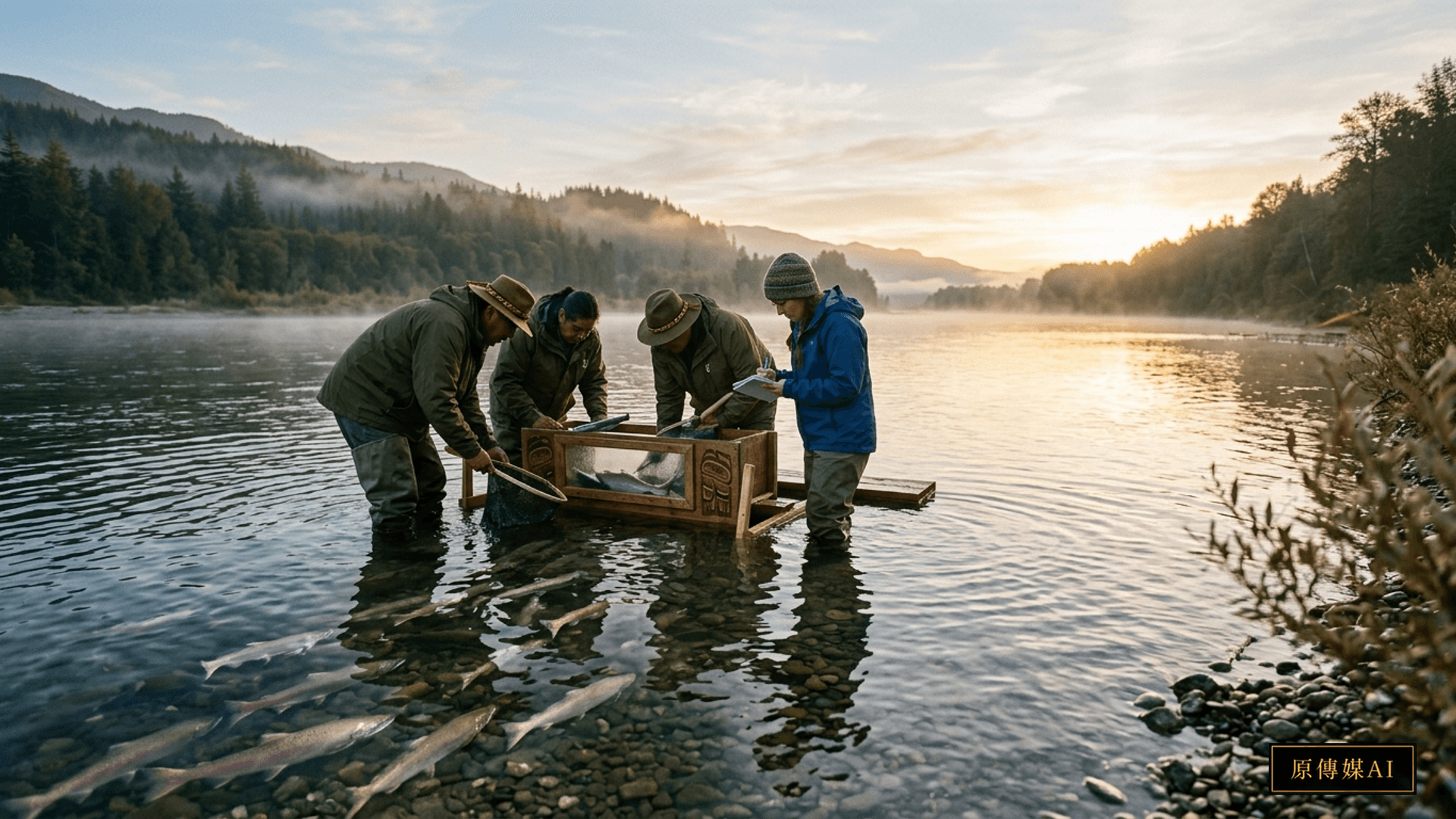
Redefining the River: From Consulted Stakeholders to Governing Authorities
In conventional fisheries resource management, Indigenous peoples are frequently relegated to the passive role of stakeholders or consulted parties. Government agencies or academic teams formulate research questions, calibrate monitoring metrics, conduct fieldwork, and only then host public consultations to present catch quotas and population estimates to communities. However, on September 22, 2026, the University of British Columbia (UBC) and the First Nations-led Lower Fraser Fisheries Alliance (LFFA) announced a deepened collaboration, signaling a fundamental paradigm shift. Representing the collective fisheries interests of 24 First Nations along the lower Fraser River corridor, the alliance spans fisheries conservation, habitat restoration, collaborative scientific research, and environmental stewardship.
The defining breakthrough of this partnership is that research priorities are no longer dictated unilaterally by academic institutions. Instead, urgent ecological vulnerabilities and management gaps are identified collaboratively with watershed Nations. Sockeye, coho, chinook salmon, and white sturgeon in the Fraser River have long faced cumulative pressures from warming waters, sediment accumulation, severe droughts, and overharvesting. Conventional management models reliant solely on statistical maximum sustainable yield often miss microclimate spawning requirements in tributary streams and multi-generational population dynamics. When 24 First Nations participate as co-governors, the analytical focus expands from merely calculating harvest quotas to sustaining overall watershed health and cultural continuity.
This approach directly challenges the historical academic practice of treating Indigenous lands and waters as unencumbered extractive data basins. The agreement explicitly mandates that scientific findings must be returned to tribal governance councils and river guardian programs. Research findings serve as empirical foundations for community harvest bylaws, environmental litigation, and policy negotiations with federal authorities. It replaces one-off project grants with institutionalized accountability founded on mutual respect and shared sovereignty.
The Science of Two-Eyed Seeing: Parallel Knowledge Systems
Operationally, the collaboration operationalizes Two-Eyed Seeing (Etuaptmumk in Mi'kmaw), a concept championed by Elder Albert Marshall. Two-Eyed Seeing does not subordinate Indigenous ecological knowledge as an anecdotal footnote to Western empirical science, nor does it attempt to blend distinct knowledge systems into a homogenized standard. Rather, it encourages looking with one eye through the strengths of Indigenous knowledge and ways of knowing, with the other eye through the strengths of Western sciences, and using both eyes together for holistic ecological stewardship.
Western fisheries science excels at generating standardized, quantitative temporal and spatial datasets. Research teams deploy acoustic telemetry to track migration pathways, monitor rotary screw traps, utilize environmental DNA (eDNA) to identify cryptic species distributions, and integrate hydrological and thermal modeling to project stream discharge and warming trends. These tools provide broad regional comparability to understand macro-level climate impacts across the watershed.
In contrast, ecological knowledge held by hereditary leaders and seasoned fishers reflects continuous, multi-generational interaction with specific river reaches. Elders monitor ecological timing through willow budding, snowpack melting rates, water turbidity, foam patterns, fish-eating bird behavior, and the physical texture and fat content of salmon muscle tissue. These nuanced indicators identify unmonitored tributary micro-refugia and illuminate multi-decadal cycles that automated algorithms often misclassify as statistical anomalies. Two-Eyed Seeing allows each system to maintain its evidentiary standards while jointly confronting urgent watershed challenges.
Data Sovereignty and Cultural Boundaries: Resisting Digital Extraction
As traditional ecological knowledge is increasingly transcribed into digital repositories, Indigenous Data Sovereignty emerges as a critical governance imperative. Field recordings of oral history, family fishing rocks, and ancestral harvesting locations risk severe misuse if deposited into open academic repositories without rigorous governance protocols. Exact coordinates of sensitive spawning beds can be exploited by poachers, and multi-generational knowledge can be appropriated for commercial ventures without community consent.
To prevent such outcomes, LFFA and UBC established data governance covenants grounded in the OCAP® principles (Ownership, Control, Access, Possession) developed by the First Nations Information Governance Centre and the international CARE Principles (Collective Benefit, Authority to Control, Responsibility, Ethics). The protocols categorize datasets into three distinct tiers: public baseline hydrological and ecological overviews; operational monitoring data shared strictly among project teams and tribal fisheries managers; and sacred cultural knowledge detailing family lineages, ceremonial laws, and sensitive sites.
The third tier remains strictly under local tribal custody and is never released into public domains. External researchers seeking access must apply directly to tribal councils, detailing explicit use cases, non-commercial restrictions, and retention limits. Critically, Nations retain unilateral authority to withdraw data or correct erroneous characterizations. This operational structure dismantles the extractive assumption that anything shared in research belongs to the public domain.
Retrieval Architectures and Ethical Guardrails in AI Systems
The integration of retrieval-augmented generation (RAG) and language models into ecological research presents both unprecedented efficiency and profound ethical hazards. In fisheries governance, AI can parse half a century of temperature logs in seconds, synthesize sonar monitoring entries, compare habitat aerial footage before and after engineering works, and index interview transcripts for authorized researchers.
Yet computational speed cannot substitute for contextual legitimacy. Statistical language models operate on probabilistic pattern matching and lack moral comprehension of cultural responsibilities. A hereditary fishing regulation derives its authority from the orator's lineage, spiritual office, and territorial stewardship, not from its keyword frequency across the web. Unrestricted models scraping cultural transcripts risk generating fluent, decontextualized fabrications that misrepresent ancestral customary law.
Responsible ecological AI architectures must therefore enforce multi-tiered retrieval boundaries. Systems must verify access clearance against contextual metadata, including source lineage, permissible scope, and geographic restrictions. When queried about sacred ceremonies or sensitive sites, the system must gracefully acknowledge knowledge limits and halt generation, directing inquiries to designated tribal cultural authorities. AI must serve as an accountable indexer rather than an unauthorized arbiter of Indigenous truth.
Reflections for Taiwan Stream and Watershed Governance
The Lower Fraser partnership provides compelling insights for Taiwan's river basin and inshore fisheries governance. In Taiwan, indigenous traditional territories frequently intersect overlapping bureaucratic mandates: the Forestry and Nature Conservation Agency manages national forest reserves, the Water Resources Agency oversees flood control channels, the Ministry of Agriculture directs agricultural fisheries production, and the Council of Indigenous Peoples, Taiwan oversees reserved lands. This fragmented administrative architecture historically marginalized tribal customary river management into folkloric cultural expressions rather than formal hydrological governance.
Taiwan's indigenous peoples—including Atayal, Bunun, Tsou, Paiwan, Rukai, and Amis—maintain sophisticated watershed practices. The Atayal customary law of Gaga establishes clan-based stream stewardship, strictly prohibiting destructive practices like chemical or electrofishing while mandating seasonal stream fallowing to protect spawning endemic fish. The Amis maritime and river harvesting tradition (Mifoting) incorporates age-grade labor divisions and regenerative harvesting cycles.
Rather than implementing top-down unilateral sensor deployments, Taiwanese environmental agencies can support tribally managed watershed monitoring units modeled on LFFA's experience. Combining traditional indicators of moss succession, insect emergence, and landslide precursors with continuous water quality sensors and thermal drone surveys creates an adaptive co-management infrastructure. When sensor data and elder observations diverge, governance systems should treat discrepancies as valuable opportunities to investigate unmapped ecological variables rather than dismissing local expertise.
Intergenerational Stewardship: Responsibility Above Yield
Global environmental crises increasingly demonstrate that treating rivers purely as industrial extraction zones drives freshwater ecosystems toward systemic collapse. The UBC-LFFA collaboration demonstrates that sustainable fisheries cannot be separated from thriving Indigenous cultures and intact community governance. River stewardship requires honoring the language, kinship obligations, and intergenerational duties inextricably linked to waterways.
Meaningful Two-Eyed Seeing requires academic and state institutions to move beyond scientific paternalism and recognize Indigenous peoples as inherent rights-holders and governing authorities. Recognizing Indigenous title, rights, and data sovereignty is an ecological necessity for planetary survival. When fish are recognized as vital kin connecting land, water, ancestors, and future generations, river management moves beyond mere harvest quotas into an enduring promise of collective flourishing.
Sources and Further Reading
Role-Driven Inquiry
Yuan Media AI | Guided Questions by Role
Select a role first, then review the complete questions from that perspective; clicking a question will display Yuan Media AI’s response in real time.
Select a role
漁業生物與水文科學研究者
Examine the article's evidence, governance boundaries, data rights, and actionable steps from the perspective of a 漁業生物與水文科學研究者.
Choose a question
AI use and content-safety disclosure
AI assisted writing and translation. Source-supported facts, editorial interpretation, and implications for Taiwan are distinguished.